




hard water solutions
How to Soften Hard Water Without Salt: A Homeowner's Guide

Most people who look up "salt-free water softener" are tired of two things: scale on their fixtures and the recurring chore of hauling 40-pound salt bags into a basement utility room. The good news is that there's a real alternative. The complicated news is that salt-free systems don't work the way most homeowners assume — and choosing the wrong one for your situation wastes money.
According to a 2024 U.S. Geological Survey survey of public water systems, roughly 85% of American households deal with hard water at some level, with mineral content above 60 mg/L of dissolved calcium and magnesium. Of those, an estimated 40 million homes have water hard enough — over 180 mg/L — to cause visible scale on fixtures and appliances within months.
Here's what salt-free conditioning actually does, where it shines, and where it doesn't.
What "Hard Water" Means and Why It's a Problem
Hardness is just dissolved calcium and magnesium. By itself, neither mineral is harmful — the World Health Organization considers calcium and magnesium in drinking water beneficial. The problem is what happens when hard water heats up or evaporates: those minerals fall out of solution and form solid scale.
That scale is the white crust on your kettle, the flaky buildup around your faucet aerators, the spots on your dishes, and — most expensively — the layer slowly building up inside your water heater, dishwasher, washing machine, and any plumbing that carries hot water.
The American Water Works Association estimates that hard water shortens the average water heater lifespan by 30–50% and reduces its efficiency by up to 25%. A 2009 Battelle Memorial Institute study (still widely cited) found that scale buildup costs the average hard-water home $325–$650 per year in extra energy, soap, and appliance wear.
The Two Approaches: Softening vs. Conditioning
This is where the terminology trips most homeowners up. "Softener" and "conditioner" are not interchangeable, even though many products use them that way.
Traditional Softening (Salt-Based, Ion Exchange)
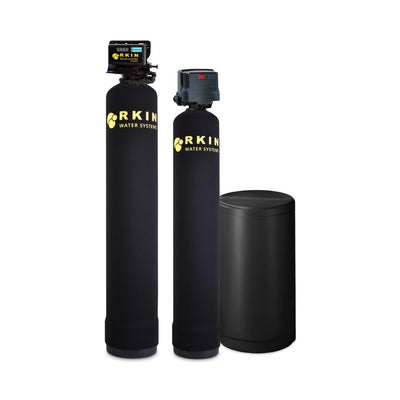
A salt-based softener uses a resin tank loaded with sodium ions. As hard water passes through, calcium and magnesium swap places with the sodium. The minerals stay behind on the resin; the water that comes out is genuinely soft — no calcium, no magnesium, slightly higher in sodium.
The system has to periodically regenerate by flushing brine through the resin, which is why it needs a brine tank and a steady supply of salt. It also discharges salty wastewater, which is why some western states and municipalities have restricted or banned salt-based softeners.
Salt-Free Conditioning (Template Assisted Crystallization)
A salt-free conditioner doesn't remove anything. The calcium and magnesium stay in your water. What it does is convert those dissolved minerals into a microscopic crystalline form (calcium carbonate crystals) that can no longer bond to surfaces. They flow through your pipes and out the drain instead of sticking to your water heater element.
The technology that does this work is called Template Assisted Crystallization (TAC). The conditioner uses a media bed loaded with TAC beads that act as nucleation sites — the minerals form crystals on the beads, then break off and travel through the plumbing as suspended particles instead of dissolved ions.
Independent testing from Arizona State University in a 2011 study found TAC conditioners reduced scale formation by 88–99% in residential applications.
What Salt-Free Conditioning Does — and Doesn't Do
What It Does
- Prevents new scale formation in pipes, water heaters, dishwashers, and washing machines
- Slowly removes existing scale over weeks and months — conditioned water dissolves old deposits
- Keeps minerals in your water, so the taste and the mineral content remain unchanged
- Requires zero salt, zero electricity, and no regeneration cycle
- Doesn't dump brine into the wastewater stream — fully compliant in salt-restricted regions
What It Doesn't Do
- Doesn't give you "soft" water in the laundry-room sense. You won't get the slippery, foamy feel of softened water. Your soap won't lather more. Your skin won't feel different in the shower.
- Doesn't remove minerals. A hardness test will still show your water as hard — the minerals are just in a different form.
- Doesn't filter contaminants. A standalone conditioner won't remove chlorine, sediment, PFAS, lead, or anything else. If you want filtration plus scale prevention, you need a combination system.
- Doesn't reverse heavy existing scale on visible fixtures overnight — the dissolution is gradual.
Which One Is Right for Your House?
The honest answer depends on what's bothering you. Here's the practical decision tree:
Pick a salt-based softener if:
- Your water is extremely hard (above 25 grains per gallon / 425 mg/L)
- You hate spotty dishes and want laundry-soft feel
- You're not in a salt-restricted area
- You don't mind handling salt and maintaining a brine tank
Pick a salt-free conditioner if:
- Your main concern is scale on appliances and plumbing
- You want a low-maintenance system with no ongoing salt purchases
- You live somewhere with salt discharge restrictions (parts of CA, AZ, TX, MI)
- You want to keep the calcium and magnesium in your drinking water
- You're on a septic system and want to avoid sodium loading
What to Look For in a Salt-Free System
Most salt-free systems on the market use one of three technologies: TAC, electromagnetic, or template-induced crystallization. The differences matter.
- TAC media — the proven, lab-tested approach. Look for systems with certified TAC media from a known supplier (NextSand or OneFlow are common).
- Electromagnetic descalers — clip-on devices that claim to alter water with magnetic fields. Independent testing has been mixed at best. Skip these.
- Polyphosphate dosing — adds a coating to plumbing that prevents scale adhesion. Works but requires consumable refills and isn't ideal for drinking water.
Three things to verify before buying:
- Flow rate match — the system needs to handle your home's peak flow. A 2-bath house typically needs 8–10 GPM; a 4-bath house needs 12–15 GPM.
- Media life — quality TAC media should last several years before performance drops.
- Tank size — undersized tanks reduce contact time and conditioning effectiveness.
The RKIN Salt-Free Option
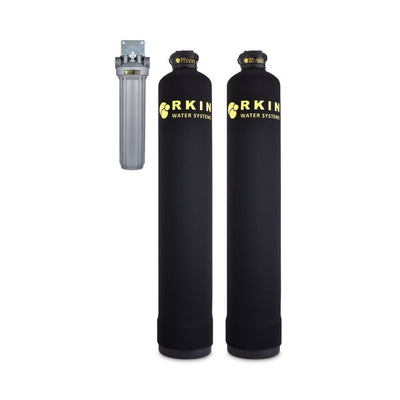
The RKIN OnliSoft Salt-Free Water Conditioner uses TAC media in a whole-house configuration. It installs on your main water line and conditions every drop entering your home — kitchen, showers, laundry, water heater, the entire system. No salt, no electricity, no regeneration wastewater.
The OnliSoft TAC media is rated for the lifetime of the system, which removes the recurring media replacement cost most salt-based systems carry. The ZEE Pro sediment prefilter is the one consumable, and it gets swapped every 6–12 months depending on your sediment load.
If you also want chlorine and contaminant filtration alongside scale prevention, the RKIN OnliSoft Pro Salt-Free + Carbon Combo pairs the TAC conditioning with a dual-carbon filtration bed in one system. You get scale prevention plus chlorine, taste, and odor removal in a single installation.
Installation Realities
A whole-house salt-free conditioner installs on your main water line, typically near where the line enters the house and before the water heater. The unit itself is a single tank, no brine tank, no drain line. Most homeowners with basic plumbing experience can install one in a few hours. If you're not comfortable cutting and soldering copper or working with PEX, a plumber's quote usually runs $400–$800 for the install depending on your region and how accessible the main line is.
One thing worth checking before you order: where the main line enters your home and whether there's enough clearance for a tank. The OnliSoft and OnliSoft Pro tanks are slim profile, but you still need vertical clearance to swap the prefilter cartridge.
Frequently Asked Questions
Does salt-free water "soften" water the same way salt-based does?
No. Salt-free conditioning doesn't remove the calcium and magnesium — it converts them so they can't form scale. A hardness test will still show your water as hard. What changes is that scale stops building up on your fixtures, plumbing, and appliances.
Will I still see white spots on my dishes?
Possibly. Conditioned water can still leave evaporation spots because the minerals are present. The scale on the spots is non-adhesive and wipes off easily, whereas hard water spots are bonded scale. If spotless dishes are your priority, a rinse aid plus the conditioner usually solves it.
How long does it take to see results?
New scale stops forming immediately after installation. Existing scale takes weeks to months to dissolve, depending on how heavy the buildup is. Most homeowners notice changes in shower head spray and faucet flow within 30–60 days.
Can salt-free conditioners be used with well water?
Yes, but the well needs to be free of iron and manganese above certain thresholds (typically below 0.3 ppm iron, below 0.05 ppm manganese). Iron will coat the TAC media and reduce its effectiveness. A well water pretreatment system upstream solves this.
Does the conditioner remove chlorine or other contaminants?
A standalone conditioner only handles scale. For chlorine, taste, odor, or contaminant removal, you need a carbon filtration stage. A combination system like the RKIN OnliSoft Pro Salt-Free + Carbon Combo handles both in one unit.
Is salt-free conditioning legal everywhere?
Yes — and it's specifically designed for jurisdictions that have banned or restricted salt-based softeners. Parts of California, Arizona, Texas, and Michigan limit brine discharge. Salt-free conditioners produce no brine and are unaffected by those rules.
How much maintenance does a salt-free system need?
The TAC media lasts the lifetime of the system in most cases. The only routine maintenance is replacing the sediment prefilter every 6–12 months, which takes about 10 minutes and requires no tools beyond a wrench.
Ready to Stop Buying Salt?
If scale is your problem and you'd rather not haul salt bags or run a regenerating system, salt-free conditioning is the practical answer. The RKIN OnliSoft Salt-Free Water Conditioner conditions your entire home's water with no salt, no electricity, and no wastewater. See current pricing and full specs at rkin.com.






0 comments