


hard water kettle
Why Does My Kettle Have White Buildup? Hard Water Explained

That chalky white crust coating the bottom of your kettle isn't dirt, and it isn't a sign your kettle is wearing out. It's limescale — a mineral deposit left behind every time hard water heats up and evaporates. If you can see it in the kettle, the same deposit is already building inside your water heater, your faucets, and the pipes running through your walls.
Roughly 85% of U.S. homes have hard water, according to data cited by the U.S. Geological Survey. Most homeowners scrub the kettle, soak it in vinegar, watch the crust come back in a few weeks, and never connect it to anything bigger. The kettle is actually doing you a favor: it's a free, visible water test sitting on your counter.
What the White Buildup Actually Is
Hard water carries dissolved calcium and magnesium. These minerals are harmless to look at while they're dissolved — your water still runs clear. But when water is heated or left to evaporate, the minerals can no longer stay dissolved. They drop out of the water and bond to the nearest surface as a hard, crystalline scale.
A kettle is the perfect storm for this. It heats water to boiling, then sits while the leftover water evaporates. Every cycle deposits another microscopic layer. Over months, those layers stack into the white or off-white crust you see on the heating element and along the waterline.
The technical name is calcium carbonate scale, but most people call it limescale. The harder your water — measured in grains per gallon (GPG) — the faster it forms. Water above 7 GPG is considered hard; above 10 GPG is very hard. In very hard water areas, a kettle can develop visible buildup in a matter of weeks.
Why It Matters Beyond the Kettle
The kettle is just the part you can see. The same scaling happens everywhere hot water touches metal:
- Water heater: Scale settles on the tank bottom and heating elements, forcing the unit to work harder to heat the same water. The U.S. Department of Energy notes that scale buildup reduces water heater efficiency over time.
- Faucets and showerheads: Mineral crust narrows the openings, weakening flow and leaving white spots on fixtures.
- Pipes: Scale slowly reduces the internal diameter of hot-water lines, lowering pressure.
- Appliances: Dishwashers, washing machines, and coffee makers all run hot water and all collect scale on internal parts.
None of this happens overnight, which is exactly why it goes unnoticed. The kettle just happens to show its scale faster than a sealed water heater does — so treat the kettle as an early-warning signal for the rest of the house.
Why Vinegar Only Buys You a Few Weeks
Descaling a kettle with vinegar or a citric acid solution works. The acid dissolves the calcium carbonate and the crust rinses away. But descaling treats the symptom, not the source.
As long as hard water keeps coming out of the tap, the scale keeps coming back. You're stuck on a permanent cleaning cycle: descale, wait a few weeks, descale again. And while you can reach inside a kettle with a brush, you can't reach inside your water heater tank or your pipes. The scale you can't see keeps accumulating no matter how often you clean the kettle.
Bottled water doesn't solve it either. People sometimes switch to bottled water for drinking to avoid the taste of hard water, but the kettle, the shower, and every appliance still run on tap water. Bottled water is an expensive patch that ignores 99% of the problem.
How to Stop Limescale at the Source
To actually stop the buildup, you have to change the water before it reaches the kettle — and that means treating it where it enters the home. There are two proven approaches, and the right one depends on your water and your goals.
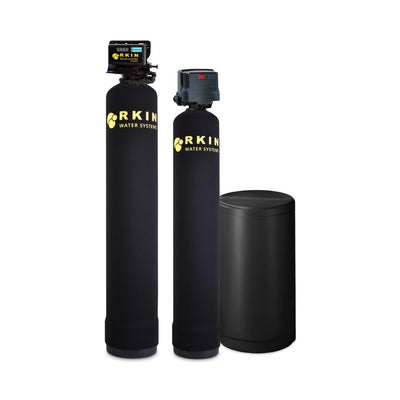
Salt-based water softeners remove calcium and magnesium entirely through ion exchange, swapping them for sodium. Softened water leaves no scale at all. The trade-off is ongoing salt purchases and a brine discharge.
Salt-free water conditioners use a process called template-assisted crystallization (TAC). Instead of removing the minerals, TAC transforms them into stable microscopic crystals that stay suspended in the water and can't bond to surfaces. The minerals are still present, but they no longer form hard scale. No salt, no electricity, and no wastewater discharge.
If your goal is specifically to stop scale buildup — kettle, water heater, fixtures — a salt-free conditioner addresses it without the maintenance of a salt system. When choosing any whole-house system, look for clear performance documentation and third-party testing so you know the technology does what it claims.
The RKIN Approach
This is exactly the problem the RKIN OnliSoft Salt-Free Water Conditioner is built to solve. It installs on your main water line and treats every drop entering the home, so the kettle, the water heater, and the fixtures all get conditioned water.
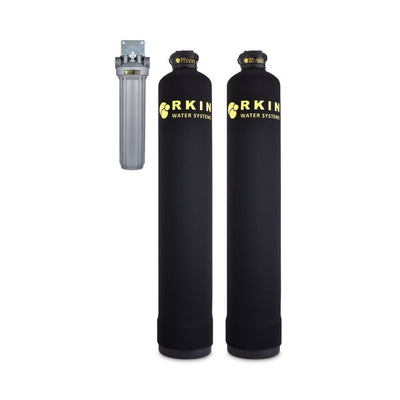
Because OnliSoft uses TAC media rather than salt, there's no salt to haul, no brine tank to refill, and no wastewater. The conditioning media is designed to last for years without replacement — only a sediment prefilter needs periodic changing. For homes that also want chlorine and sediment filtration in one unit, the RKIN OnliSoft Pro Salt-Free + Carbon Combo pairs the conditioner with a carbon stage. Both are designed for hard-water homes that want to stop scale without the upkeep of a traditional softener.
Frequently Asked Questions
Is the white buildup in my kettle dangerous to drink?
Calcium and magnesium are minerals the body uses, and limescale itself is not considered a health hazard by the EPA, which classifies water hardness as an aesthetic issue rather than a safety one. The bigger concerns are appliance damage, reduced efficiency, and the constant cleaning. If you don't like loose mineral flakes ending up in your cup, that's a taste and quality preference worth addressing.
How do I remove limescale from a kettle right now?
Fill the kettle with equal parts water and white vinegar, bring it to a boil, then let it sit for 20 to 30 minutes. Pour it out, scrub any remaining crust with a soft brush, and rinse thoroughly. Citric acid powder works the same way. This removes existing scale but won't stop it from returning if your water is hard.
Does a water filter pitcher stop limescale?
Most standard pitcher filters reduce taste and odor but do not remove the calcium and magnesium that cause scale. To stop scale buildup throughout the house, you need to treat the water at the point it enters the home with a softener or a salt-free conditioner.
What's the difference between a water softener and a water conditioner?
A salt-based softener removes hardness minerals through ion exchange and requires ongoing salt. A salt-free conditioner transforms the minerals so they can't form scale, without removing them and without salt. Both stop scale buildup; the conditioner has lower maintenance, while a softener also gives water that classic "slippery" softened feel.
How fast does limescale come back after I clean the kettle?
It depends on how hard your water is and how often you use the kettle. In very hard water areas — above 10 grains per gallon — visible buildup can return within two to four weeks. The harder the water and the more you boil, the faster it reappears.
Will treating my water help my water heater too?
Yes. A whole-house softener or conditioner treats all the water entering your home, so the water heater, faucets, dishwasher, and washing machine all receive treated water. Reducing scale helps these appliances run more efficiently and last longer.
Ready to Stop the Buildup for Good?
The crust in your kettle is the easiest hard-water problem to see — and a clear signal of what's building up where you can't see it. Descaling cleans the symptom; treating your water at the source removes the cause.
The RKIN OnliSoft Salt-Free Water Conditioner stops scale across your whole home with no salt, no electricity, and no wastewater. See current pricing and specs at rkin.com.




0 comments