







city-water
Hard Water and Sensitive Skin: What City Families Actually Need

If your family's skin has been dry and irritated since you moved in — and the scale buildup on your faucets and shower glass keeps coming back no matter how often you clean — your city water is almost certainly the reason. Hard water loaded with calcium and magnesium plus chlorine used for municipal disinfection is a combination that hits sensitive skin harder than most people realize. The good news: it is a solvable problem. The part most people get wrong is how they solve it.
This guide is for the family that has done the research, pulled their water report, and is now standing at the decision point: what do you actually buy, and why does a purpose-built whole-home system beat mixing individual components from different brands?
What City Water Is Actually Doing to Your Skin
Municipal water is treated to be safe to drink under EPA standards — but "safe to drink" and "good for sensitive skin in the shower" are two completely different bars. City water suppliers use chlorine and chloramines to kill bacteria and pathogens during distribution. By the time water reaches your home, those disinfectants are still present at levels that can disrupt the skin's natural moisture barrier.
According to a study published in the Journal of Investigative Dermatology, hard water significantly increases skin surface pH, which disrupts the protective acid mantle and reduces the skin's ability to retain moisture. Researchers found this effect was measurably worse in people with a genetic predisposition to eczema — meaning families where one or more members already has sensitive skin are particularly vulnerable.
What is happening chemically in your home:
- Hard water minerals (calcium and magnesium) bond with soap to form soap scum instead of lathering — leaving residue on skin rather than rinsing clean
- Chlorine strips the skin's natural oils, reducing moisture retention after every shower or bath
- Combined effect: dry, itchy, reactive skin — especially noticeable in children whose skin barrier is thinner than adults
The scale buildup you see on your faucets and shower glass is the same mineral load going through your family's skin. If your city water tests at 9 GPG (grains per gallon) — which the EPA classifies as moderately hard to hard — and carries 2–3 ppm of chlorine, both problems need to be addressed at the same time to actually fix sensitive skin complaints.
Why Most Homeowners Get This Wrong
The most common mistake: buying a standalone water softener and a separate carbon filter, often from two different brands, with different flow rates, different maintenance cycles, and no integrated bypass system.
Here is what happens:
- The softener handles hardness but does nothing about chlorine — skin still reacts to shower water
- The carbon filter handles chlorine taste/smell but has no effect on scale or the mineral load irritating skin in the bath
- Two separate systems require two separate maintenance schedules, two sets of replacement components, and two different service contacts if anything goes wrong
- Mismatched flow rates can cause pressure drops — the household gets the worst of both systems
Online communities are full of this pattern. People research the "best water softener" and the "best carbon filter" separately, buy whichever brands rank highest in each category, and then spend the next few months troubleshooting why their water still tastes off or their skin is still reacting. The issue is not the individual products — it is the assumption that mixing components from two separate systems will behave like a purpose-built solution.
Salt-Free vs. Salt-Based: Which Is Right for Your Water?
At 9 GPG city water, both salt-free (template-assisted crystallization, or TAC) and salt-based (ion exchange) systems will work. The right choice depends on your household priorities.
Salt-based softeners (ion exchange):
- Remove calcium and magnesium through ion exchange, replacing them with sodium ions
- Produce true "soft" water — slick feel, better soap lather
- Require periodic salt refilling (typically every 6–8 weeks for a family of four)
- Generate a backwash cycle that uses water to regenerate the resin bed
- Ideal for families with genuinely very hard water (12+ GPG) or where the "silky soft" water feel is a priority
Salt-free conditioners (TAC / template-assisted crystallization):
- Neutralize hardness minerals by transforming them into non-adherent crystals — they pass through pipes and surfaces without bonding
- No salt, no backwash cycle, no electricity required, no ongoing consumables beyond media replacement every several years
- Protect pipes and appliances from scale just as effectively as salt-based systems
- Water does not have the "slick" feel of traditional softened water — feels more like natural spring water
- Ideal for families who want the protection and skin benefits without the ongoing salt cost and maintenance
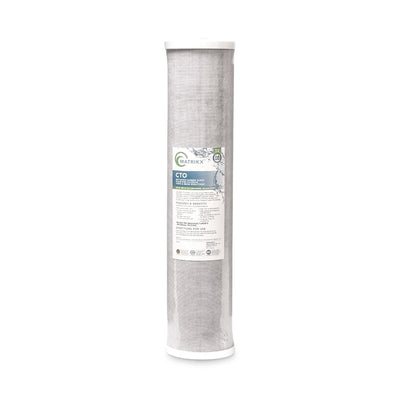
For city water at 9 GPG, both approaches address the hardness problem effectively. The sensitive skin improvement comes primarily from eliminating the chlorine — which is where the carbon filtration stage matters most. A system that combines both stages in one unit ensures they are engineered to work at the same flow rate and pressure.
The Case for an Integrated Whole-Home System
When both the conditioner/softener stage and the carbon filtration stage are built into a single purpose-designed system, several things that are easy to miss with DIY mixing become automatic:
- Matched flow rates — both stages are sized for the same household water demand, so there is no bottleneck causing pressure drops
- Correct sequencing — conditioning happens before carbon filtration in the right order for each technology
- Single maintenance schedule — one service call, one contact, one warranty
- Verified performance — the system is tested as a unit, not two separate units assumed to be compatible
For families with sensitive skin members, this matters because the chlorine removal stage is the one that directly affects shower and bath water quality. If the carbon media is undersized relative to household flow — a common result of mixing a carbon filter spec'd for one flow rate with a softener spec'd for a different one — the chlorine reduction at peak usage hours (morning showers) can be significantly worse than rated.
What to Look for in a Whole-Home System for Sensitive Skin
When evaluating a combined softener-plus-carbon system for a family with sensitive skin and city water, these are the specifications that actually matter:
- Carbon stage rated for chlorine and chloramine removal — chloramines are a more stable disinfectant used by many municipalities and harder to remove than free chlorine. Verify the carbon media handles both.
- Hardness capacity appropriate for your GPG — at 9 GPG with typical city water volume, a properly sized system should handle the load without frequent regeneration cycles that create gaps in soft water delivery
- Lifetime warranty on tanks — whole-home systems involve plumbing connections and should not be a consumable item. A lifetime warranty on the tank is the standard to hold manufacturers to.
- Certified components — third-party certification of key components (valves, media, housing) confirms the system performs to advertised specs
- Assembled in the USA — indicates quality control standards and simplifies warranty service
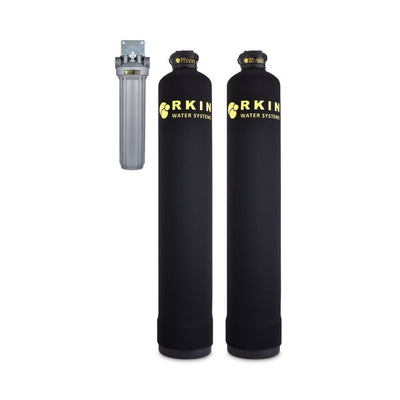
The RKIN OnliSoft Pro Salt-Free + Carbon Combo
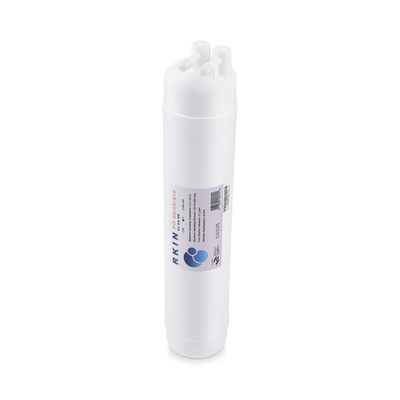
The RKIN OnliSoft Pro Salt-Free + Carbon Combo was designed specifically for households with this combination of problems — hard city water, chlorine, and the skin and appliance consequences that follow. It integrates a salt-free TAC conditioner with a whole-home carbon filter in a single engineered system.
What it delivers:
- Scale protection for pipes, water heaters, dishwashers, and other appliances
- Chlorine and disinfection by-product removal at every tap and shower in the home
- No salt to buy or carry, no electricity, no backwash wastewater
- Lifetime warranty on tanks, certified components, assembled in the USA
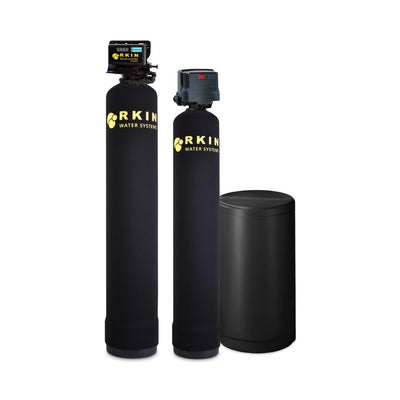
For families where a member prefers traditional salt-based softening — the slicker water feel, or genuinely very hard water (14+ GPG) — the RKIN Water Softener and Whole House Carbon Filter System integrates a salt-based ion-exchange softener with the same carbon filtration stage in a purpose-built combo unit, with the same lifetime warranty and certified components.
Both systems address the two-layer problem — hardness and chlorine — that causes the scale on fixtures and the skin reaction in the shower. Both come from one manufacturer, ship as a tested unit, and carry a single warranty.
You can browse the full whole-home water treatment lineup at rkin.com/collections/whole-house-water-treatment.
Frequently Asked Questions
Can hard water actually cause dry skin, or is that a myth?
It is real and well-documented. Research published in the Journal of Investigative Dermatology found that hard water disrupts the skin's natural moisture barrier by raising surface pH. This effect is more pronounced in people with existing skin sensitivity or eczema. The combination of hard water and chlorine — the standard profile for city water — compounds the irritation: hard water deposits residue and chlorine strips natural skin oils, leaving skin dry and reactive after every shower.
Will a water softener alone fix my family's skin problems?
A softener alone handles the hardness minerals but does nothing about chlorine. In city water, chlorine is typically the bigger driver of skin irritation in the shower — it strips the skin's natural oils on contact. A complete solution for sensitive-skin families needs both: a softening or conditioning stage (for scale and hardness) and a carbon filtration stage (for chlorine and disinfection by-products). That is why an integrated combo system is more effective than a standalone softener.
Is 9 GPG hard enough to need a salt-based softener, or will salt-free work?
At 9 GPG, salt-free conditioning (TAC technology) works well. Salt-free systems are generally recommended up to about 25 GPG. The difference is the feel: salt-based ion exchange produces the classic "silky" soft water feel because it replaces calcium and magnesium ions with sodium ions. Salt-free conditions the minerals so they do not adhere to pipes or skin, but the water does not feel slick. Both protect your plumbing and appliances effectively at 9 GPG — the choice comes down to whether you want the traditional soft water feel and are willing to maintain a salt supply.
Do I need to hire a plumber to install a whole-home water treatment system?
Most homeowners with basic plumbing experience can install a whole-home system themselves — it connects to the main water line at the point of entry. If you are not comfortable cutting into main line pipes, a licensed plumber can complete the installation in a few hours. RKIN provides installation documentation, and the consultation team can walk you through your specific setup before purchase.
Why does mixing a separate softener and carbon filter cause problems?
The main issue is flow rate mismatch. A softener spec'd for 7 GPM and a carbon filter spec'd for 10 GPM will behave differently under real household demand. During peak usage (multiple showers in the morning), the system may not deliver full chlorine reduction because the carbon filter is seeing more flow than it was rated for when paired with that softener. Purpose-built combo systems are engineered and tested at matched flow rates, which is why they perform more consistently.
How long does a whole-home water treatment system last?
The tanks on quality whole-home systems typically carry a lifetime warranty — meaning the tank housing itself is not a consumable. The media inside (resin for salt-based, TAC media for salt-free, carbon media for filtration) has a service life measured in years and requires periodic replacement. Salt-based systems need ongoing salt replenishment. A well-maintained system from a reputable manufacturer is a multi-decade investment in your home's water quality.
How do I know if my city water report shows chloramine vs. free chlorine?
Your local water utility is required to publish an annual Consumer Confidence Report (CCR) — this is the plain-language water quality report required by the EPA. Search for "[your city name] water quality report 2025" or look for a link on your water utility's website. The disinfectant type (chlorine vs. chloramine) should be listed. If your utility uses chloramine, confirm that the carbon filter stage you choose is rated for chloramine removal — not all carbon media handles chloramines as effectively as free chlorine.
Ready to Fix the Root Problem?
Scale on every fixture, dry skin after showers, strong chlorine taste in the water — these are all symptoms of the same underlying water chemistry. A purpose-built whole-home system that addresses hardness and chlorine together is the most reliable way to fix all of them at once, without the guesswork of matching components from separate manufacturers.
The RKIN OnliSoft Pro Salt-Free + Carbon Combo and the RKIN Water Softener and Whole House Carbon Filter System are both built for exactly this situation. Lifetime warranty on tanks, certified components, assembled in the USA — and one manufacturer to call if anything ever needs attention.
Browse the full lineup and find the right fit for your home at rkin.com/collections/whole-house-water-treatment.






0 comments