


Is a Salt-Free Water Conditioner Better for the Environment?

If you're researching water softeners, you'll quickly run into a divide: traditional salt-based ion exchange systems on one side, and salt-free water conditioners on the other. The technology works differently. The environmental footprint is different. And for homeowners who care about what their household systems discharge into the water supply, that difference matters.
This article examines the environmental case for and against each approach — and explains why salt-free water conditioners like the RKIN OnliSoft have become the preferred option for eco-conscious homeowners.
How Traditional Salt-Based Water Softeners Work
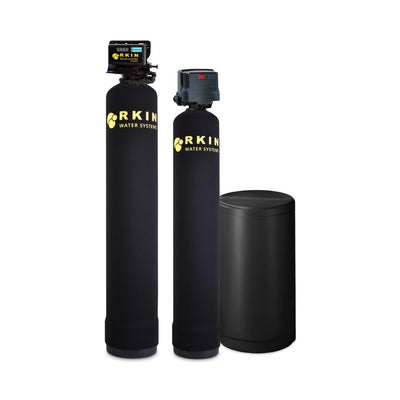
A salt-based water softener uses ion exchange resin — a bed of tiny beads that carry sodium ions. As hard water passes through, calcium and magnesium ions (the minerals that cause hardness and scale) swap places with sodium ions in the resin. The water leaving the tank has the hardness minerals removed and replaced with sodium.
Over time, the resin becomes saturated with calcium and magnesium and can no longer exchange ions effectively. The system then regenerates: it flushes the resin with a concentrated salt (brine) solution, which strips the calcium and magnesium off the resin and replaces them with sodium again. The spent brine — now concentrated with calcium, magnesium, sodium, and chloride — drains out of the system and into the household wastewater.
That brine discharge is where the environmental concern begins.
The Brine Discharge Problem
During each regeneration cycle, a salt-based water softener discharges several gallons of concentrated brine. Depending on the system size and water hardness, a typical household softener regenerates every few days. Over the course of a year, a single home softener can discharge hundreds of pounds of salt into the wastewater system.
The environmental consequences of this discharge have been documented in peer-reviewed research and regulatory reviews across multiple states:
- Municipal wastewater treatment limitations: Conventional wastewater treatment plants are designed to remove biological waste and certain chemicals — but they are not equipped to remove dissolved sodium, calcium, magnesium, or chloride. Salt from water softener discharge passes through treatment plants largely unchanged.
- Recycled water quality: In regions where treated wastewater is recycled for irrigation or groundwater recharge, elevated salinity from softener discharge creates problems. Sodium damages soil structure, reducing its water-holding capacity and affecting crops. Some California municipalities have explicitly cited water softener discharge as a threat to their recycled water programs.
- Aquatic ecosystem effects: In areas where treated wastewater discharges into rivers, streams, or estuaries, elevated chloride concentrations can harm freshwater organisms that are sensitive to salinity changes. Research has found negative effects on invertebrate populations in receiving waterways.
In response to these documented concerns, multiple states and municipalities have taken action. California passed legislation allowing local agencies to restrict or ban residential water softeners in water-recycling areas. Texas has seen similar discussions at the municipal level. Santa Clarita, CA has had a ban on salt-based softeners since 2004. More restrictions are being considered in water-stressed regions.
What Is a Salt-Free Water Conditioner?
A salt-free water conditioner uses a fundamentally different approach to address hard water. Rather than removing calcium and magnesium from the water (as ion exchange does), it changes the form of those minerals so they can't bind to surfaces.
The most proven salt-free technology is Template Assisted Crystallization, or TAC. In a TAC system, water passes over specially engineered polymer beads. These beads provide nucleation sites — surfaces where dissolved calcium and magnesium carbonate molecules can form tiny crystals. Once crystallized, those mineral particles no longer have the electrical charge that makes them stick to pipe walls, heating elements, or fixtures.
The minerals remain in the water — dissolved hardness minerals aren't harmful to drink — but they pass through your plumbing without depositing scale. Your water heater, dishwasher, shower heads, and pipes are protected from buildup without any chemistry involving salt.
The Environmental Profile of Salt-Free Conditioning
When you compare the environmental footprint of salt-free conditioning to traditional softening, several differences stand out:
- Zero brine discharge: A TAC conditioner doesn't regenerate. It doesn't flush anything down the drain. There is no brine, no concentrated salt waste, and no ongoing chemical discharge into the wastewater system.
- No electricity required: Most salt-free conditioners operate entirely on water pressure — no pumps, no control valves, no timers, no electricity consumption. The RKIN OnliSoft is a passive system with no electrical components.
- No salt production footprint: Salt for water softeners has to be mined, processed, and shipped — a supply chain with its own energy and environmental cost. A salt-free system eliminates that ongoing footprint entirely.
- Compliant in all regions: Because there's no brine discharge, salt-free conditioners are not subject to the restrictions that apply to salt-based softeners. They're usable in California water-recycling zones, on septic systems, and in municipalities that have restricted traditional softeners.
- Lower maintenance waste: Salt-based softeners require periodic servicing of control valves, brine tanks, and resin beds. Salt-free conditioners have minimal moving parts and generate minimal maintenance waste.
The RKIN OnliSoft: Salt-Free Conditioning for Whole-House Protection
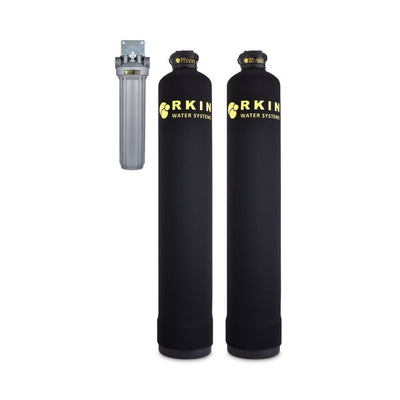
The RKIN OnliSoft is a whole-house salt-free water conditioner designed for homeowners who want scale protection without the environmental trade-offs of traditional softening.
It uses TAC media to convert hardness minerals into non-adherent crystals — protecting water heaters, appliances, pipes, and fixtures from scale buildup without any salt, electricity, or chemical discharge. Once installed on the main water line, it conditions every drop of water that enters the home: showers, laundry, dishwashers, ice makers, and outdoor taps.
Installation is straightforward for a licensed plumber: the unit connects inline to the main water supply, typically before any other point-of-use equipment. No brine tank to place, no drain connection required, no control head to program.
The OnliSoft Pro handles higher-flow applications for larger homes or homes with very high water hardness levels. Both systems are designed for long service life with minimal maintenance — the TAC media typically lasts several years before requiring replacement, and there are no salt purchases, no regeneration cycles, and no ongoing chemical costs.
Does Salt-Free Mean "Less Effective"?
This is the question that comes up most often when homeowners compare options. The short answer is that it depends on what you're trying to accomplish:
- For scale prevention: Salt-free TAC conditioners are highly effective. Multiple independent studies have found TAC to be comparable to ion exchange for preventing scale deposits on surfaces. If your goal is protecting appliances and plumbing, a quality salt-free conditioner delivers that outcome.
- For "soft water feel": Some people prefer the slippery feel of softened water (which has the hardness minerals removed). Salt-free conditioned water doesn't have that feel — the minerals are still present, just in a different form. Some homeowners notice a difference; others prefer conditioned water.
- For drinking water: From a health standpoint, conditioned water retains beneficial minerals like calcium and magnesium. Softened water replaces those minerals with sodium. For drinking, many people and health professionals prefer conditioned water.
For homeowners whose primary concerns are environmental (avoiding brine discharge, eliminating salt use, maintaining septic system health), the performance trade-off on "soft feel" is typically a non-issue. The scale protection is real, the environmental footprint is dramatically lower, and the operational simplicity is a genuine quality-of-life improvement.
Making the Decision for Your Home
If you're evaluating water treatment options and environmental impact is a factor in your decision, the case for salt-free conditioning is strong. Here's when each option tends to make sense:
- Choose salt-free conditioning: You're on a septic system. You're in a region with water softener restrictions. You want to eliminate ongoing salt purchases. Your primary goal is scale protection and appliance longevity. You want a passive, maintenance-light system.
- Evaluate both options: You have extremely high hardness levels (above 25 grains per gallon). You have a specific preference for softened water feel. You're in an area without discharge restrictions.
The RKIN OnliSoft is available for homes of various sizes, and the OnliSoft Pro handles higher-flow and higher-hardness applications. Both deliver whole-house scale protection without salt, without brine discharge, and without electricity.
Explore both models at rkin.com/products/rkin-whole-house-salt-free-water-softener.
Frequently Asked Questions
Why are salt-based water softeners considered bad for the environment?
Salt-based water softeners discharge concentrated brine (salt water) during each regeneration cycle. This brine enters municipal wastewater systems, which are not designed to remove dissolved salts. In regions that recycle treated wastewater, the elevated sodium and chloride levels can damage soil and affect aquatic ecosystems. Some states and municipalities have restricted or banned salt-based softeners for this reason.
Does a salt-free water conditioner actually prevent scale?
Yes. Salt-free TAC conditioners convert dissolved calcium and magnesium into microscopic crystals that pass through plumbing without sticking to surfaces. Independent studies have found TAC technology comparable to ion exchange softening for scale prevention on pipes, water heaters, and appliances.
Can I use a salt-free conditioner if I'm on a septic system?
Yes — and for septic system owners, salt-free is generally the recommended choice. Brine from salt-based softeners can kill the beneficial bacteria that make septic systems function properly, and concentrated sodium can damage drain field soils. Salt-free conditioners have no brine discharge and are safe for septic systems.
Is salt-free water safe to drink?
Yes. Salt-free conditioned water retains naturally occurring minerals like calcium and magnesium in a form that passes harmlessly through your body. Unlike salt-based softened water, it does not add sodium to your drinking water — which is a consideration for people on low-sodium diets.
Where are salt-based water softeners banned or restricted?
Several California municipalities including Santa Clarita, Pasadena, and others have restricted or banned salt-based water softeners in water-recycling service areas. Texas and other states have seen similar discussions. More regions are considering restrictions as water recycling programs expand and salinity concerns grow.
Does the RKIN OnliSoft require electricity?
No. The RKIN OnliSoft operates entirely on water pressure — there are no electrical components, no pumps, and no control heads to program. It's a passive system that conditions water continuously without any energy input.





0 comments