




costo del agua dura para propietarios
How Much Does Hard Water Cost Homeowners? 2026 Guide

Short answer: hard water costs homeowners through scale buildup, extra cleaning, lower appliance efficiency, and more frequent maintenance. It is not always dramatic in week one, but it adds up in the places you do not look: water heaters, faucet aerators, shower glass, dishwashers, coffee makers, and plumbing fixtures.
The mistake is treating hard water like a cosmetic problem only. White spots are the visible clue. The bigger issue is what scale does inside equipment that depends on clean water flow and heat transfer.
What is hard water?
Hard water means water contains dissolved minerals, mainly calcium and magnesium. The Penn State Extension water softening guide explains that hardness minerals can form scale deposits in plumbing and appliances. Those deposits are why hard water shows up as spots, crust, and reduced flow.
Hardness is often measured in grains per gallon or milligrams per liter. A city water report may list it. A private well usually needs direct testing. Two homes in the same county can have very different hardness, especially when one is on a well and the other is on municipal water.
The important part: hard water is dissolved minerals, not dirt. A simple screen cannot catch it. You need the right treatment method for the job. A sediment filter catches particles. A carbon filter helps with certain taste and odor issues. A water softener removes hardness minerals through ion exchange. A salt-free conditioner changes how hardness minerals behave so they are less likely to form hard scale.
That is why the cheapest wrong system can become the most expensive choice. It may leave the real problem untouched.
The hidden hard water tax: where the cost shows up
The hidden hard water tax is not one bill with a neat label. It is a stack of small annoyances and repairs.
It shows up when a shower head sprays sideways because mineral buildup blocked half the holes. It shows up when a faucet aerator clogs again after you cleaned it last month. It shows up when the dishwasher leaves spots and the coffee maker needs descaling more often. It shows up when soap does not rinse the way you expect and you use more detergent to get the same result.
Water heating is another part of the equation. The EPA WaterSense water-softener guide explains that scale on water heaters and other appliances impedes water flow and heat conductivity. As a result, water heaters operate less efficiently and scaled equipment can require more frequent cleaning or replacement.
Hard water also steals time. Cleaning glass, scrubbing faucets, soaking shower heads, replacing cartridges, and descaling small appliances all take attention. That is not a line item on the utility bill, but homeowners feel it.
Why summer makes hard water more obvious
Summer water use tends to climb. Families shower more, fill bottles more often, rinse patio furniture, top off pools, use ice makers, and run laundry after outdoor days. More water through the same fixtures means more chances for scale to show up.
Warm weather also makes spots easier to notice. Water dries faster on glass, faucets, and outdoor surfaces. If your tap water is hard, those minerals are left behind as the water evaporates. That is why a patio rinse, shower door, or stainless faucet can look dirty even when the water itself looked clear.
This is also the season when homeowners start asking whether they need a water softener, a salt-free conditioner, or a whole-house filter. The answer depends on the water data and the complaint. If the problem is scale, you need a hardness strategy. If the problem is chlorine taste, you need carbon. If the problem is PFAS, lead, or drinking-water contaminants, you need a system rated for that specific concern.
Hard water is common, but it should not be handled with guesswork.
What hard water can do to fixtures and appliances
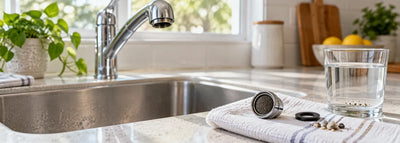
Scale builds where water sits, flows, heats, or evaporates. Shower heads and faucet aerators are common first signs because their tiny openings make buildup easy to see. Flow gets weaker, spray patterns get uneven, and cleaning becomes routine.
In water heaters, scale can collect on heating surfaces. That can reduce heat transfer and make equipment work harder. In dishwashers, scale and spotting can make dishes look unclean even after a full cycle. In coffee makers and kettles, mineral deposits can affect taste and performance.
Hard water can also change how soaps and detergents behave. You may feel like you need more product to get a good lather or rinse. That does not mean the water is dirty. It means dissolved minerals are interacting with the soap.
None of this means every hard-water home needs the same equipment. A home with mild hardness and mostly spot complaints may need a different solution than a well with very high hardness, iron staining, and rotten-egg odor. The job is to diagnose first, then pick the smallest system that solves the real problem.
What does not fix hard water?
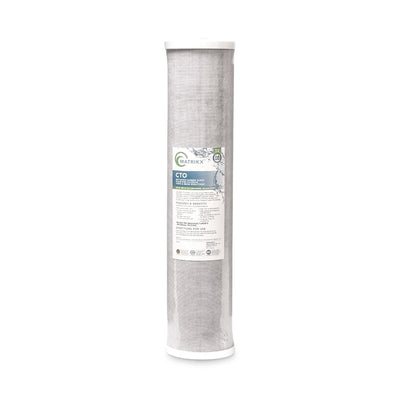
A carbon filter does not remove hardness minerals. Carbon is useful for many taste and odor problems, including chlorine, but it does not turn hard water into soft water.
A sediment filter does not remove dissolved hardness either. It can catch sand, rust, and particles, but calcium and magnesium are dissolved. They pass through a simple particle filter.
Boiling is not a hard-water fix. It can leave more scale behind because water evaporates and minerals remain. That is why kettles and coffee makers in hard-water homes need regular descaling.
A shower head filter may help with certain taste, odor, or sediment complaints depending on the media, but it should not be sold as a whole-home hardness solution. If your fixtures, water heater, and dishwasher are all seeing scale, the problem is upstream of the shower head.
Water softener vs salt-free conditioner: the cost question
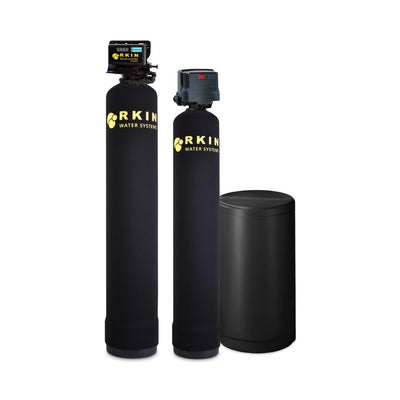
A traditional salt-based water softener removes hardness minerals through ion exchange. If you want water that tests soft, that is the direct method. It can be the right choice when hardness is high, when the soft-water feel matters, or when the home has severe scale issues.
The trade-off is maintenance. Salt-based softeners need salt or potassium, a brine tank, regeneration cycles, and discharge. Some homeowners are fine with that. Others do not want to carry salt bags or manage another routine.
A salt-free water conditioner works differently. It does not remove calcium and magnesium. Instead, it changes how those minerals behave so they are less likely to stick as hard scale. That means it is a scale-control tool, not a true softener. The water will not test soft, and it will not have the slick feel of softened water.
For many homeowners, that distinction is exactly the point. If the goal is lower-maintenance scale control without salt, a conditioner can be a better fit than a softener. If the goal is true hardness removal, choose a softener.
Where RKIN fits
The RKIN whole-house water treatment collection is built around matching the system to the water problem: scale control, softening, carbon filtration, well water, and other whole-home needs.
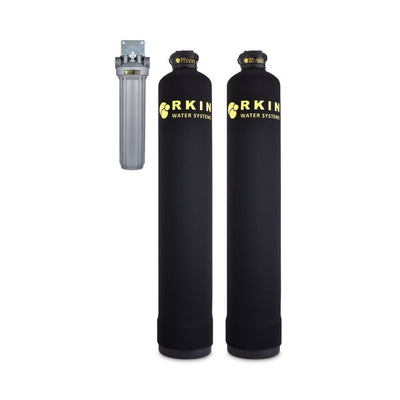
For hard-water scale without salt, the relevant product family is the RKIN OnliSoft Salt-Free Water Conditioner and the RKIN OnliSoft Pro Salt-Free + Carbon Combo. These are designed for homeowners who want scale control without a brine tank or salt routine. The RKIN OnliSoft Pro Salt-Free + Carbon Combo adds whole-house carbon filtration for homes that also want help with chlorine taste and odor, depending on the source water.
If your water is very hard and you want true hardness mineral removal, a salt-based softener may still be the better fit. If you have well water with iron, sulfur, manganese, or staining, test first. A hard-water article cannot replace a lab result.
The best next step is not guessing. It is finding the hardness level, identifying the complaint, and choosing the system around that evidence.
How to check if hard water is costing you money
Look at the home in zones.
In the bathroom, check shower glass, shower heads, faucet aerators, and white crust around handles. If cleaning only gives you a short break before buildup returns, hardness may be part of the pattern.
In the kitchen, check the dishwasher, stainless sink, coffee maker, kettle, and ice maker. Spots and repeated descaling are clues. If filtered drinking water tastes fine but the dishwasher still spots, you may be dealing with whole-home hardness rather than a drinking-water issue.
In the utility area, check the water heater age, service history, and any signs of scale-related maintenance. Do not open equipment unless you know what you are doing. The point is to collect clues, not turn a blog article into a repair job.
Then check data. City water users should look up the latest water quality report. Well owners should test directly. Hardness, iron, manganese, pH, TDS, and sulfur indicators can change what system makes sense.
Frequently Asked Questions
How much does hard water cost homeowners?
There is no single number that applies to every home. The cost depends on hardness level, water use, appliance age, and how much scale has already built up. The common costs are extra cleaning, descaling, fixture maintenance, reduced flow, and possible efficiency loss in equipment that heats water.
Does hard water damage appliances?
Hard water can contribute to mineral scale inside appliances that heat or move water, such as water heaters, dishwashers, coffee makers, and ice makers. The effect depends on hardness level and maintenance. If you see repeated scale buildup, test hardness before choosing equipment.
Will a carbon filter fix hard water?
No. Carbon can help with certain taste and odor problems, but it does not remove dissolved calcium and magnesium. If the issue is white scale, spots, or hardness test results, look at a softener or salt-free conditioner instead.
Is a salt-free conditioner the same as a softener?
No. A traditional softener removes hardness minerals through ion exchange. A salt-free conditioner changes how minerals behave so they are less likely to stick as hard scale. Choose based on whether you want true hardness removal or lower-maintenance scale control.
Should I test city water or well water for hardness?
Yes. City water users can start with the latest water quality report, but a home test can confirm what reaches the tap. Well owners should test directly because well chemistry can vary by property. Testing helps avoid buying a system that does not match the problem.
Ready to Stop Paying the Hidden Hard Water Tax?
Hard water is easier to manage when you stop guessing. Check your water data, identify where scale is showing up, and choose a system around the real problem. Start with the RKIN whole-house water treatment collection if you want scale control, softening, or carbon filtration matched to your home.


0 comentarios