




drinking water
Does RO Filtration Reduce Microplastics in Drinking Water?

You saw a headline about microplastics in tap water. Now you're wondering: does your water filter actually do anything about them?
It's a reasonable question — and the answer depends entirely on what type of filter you have. Here's the honest breakdown.
What Are Microplastics, Exactly?
Microplastics are plastic fragments smaller than 5 millimeters. They break down from larger plastics in the environment — packaging, synthetic clothing, tires — and end up in rivers, groundwater, and eventually your tap.
Researchers at the University of Vienna detected microplastic particles in 81% of tap water samples tested across multiple continents. The particles ranged in size from 5mm down to roughly 1 micrometer (1µm) — about 70 times smaller than a human hair. A 2020 review published in the International Journal of Environmental Research and Public Health confirmed that microplastic contamination is now widespread in drinking water sources globally, with particle sizes spanning from visible fragments down to the nanoscale.
The smaller the particle, the harder it is to filter. Which is why filter type matters a lot.
Why Most Filters Don't Cut It for Microplastics
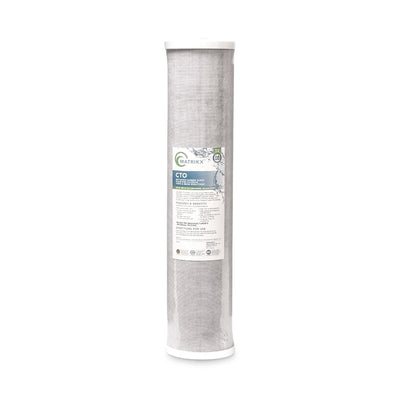
Standard pitcher filters use activated carbon and sediment media. Carbon is excellent at reducing chlorine taste and some contaminants — but its pore structure is measured in microns to millimeters. Microplastic particles at 1–10µm pass right through most pitcher and faucet filters.
Here's a rough comparison of filter types and their effective pore sizes:
- Pitcher filters (carbon block): ~0.5–5 microns — filters some but not the smallest particles
- Sediment filters: ~1–100 microns — depends heavily on rating
- Ultrafiltration (UF): ~0.01–0.1 microns — removes most microplastics
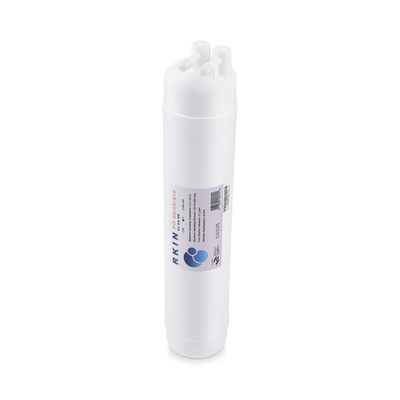
- Reverse osmosis (RO) membranes: ~0.0001 microns — filters particles far smaller than any known microplastic
The RO membrane pore size of 0.0001 microns is not a marketing claim — it's the physical rating of the semi-permeable membrane used in RO systems. Microplastic particles, even at their smallest detected size of ~1µm, are 10,000 times larger than an RO membrane pore.
How RO Filtration Reduces Microplastics
Reverse osmosis works by pushing water through a semi-permeable membrane under pressure. The membrane's pores are so small that only water molecules pass through — dissolved salts, heavy metals, and yes, microplastic particles are rejected and flushed away in the wastewater stream.
This isn't a filter that captures particles in a mesh. It's a size-exclusion barrier at the molecular level. A microplastic fragment has no physical mechanism to pass through a 0.0001-micron RO membrane.
The result: RO-filtered water has dramatically reduced microplastic content compared to unfiltered tap or pitcher-filtered water.
Which RKIN Systems Use RO Membranes?
All of RKIN's countertop and under-sink drinking water systems use reverse osmosis membranes as a core filtration stage:
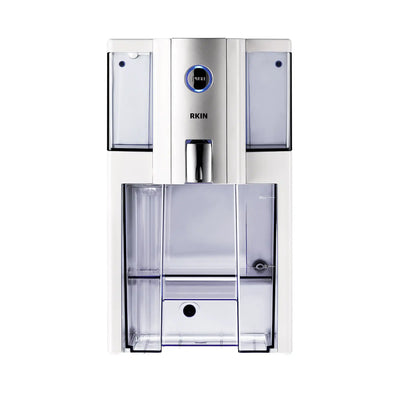
- RKIN U1 — Countertop RO system with 5-stage filtration including a 0.0001-micron RO membrane. No installation required. Designed for apartments, condos, and renters who can't modify plumbing.
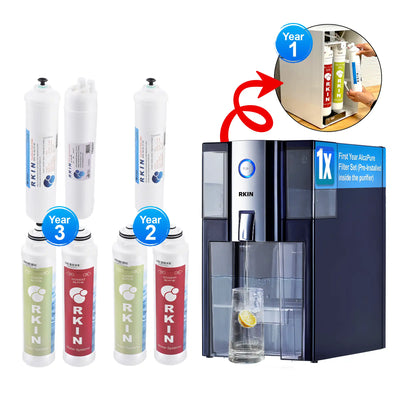
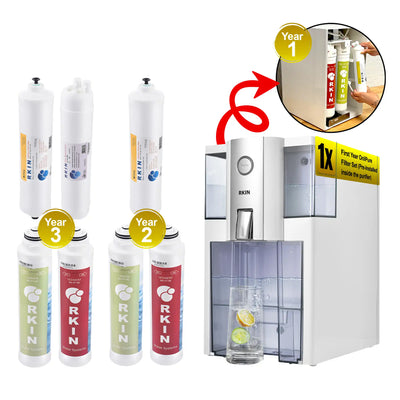
- RKIN Zero Installation Purifier — Countertop RO with AlcaPure or OnliPure post-filter options. Works like a coffee maker — fill, push, done. No hoses, no installation.
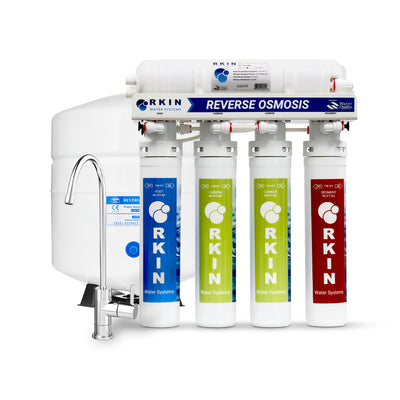
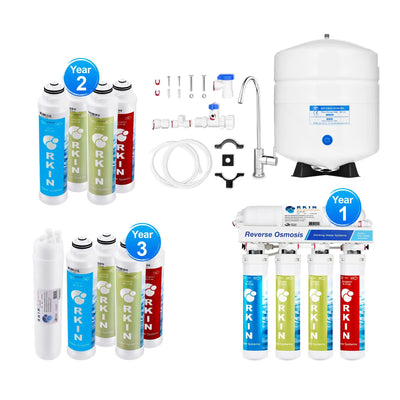
- RKIN Flash — Under-sink RO system for permanent installation. Higher flow rate, connects directly to your cold water line.
All three use RO membranes rated to 0.0001 microns, which means microplastics — at any size currently detected in drinking water — are physically too large to pass through.
A Note on Language: "Reduces" vs. "Eliminates"
We use "reduces" and "filters" rather than "eliminates" deliberately. No filtration system can claim 100% removal of any contaminant under all conditions — membrane integrity, water pressure, and system maintenance all affect performance. What the data shows: RO membranes are the most effective filtration technology currently available for microplastic reduction in residential drinking water.
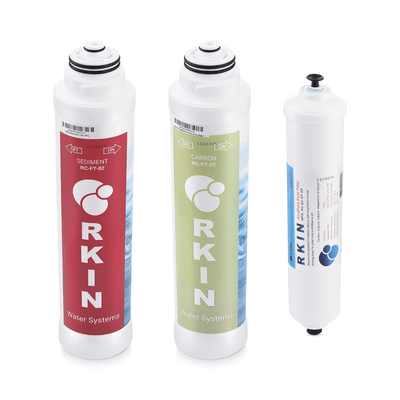
If you want the highest confidence level, look for systems that include pre-filters (sediment and carbon) before the RO membrane — these protect the membrane and extend its life. All RKIN RO systems include multi-stage pre-filtration.
What About Whole-Home Filtration?
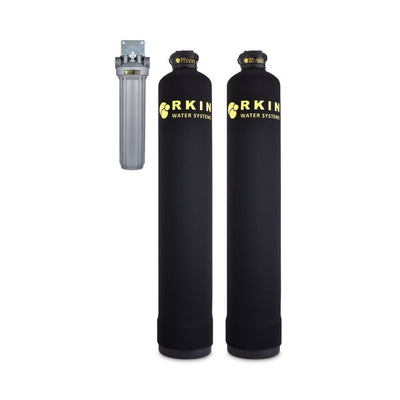
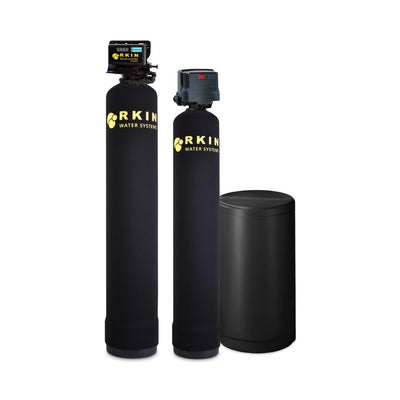
Whole-home systems like RKIN's whole-house water treatment line are designed primarily for hardness, chlorine, sediment, and chemical reduction — not microplastic reduction specifically. Most whole-home systems use carbon block or catalytic carbon media, which are effective at micron-range particles but not at the sub-micron range where microplastics are found.
For microplastic reduction, a point-of-use RO system at the tap is the right approach. Many households use a whole-home system for general water quality and an RO system at the kitchen tap for drinking water — getting the benefits of both.
Frequently Asked Questions
Does reverse osmosis filter reduce microplastics?
RO membranes are rated to 0.0001 microns — far smaller than any microplastic particle detected in tap water. RO filtration significantly reduces microplastic content. No filter claims 100% removal, but RO is the most effective residential option available.
What size are microplastics in tap water?
Microplastics range from 5mm down to roughly 1 micrometer (1µm) in tap water. Nanoplastics — smaller than 1µm — are increasingly detected as lab methods improve. An RO membrane at 0.0001 microns filters particles far smaller than either range.
Does a Brita or pitcher filter reduce microplastics?
Standard pitcher filters use carbon media with pore sizes in the micron range. They may catch larger fragments but are not rated for sub-micron particles. For reliable microplastic reduction, reverse osmosis is the recommended technology.
Which RKIN system is best for microplastic reduction?
The U1, Zero Installation Purifier, and Flash all use 0.0001-micron RO membranes. The U1 and Zero Installation Purifier need no installation — ideal for renters and apartment dwellers. The Flash connects under the sink for higher flow.
Are microplastics in tap water dangerous?
Research is still developing. The EPA and WHO have flagged microplastics as an emerging concern but have not set a regulatory limit for tap water as of 2026. Many researchers recommend reducing exposure as a precaution while science continues.
Does the RKIN U1 require installation to filter microplastics?
No. The U1 is a countertop system — you fill the tank manually, and it filters through all 5 stages including the RO membrane. No plumbing modifications needed.
How often does the RO membrane need replacing?
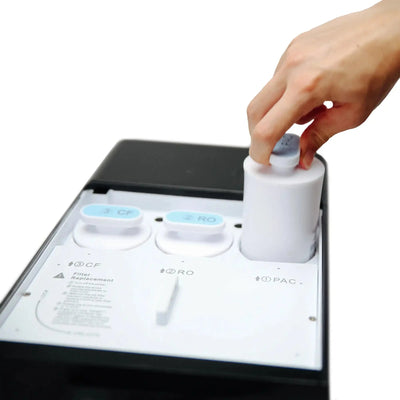
Typically every 1–2 years depending on water quality and usage. Higher TDS water shortens membrane life. RKIN offers annual filter bundles that include RO membrane replacement on schedule.
The Bottom Line
If reducing microplastics in your drinking water is the goal, reverse osmosis is the right technology. The physics are straightforward: an RO membrane at 0.0001 microns physically cannot pass a microplastic particle at 1µm or larger.
RKIN's countertop RO systems — the U1 and the Zero Installation Purifier — are built specifically for people who want RO filtration without touching their plumbing. If you have a kitchen sink and an outlet, you're set. If you're ready for under-sink installation, the Flash delivers higher flow at the tap.
See current pricing and system specs at rkin.com.






0 comments