


cloudy glasses dishwasher
Why Does My Dishwasher Leave White Film on Glasses?

You ran the dishwasher on the heavy cycle. You used the rinse aid. You even tried the "extra dry" setting. The glasses still came out cloudy, with that chalky white film that won't wipe off without elbow grease and vinegar. If this happens every load, no detergent change is going to fix it. The problem isn't your dishwasher. It's your water.
According to the U.S. Geological Survey's 2023 hardness map, roughly 85% of American homes get hard water — water carrying dissolved calcium and magnesium picked up as it travels through limestone and chalk deposits underground. When that water hits a hot dishwasher cycle and evaporates off your glassware, the minerals stay behind. That's the white film. It's not soap scum, and it's not a rinse-aid issue. It's mineral deposit, and on glass it can become permanent over time.
What's Actually on Your Glasses
The white residue you're scrubbing off is mostly calcium carbonate and magnesium silicate — the same compounds that build up inside your kettle and crust the bottom of your coffee maker. Heat accelerates the process. Inside a dishwasher, water hits 130–155°F during the wash and final rinse, which is exactly the temperature range where dissolved minerals start dropping out of solution and bonding to whatever surface they touch.
On stainless steel and dishes, you can usually wipe the film off. On glass, it's a different story. Repeated exposure to hard water and high heat causes a process called etching — the minerals chemically interact with the silica in the glass, leaving behind microscopic pits. Once a glass is etched, it stays etched. No detergent, rinse aid, or vinegar soak will bring it back. That's why people often notice their "good glasses" eventually go permanently cloudy after a year or two of dishwasher use.
A 2024 Water Quality Association report found homes with water harder than 7 grains per gallon (gpg) — about 60% of U.S. households — see noticeable scale buildup on appliances within 90 days. For glassware specifically, etching damage starts as low as 5 gpg.
Why Detergent and Rinse Aid Aren't Solving It
Most homeowners assume that a stronger detergent or more rinse aid will fix the problem. It rarely does. Here's why:
- Detergent boosters (oxygen bleach, enzymes) are designed to break down food and grease, not minerals. They have no effect on calcium carbonate.
- Rinse aid lowers the surface tension of water so it sheets off rather than beads up. It helps glasses dry without spots, but it doesn't remove dissolved minerals from the water itself.
- Citric-acid additives (the "lemonade hack") can dissolve some buildup if you run an empty cycle with them, but they don't treat the incoming water — every new load brings fresh minerals.
- Vinegar rinses clean the inside of the dishwasher itself, but they don't condition the water before it touches your dishes.
You can keep stacking products, but you're treating the symptom, not the source. The minerals are dissolved in the water before it ever enters the dishwasher. You have to treat them there, or accept that every load will deposit a fresh layer.
What Actually Works
There are two real solutions for white film on dishwasher glasses, and both work by changing the water before it gets to the appliance.
Option 1: Salt-Free Water Conditioning
Salt-free conditioners use a process called template-assisted crystallization (TAC). Instead of removing calcium and magnesium, the media converts those minerals into a crystalline form that doesn't bond to surfaces. The water still has the minerals in it — but they pass through your plumbing, water heater, and dishwasher without leaving deposits.
This is the right choice for homeowners who: - Don't want to add sodium to their water - Don't want to deal with bagged salt every month - Want a low-maintenance system that runs for years without intervention - Have moderate hardness (under 25 gpg)
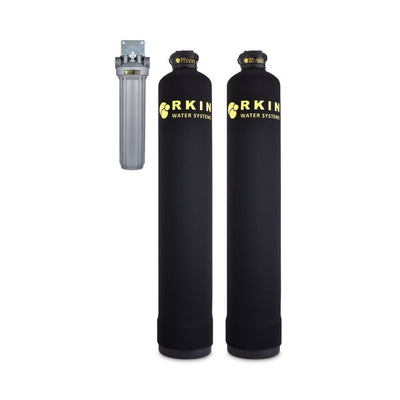
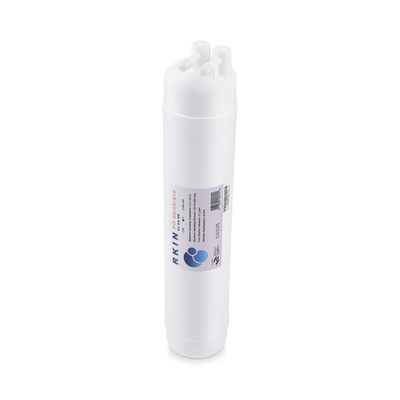
The RKIN OnliSoft Salt-Free Water Conditioner treats the entire home — every faucet, shower, and appliance gets conditioned water. Once it's installed, the dishwasher stops depositing film, the showerhead stops crusting over, and the water heater stops scaling on its element. The TAC media itself lasts a lifetime — there's no replacement to schedule.
Option 2: Traditional Salt-Based Softening
If your water is very hard (above 25 gpg) or you want fully softened water for laundry and bathing, a salt-based softener actively removes calcium and magnesium and replaces them with sodium ions. The output water is genuinely soft — no minerals, no film, slick to the touch.
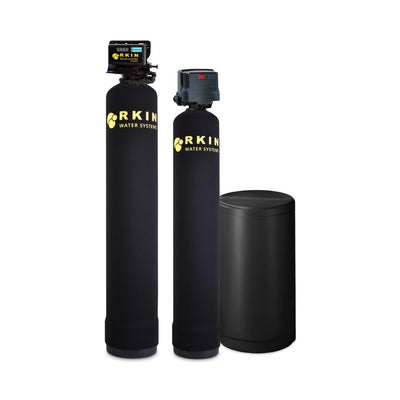
The trade-offs are real: you'll add bagged salt every 4–8 weeks, the system needs a drain line, and you're adding a small amount of sodium to your drinking water. For homes with extreme hardness or iron, salt-based is still the most effective option. The RKIN Whole House Salt-Based Water Softener handles up to 75 gpg and is sized for households of 1–6 people.
For a combined approach — softened water plus carbon filtration for chlorine and taste — the RKIN OnliSoft Pro Salt-Free + Carbon Combo is one whole-house unit that handles both jobs.
How to Confirm It's Hard Water (Not Something Else)
Before buying anything, run a quick diagnosis. The white film could also be caused by:
- Old dishwasher gaskets or filter — pull the filter, rinse it, check the door seal
- Wrong detergent dose — too little leaves food residue; too much leaves a powdery layer
- Dishwasher needing a clean cycle — limescale builds up inside the spray arm and can flake onto dishes
To rule out hard water specifically: 1. Take a clean dry glass straight from the dishwasher 2. Wipe it with a paper towel dipped in white vinegar 3. If the film disappears immediately, it's mineral deposit — hard water is the cause 4. If it doesn't, you're dealing with detergent residue or a dishwasher issue
You can also pick up a hard water test strip at any home improvement store for a few dollars. Anything reading above 7 gpg means scale buildup is on its way. Above 10 gpg and it's already happening.
The Long-Term Cost of Ignoring It
Hard water doesn't just cloud your glasses. The 2023 Battelle Institute appliance study found that homes with untreated hard water see:
- Dishwashers losing efficiency within 18 months and failing 30–50% sooner
- Water heater elements scaling and burning out within 4–7 years (vs. 10+ on soft water)
- Faucet aerators and showerheads requiring replacement every 6–12 months
- Higher detergent and soap usage — typically 30–50% more product needed for the same clean
The replacement and repair costs of those appliances over a decade often exceed the cost of installing a whole-house treatment system in the first year. White film on glasses is the visible warning sign. The damage is happening throughout the plumbing whether you see it or not.
Frequently Asked Questions
Is white film on dishwasher glasses dangerous?
No. The film is calcium and magnesium — the same minerals you'd find in mineral water or a multivitamin. They aren't harmful to ingest. The issue is cosmetic (etched glassware) and mechanical (scale buildup damaging your dishwasher and water heater over time).
Can I remove the white film once it's there?
If your glasses are recently affected, soak them in undiluted white vinegar for 15–30 minutes, then scrub with a non-abrasive sponge. This works on mineral deposit. If the cloudiness doesn't come off after vinegar — and the glass looks slightly frosted in certain light — the glass has been etched and the damage is permanent.
Does a salt-free conditioner work as well as a salt-based softener?
For preventing scale and film, both work. Salt-free conditioners change how the minerals behave so they don't deposit; salt-based softeners actually remove the minerals. For laundry and bathing feel, salt-based produces water that feels slicker. For drinking and dishwashing, the visible result is the same — no more white film, no more crusty showerheads, no more scaling.
How long after installing a softener will the film stop?
You'll usually see a difference within the first few dishwasher loads. The water hitting your dishes is treated immediately. The only delay is removing existing buildup inside the dishwasher itself, which can take 2–3 cycles to flush out.
Will a countertop water filter fix this?
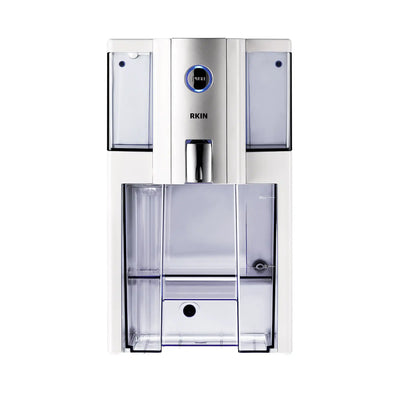
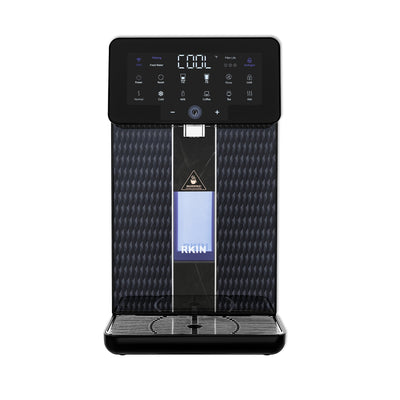
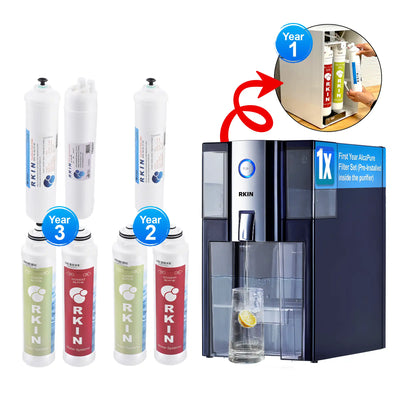
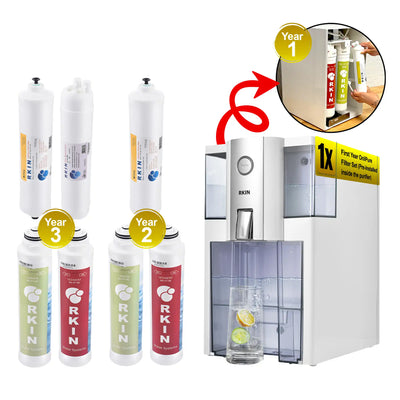
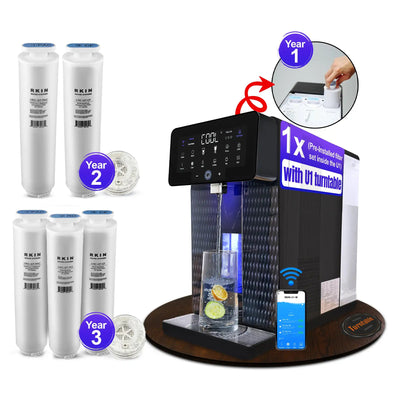
No. Countertop systems like the Zero Installation Purifier and the RKIN U1 4-in-1 Water Filter System treat your drinking water to a higher standard — removing PFAS, lead, fluoride, and TDS — but they don't pipe water to your dishwasher. For appliance protection, you need treatment at the point where water enters the home.
Is hard water causing problems beyond the dishwasher?
Almost certainly. If you see film on glasses, you also have scale building up inside your water heater, on shower glass, in faucet aerators, and inside the dishwasher itself. Soap not lathering well, dry skin after showers, spots on clean cars, and a stiff feel to laundry are all signs of the same hardness problem.
Stop Treating the Symptom
White film on dishwasher glasses means dissolved minerals are surviving every wash cycle and bonding to your dishes. Switching detergents won't change what's in the water. The fix is treating the water at the point of entry so every appliance, fixture, and load benefits.
The RKIN OnliSoft Salt-Free Water Conditioner handles this for the whole home — no salt, no maintenance schedule, no drain line. The minerals stay in your water but lose the ability to stick. Glasses come out clear. Showerheads stop crusting. Your water heater lasts longer.
See the RKIN whole-house water treatment lineup to find the right fit for your home's hardness level and household size.




0 comments