




fluoride
Does Reverse Osmosis Remove Fluoride? What You Need to Know

About 73% of Americans on community water systems receive fluoridated water, according to CDC data. For decades, that was largely accepted without question. Today, more homeowners want to understand exactly what's in their water — and whether they can choose to reduce it.
If you've been researching how to remove fluoride from water, you've probably landed on reverse osmosis as a leading option. That instinct is correct. But not all filter types work, and the details matter. Here's a straight answer on what RO does, why other methods fall short, and what to look for when choosing a system.
What Is Fluoride and Why Is It in Your Water?
Fluoride is a naturally occurring mineral found in soil, rocks, and groundwater at varying levels. The U.S. has added fluoride to public water supplies since 1945 with the stated goal of reducing tooth decay across the population.
The EPA sets a maximum contaminant level (MCL) of 4 mg/L for fluoride in drinking water. But the Department of Health and Human Services recommends keeping levels at 0.7 mg/L — significantly lower — to balance any dental benefit while reducing risk of overexposure. That gap between the legal limit and the health recommendation is part of why the conversation has shifted.
In 2024, the National Toxicology Program (NTP) released a report concluding that fluoride is "probably neurotoxic" at levels above 1.5 mg/L, based on a systematic review of available research. The report has been widely cited and remains a point of active scientific discussion. You can read the full NTP finding here.
The concern many people raise isn't a single glass of water — it's cumulative exposure over years, factoring in fluoride from multiple dietary sources. Whether you're acting on precaution or on specific water quality results, understanding your removal options is practical and reasonable.
What Doesn't Remove Fluoride
Before getting to what works, it's worth clearing up what doesn't — because there's real confusion here.
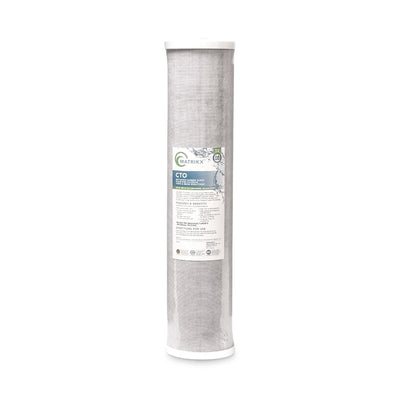
Standard activated carbon filters — the kind in pitcher filters, refrigerator filters, and most basic under-sink units — do not effectively remove fluoride. Carbon is excellent at reducing chlorine, chloramines, VOCs, and improving taste. Fluoride, as an ion, passes right through it. If your filter doesn't specifically list fluoride removal with a percentage and a supporting test, assume it isn't doing the job.
Boiling water makes the situation worse, not better. As water evaporates, the fluoride concentration in what remains actually increases. Boiling is useful for pathogens — not for dissolved minerals or ions.
Pitcher filters with basic carbon block media have minimal effect on fluoride removal. Some pitcher-style filters do include bone char or activated alumina media specifically for fluoride, but they're less common, and performance varies by brand, media age, and contact time.
If you're serious about reducing fluoride in drinking water, none of the above is a reliable solution. You need a filtration method that physically separates fluoride ions from the water at the molecular level.
How Reverse Osmosis Removes Fluoride
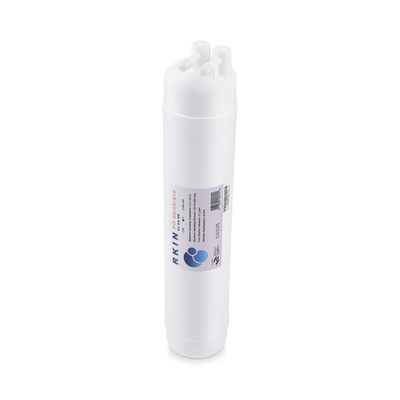
Reverse osmosis works by pushing water through a semi-permeable membrane with pores small enough to block dissolved solids, ions, and contaminants — including fluoride. The membrane has a pore size of approximately 0.0001 microns, which is far smaller than fluoride ions.
The result: RO systems remove 85–95%+ of fluoride from tap water, depending on membrane quality, water pressure, and system maintenance. This is consistent across multiple independent tests and is the basis for NSF/ANSI Standard 58, the certification benchmark for residential RO systems. Systems certified to NSF/ANSI 58 are tested specifically for fluoride reduction, among other contaminants.
RO also removes a wide range of other contaminants — arsenic, lead, nitrates, PFAS, chromium, and total dissolved solids — making it one of the most thorough point-of-use filtration methods available.
Other methods that do work to varying degrees:
- Bone char carbon — made from charred animal bones, removes fluoride through adsorption. Effective but less common in consumer products and requires regular replacement.
- Activated alumina — a mineral media specifically effective for fluoride and arsenic. Used in some specialty filter cartridges, but flow rates are slow.
Both are legitimate options for fluoride reduction, but neither is as practical or widely available as RO for residential use. RO systems integrate into a normal water routine without requiring unusual cartridge sourcing or special handling.
RKIN Reverse Osmosis Systems That Remove Fluoride
Choosing the right RO system comes down to where you want filtered water and how much you want to modify your plumbing. RKIN offers three configurations worth knowing.
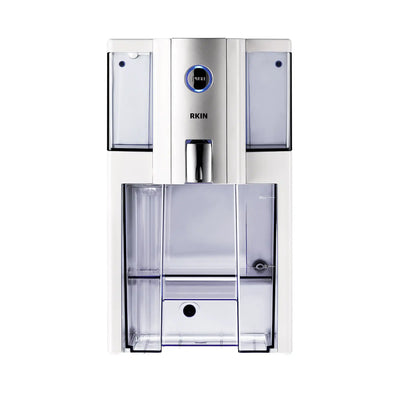
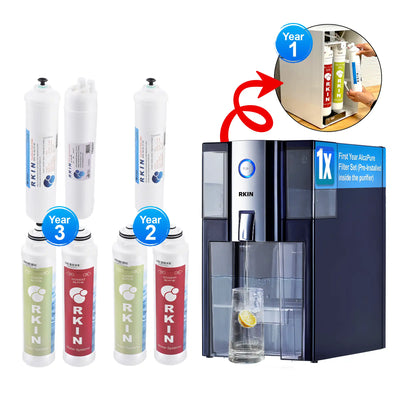
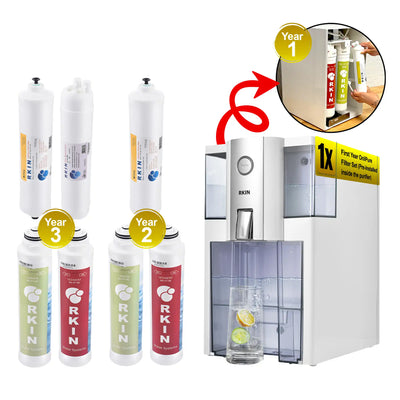
Zero Installation Purifier (Countertop RO) — The countertop option that requires zero plumbing. It connects to your faucet with a diverter valve and filters water on demand. If you rent, move frequently, or just don't want to cut into cabinet space, this is the most accessible entry point. NSF/ANSI 58 certified for fluoride reduction.
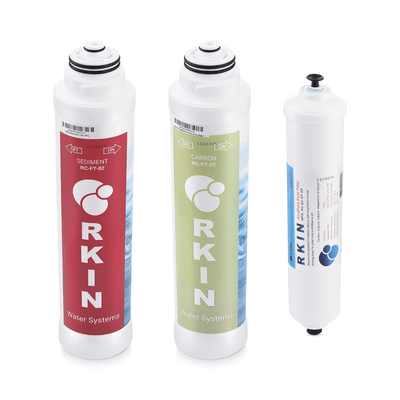
RKIN U1 4-in-1 Countertop System — A countertop unit with a fill tank and a 5-stage filtration process: sediment pre-filter, carbon block, RO membrane, UV sterilization, and post-filter polishing. The UV stage adds pathogen reduction on top of the chemical and mineral removal from the RO membrane. The U1 is third-party tested for performance. No installation required — fill the tank, power it on, and it produces filtered water at whatever pace your household needs.
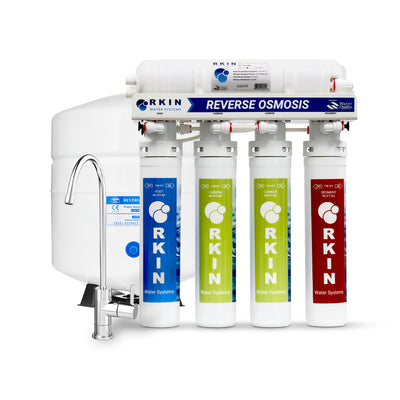
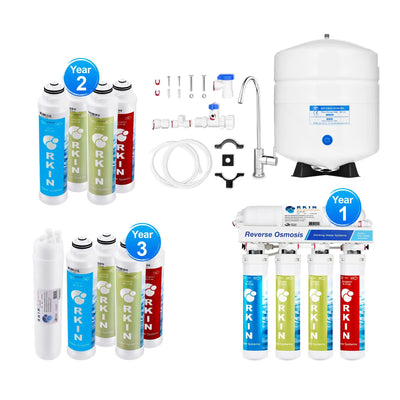
RKIN Flash Undersink RO System — If you want filtered water directly from a dedicated faucet at the sink, the Flash mounts under the cabinet with a pressurized storage tank. It handles continuous use well and keeps the countertop clear. This is the right call if you have a larger household or prefer a plumbed-in solution.
For most people starting out, the Zero Installation Purifier or the U1 removes the most friction. You don't need a plumber, a landlord's permission, or tools. If your household goes through a high volume of filtered water and you want it integrated into the sink, the Flash is worth the installation step.
Frequently Asked Questions
Does reverse osmosis remove all fluoride?
No filter removes 100% of any contaminant — but RO gets close. A well-maintained RO system with a quality membrane removes 85–95%+ of fluoride, which is the standard range verified through NSF/ANSI 58 testing protocols. Actual removal rates depend on membrane age, water pressure, and incoming water chemistry. Replacing your RO membrane on schedule (typically every 2–3 years) keeps performance in that range.
Is fluoride in drinking water harmful?
The EPA's legal limit is 4 mg/L. Most municipal water systems target 0.7 mg/L per federal health guidance. At recommended levels, fluoride isn't acutely harmful — the concern is about long-term cumulative exposure from multiple sources. The 2024 NTP report flagged higher concentrations (above 1.5 mg/L) as a research area of concern. Whether you choose to filter fluoride is a personal decision; the data supports both sides of the conversation. This post doesn't make any health recommendations — it just explains your options.
Will a Brita or PUR filter remove fluoride?
Standard pitcher filters using activated carbon do not meaningfully remove fluoride. Some specialized pitcher media (bone char or activated alumina) can reduce it, but standard carbon-based pitchers will not. If fluoride removal is your goal, check the manufacturer's testing data for that specific contaminant before relying on a pitcher filter.
Does boiling water remove fluoride?
No — boiling actually concentrates fluoride. As water evaporates through boiling, the dissolved minerals and ions that remain get more concentrated in the smaller volume of water left behind. Boiling is appropriate for killing bacteria and some pathogens. It should not be used as a method for fluoride reduction.
How do I know if my tap water has fluoride?
Check your municipality's annual water quality report (also called a Consumer Confidence Report). Water utilities are required to publish these each year. You can also use a home water test kit that includes fluoride, or send a sample to a certified lab for an accurate reading. The EPA's water quality database can point you toward your local utility's report.
Does the RKIN Zero Installation Purifier remove fluoride?
Yes. The Zero Installation Purifier is NSF/ANSI 58 certified, which includes verified fluoride reduction testing. The RO membrane at the core of the system is what handles fluoride removal — alongside a wide range of other dissolved contaminants including arsenic, lead, and nitrates.
Choose Your Setup
If reducing fluoride in your drinking water is the goal, reverse osmosis is the most practical method available for home use. The difference between systems is mostly about installation preference and household volume — not filtration capability.
Browse the RKIN countertop filter collection if you want filtered water without any plumbing work. If you're ready for a dedicated under-sink setup, the RKIN Flash Undersink RO System handles high daily use with a pressurized tank and a clean countertop.
Start with what fits your living situation. You can always upgrade later.






0 comments