


SAC water conditioner
SAC Scale Conditioning: What Changes and What Does Not

Seed-assisted crystallization, or SAC, is a salt-free scale-conditioning process. Its goal is to change how hardness minerals behave so they are less likely to adhere as scale; it is not designed to remove calcium or magnesium from the water.
That distinction affects expectations. A hardness test may read about the same before and after SAC, soap behavior may not match softened water, and total dissolved solids do not disappear. Use the system for a scale-control goal, not as a synonym for softening.
Measure Hardness and Identify the Actual Symptom
Hard water is mainly about calcium and magnesium. Those minerals are common in groundwater and in municipal systems that draw from hard source water. They are not automatically a drinking-water emergency, but they can be annoying and expensive to live with.
Penn State Extension explains that hard water can leave gray or white deposits when heated, reduce soap performance, and contribute to scale in pots, fixtures, pipes, and water heaters Penn State water softening guide. EPA WaterSense also notes that hard water can cause scale inside pipes, water heaters, appliances, and equipment, and that scale does not conduct heat well EPA WaterSense technical sheet.
That is why homeowners search for a fix after seeing the same symptoms:
- White scale on faucets, shower doors, and dishes.
- Soap that feels hard to rinse.
- Spotting on glassware after the dishwasher runs.
- Scale in tea kettles, coffee makers, and humidifiers.
- More frequent maintenance for water heaters or fixtures.
A water test should come before the system choice. Hardness is usually reported in mg/L as calcium carbonate, parts per million, or grains per gallon. Penn State notes that one grain per gallon is about 17 mg/L, and water above 7 grains per gallon is commonly where homeowners begin noticing symptoms.
How Ion Exchange Removes Hardness Ions
A traditional softener is an ion-exchange system. Hard water passes through resin. Calcium and magnesium ions swap places with sodium or potassium ions. The system then regenerates with brine so the resin can keep softening.
NSF describes NSF/ANSI 44 as the standard for residential cation-exchange water softeners using resin regenerated with sodium or potassium chloride NSF/ANSI 44 technical requirements. EPA WaterSense says these systems remove calcium and magnesium ions by exchanging them with sodium or potassium ions, then use a regeneration process to flush the system.
The upside is direct hardness reduction. If your goal is true softened water across the home, an ion-exchange softener is the classic tool.
The trade-offs are also real:
- You need salt or potassium chloride for regeneration.
- The system uses water during regeneration.
- Some households prefer not to add sodium to softened water.
- Some local rules or site conditions can affect discharge options.
- Maintenance matters because an empty brine tank means the system is not doing its job.
That does not make softeners bad. It means they are a fit when the main problem is hardness removal and the homeowner accepts the maintenance model.
There is one more planning step: check where the drain, power, and bypass valve would go. A softener is usually installed where it can treat water for the whole home and discharge regeneration water properly. If the plumbing space is tight, if the home has a septic system, or if local rules affect discharge, those details can change the best choice even when hardness numbers point toward softening.
How SAC Conditions Hardness Minerals
A salt-free water conditioner is not the same as a softener. It does not remove calcium and magnesium the way ion exchange does. Instead, it is designed to reduce scale behavior so minerals are less likely to stick to plumbing and fixtures.
That distinction matters for expectations. If you test water before and after a salt-free conditioner, the hardness number may remain similar because the minerals are still present. The point is scale control, not mineral removal.
Salt-free conditioning can be a strong fit when you want a whole-home approach with no salt bags, no brine tank, and no regeneration cycle. It can also make sense for homeowners focused on protecting fixtures and equipment from scale while keeping the feel of mineral-containing water.
It may not be the right fit if you specifically want the slick feel of softened water, if you need measured hardness reduction for a process, or if your water contains iron, manganese, sulfur odor, sediment, or other issues that need separate treatment. In those cases, conditioning alone is the wrong expectation.
Choose Between Removal and Scale-Control Goals
Use the problem, not the product name, to decide.
Choose a traditional water softener if:
- Your lab report shows high hardness and you want hardness minerals reduced.
- You want the classic soft-water feel for bathing, laundry, and soap performance.
- You are comfortable adding salt or potassium chloride and maintaining a brine tank.
- Your home setup allows the regeneration discharge required by the system.
Choose a salt-free water conditioner if:
- Your main concern is scale on fixtures, pipes, heaters, or appliances.
- You want to avoid salt handling and regeneration water use.
- You prefer a whole-home conditioner that does not remove calcium and magnesium.
- Your water test does not show other problems that need separate filtration.
Choose a combined system if hard water is only one part of the picture. Many homes need scale control plus filtration for chlorine taste, sediment, iron, or other source-specific issues. That is especially common with wells and older plumbing.
How RKIN OnliSoft Fits a Whole-Home Plan
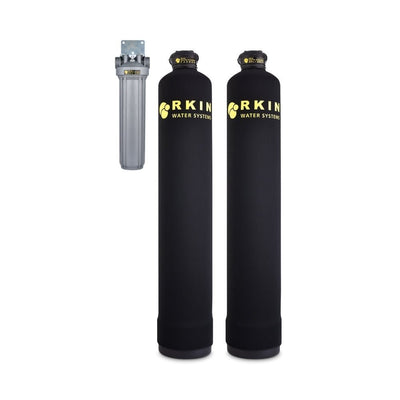
For homeowners comparing salt-free conditioning, the RKIN OnliSoft Salt-Free Water Conditioner System is the starting point. It is a whole-home salt-free conditioner for scale control without a brine tank.
If you also want whole-home carbon filtration, compare the RKIN OnliSoft Pro Salt-Free Water Conditioner and Whole House Carbon Filter System. It pairs salt-free conditioning with carbon filtration for homes where scale and general whole-home filtration are both part of the decision.
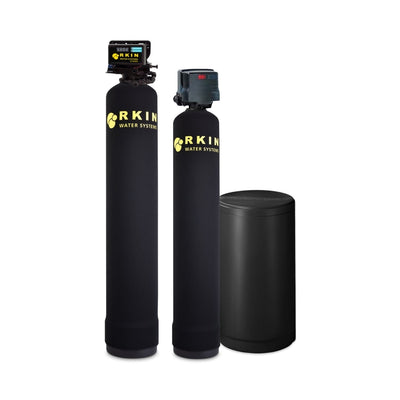
If your water test shows you need traditional hardness reduction, compare the RKIN Water Softener System. If you are still sorting out the right category, review RKIN whole-home treatment options and match the system to your water report.
Set Expectations Before Installation
Do not buy based only on shower-door spots. Spots can come from hardness, high total dissolved solids, silica, detergent, or dishwasher settings. A hardness test tells you whether you are solving the right problem.
Do not expect a salt-free conditioner to produce the same lab result as a softener. If a sales page or installer does not explain that difference clearly, slow down.
Do not ignore iron and manganese. If your water leaves orange, brown, or black stains, hard water may not be the only issue. EPA lists iron and manganese under secondary standards because they can affect color, taste, sediment, and staining EPA secondary standards.
Do not install a system before knowing where it fits. Whole-home systems usually belong near the main water line after any required pressure tank, shutoff, or prefilter location. The right layout depends on city water versus well water, plumbing space, pressure, and whether other treatment equipment is already installed.
Define the Outcome in Measurable Terms
Write down the symptoms you want to change: scale adhesion on fixtures, water-heater deposits, soap performance, spotting, or a laboratory hardness value. These are related but not identical outcomes.
An ion-exchange softener removes hardness ions by exchanging them, typically for sodium or potassium. SAC conditions hardness minerals into forms intended to reduce adhesion while leaving the minerals in the water.
- Test incoming hardness and note flow requirements.
- Decide whether the goal is mineral removal or reduced scale adhesion.
- Do not use TDS as proof that SAC removed hardness.
- Confirm pretreatment and water-quality limits in the manual.
- Inspect fixtures and equipment on a set schedule after installation.
For private wells or challenging chemistry, check iron, manganese, sediment, pH, and other conditions that may affect equipment selection and pretreatment.
Review Scale Where It Actually Forms
Choose repeatable inspection points such as a showerhead, faucet aerator, glass surface, and water-heater service record. Photograph them before installation and at regular intervals. Because SAC does not lower measured hardness, changes in scale adhesion and equipment maintenance are more relevant than expecting a lower hardness or TDS reading.
Frequently Asked Questions
Does SAC remove calcium and magnesium?
No. SAC conditions hardness minerals to help reduce scale adhesion; it does not remove calcium or magnesium.
Will a hardness test read lower after SAC?
Usually not, because the hardness minerals remain present even though their scale-forming behavior is being conditioned.
Is SAC the same as ion-exchange softening?
No. Ion exchange removes hardness ions, while SAC is a salt-free scale-conditioning process.
Does SAC lower TDS?
No. It is not a dissolved-solids removal process.
When is a traditional softener a better fit?
It may be a better fit when the goal is measured hardness removal or classic softened-water behavior, subject to local rules and water chemistry.
Match OnliSoft to a Scale-Control Goal
RKIN OnliSoft uses seed-assisted crystallization to condition hardness minerals and help reduce scale adhesion. It does not remove calcium, magnesium, hardness, or TDS. Confirm incoming-water limits and sizing for the exact installation.






0 comments