




countertop-filters
What Is TDS in Drinking Water and Why Does It Matter?

You dip a TDS meter into your tap water and watch the number climb — 180, 290, 430. The display stops and blinks. Now what? Most people have no idea whether that number means their water is fine, concerning, or flat-out bad. And the vague answers online — "above 500 is bad," "minerals are good," "just buy a filter" — don't help much.
TDS is one of the most misunderstood measurements in water quality. It's not a contaminant itself. It doesn't tell you what's in your water. But it does tell you something, and knowing how to read it — and act on it — is worth understanding before you make any decisions about filtration.
What TDS Actually Means (and What It Doesn't)
TDS stands for total dissolved solids. It's a measurement — expressed in parts per million (ppm) or milligrams per liter (mg/L) — of everything dissolved in your water that isn't H₂O itself.
That includes:
- Minerals like calcium, magnesium, and sodium
- Metals like iron, manganese, and sometimes lead or arsenic
- Chlorides, sulfates, and nitrates from agricultural runoff or municipal treatment
- Chlorine byproducts (disinfection byproducts, or DBPs) from water treatment
- Trace organics from pipes, soil, or industrial sources
A TDS meter doesn't distinguish between any of these. It measures electrical conductivity — dissolved ions carry a charge, and the meter uses that to estimate concentration. A reading of 250 ppm could be mostly calcium (generally harmless at that level) or it could include elevated nitrates and chloramines. The number alone won't tell you which.
The EPA's secondary standard for TDS is 500 ppm (U.S. EPA, Secondary Drinking Water Standards). That's a recommendation for taste and aesthetics, not a health threshold. Water utilities aren't legally required to keep TDS below 500 ppm — they're required to test for specific contaminants at their own limits, which is a different thing entirely.
So what does a high TDS reading actually tell you? It tells you there's a lot of something dissolved in your water. It's a flag, not a diagnosis. The right follow-up is either a full water test (mail-in lab tests typically run a detailed panel) or, if you already know your area's water quality issues, a targeted filter choice.
Where do those dissolved solids come from? Several places:
- Your water source — groundwater naturally picks up minerals from rock and soil. Surface water picks up more agricultural and industrial runoff.
- Your municipal system — treatment adds chlorine, chloramines, and sometimes fluoride, all of which contribute to TDS.
- Your pipes — older copper or galvanized pipes can add metals downstream of the utility's treatment plant, which means your home's TDS can be higher than what the city reports.
Why Most Filters Barely Touch TDS
This is where a lot of people run into frustrating surprises.
They buy a pitcher filter — a name-brand one with a respected logo on the box — fill it up, test the water, and find the TDS reading is nearly identical to what came out of the tap. Same story with fridge filters. Same story with basic faucet-mounted carbon filters.
That's not a defect. Those filters are doing what they're designed to do: reduce chlorine taste and odor, capture some sediment, and in better models, reduce specific contaminants like lead or VOCs. They are not designed to reduce TDS. Carbon filtration works through adsorption — contaminants stick to the carbon surface as water passes through. Dissolved minerals and salts don't stick. They pass right through.
Boiling water has a similar problem, except worse. Boiling kills biological contaminants — bacteria, some viruses — but it actually concentrates TDS because evaporation removes water while leaving dissolved solids behind. If you boil tap water and test the cooled result, TDS often goes up.
Softeners are a common misconception too. A water softener replaces calcium and magnesium ions with sodium ions through an ion exchange process. TDS stays roughly the same — the minerals change, but the total concentration doesn't drop significantly. Softened water often reads a similar TDS to hard tap water.
The only filtration technology that reliably reduces TDS — across a wide range of dissolved solids — is reverse osmosis.
How Reverse Osmosis Reduces TDS
Reverse osmosis (RO) works by forcing water through a semi-permeable membrane under pressure. The membrane's pores are small enough — around 0.0001 microns — to block dissolved ions and molecules while allowing water molecules to pass through. What gets left behind is flushed away as concentrate. What comes through is water with dramatically reduced TDS.
A well-maintained RO system typically removes 90–99% of total dissolved solids (Water Quality Association, Reverse Osmosis Overview). That means water testing at 400 ppm coming in can drop to 10–40 ppm at the output.
What RO removes:
- Dissolved salts and minerals (calcium, magnesium, sodium, potassium)
- Heavy metals (lead, arsenic, chromium-6, barium)
- Nitrates and nitrites
- Fluoride
- Chlorine and chloramines (when paired with carbon pre-filters)
- Disinfection byproducts
What it doesn't remove well:
- Some dissolved gases (like CO₂, which affects pH but not TDS)
- Certain pesticides and herbicides at very low concentrations (depends on membrane quality)
- Bacteria and viruses — though most RO systems include pre-filters that handle these
RO systems come in two main configurations: countertop and under-sink. Both produce the same membrane-filtered output. The difference is installation — countertop units connect to your faucet or have a fill tank with no plumbing required, while under-sink units tap into your cold water line and store filtered water in a tank.
One thing to plan for: RO does produce wastewater. For every gallon of purified water, a typical system flushes some volume of concentrate down the drain. Modern systems have improved significantly on this ratio, though older designs run higher.
TDS is a useful verification tool for RO performance. Testing your output water monthly is a good way to know when your membrane needs replacing — if your previously low-TDS output starts creeping up, it's time to swap the membrane.
RKIN Systems Built for TDS Reduction
All three of our RO systems use multi-stage filtration with a high-rejection membrane at the core. Here's how to think about which one fits your setup.
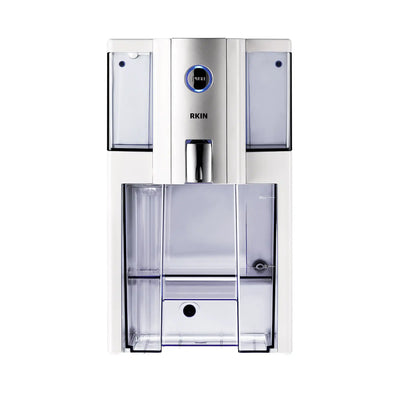
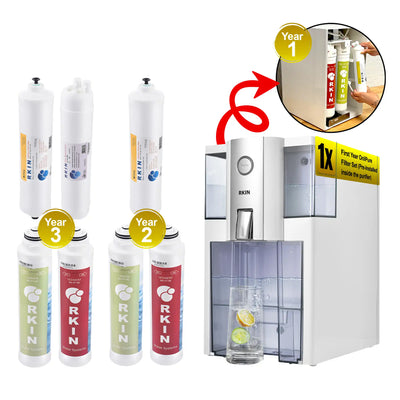
RKIN Zero Installation Purifier — If you rent, travel, or just don't want to touch your plumbing, this is the one. It sits on your countertop and connects to your existing faucet in minutes — no drilling, no plumber, no tools beyond what's in the box. It draws directly from your tap, runs water through the RO membrane and carbon stages, and delivers filtered water on demand. TDS reduction is consistent with what you'd expect from a full membrane system.
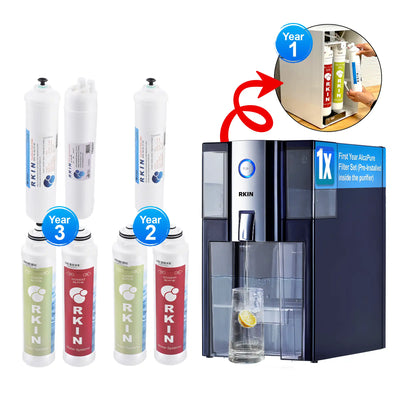
RKIN U1 4-in-1 Water Filter System — The U1 is also a countertop unit — plug in and go, no plumbing involved. The key difference is the built-in fill tank, so filtered water is ready when you want it rather than produced on demand. It combines four stages of filtration in a compact design. Good choice if your household goes through a lot of water and you want a reservoir ready. No installation, no plumber — just a countertop spot and an outlet.
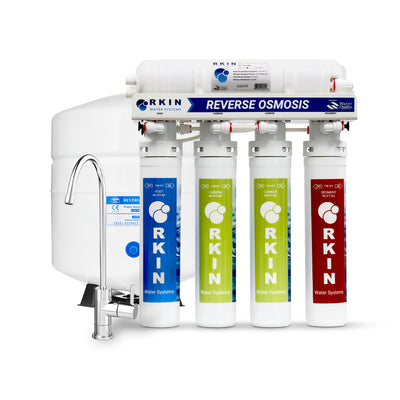
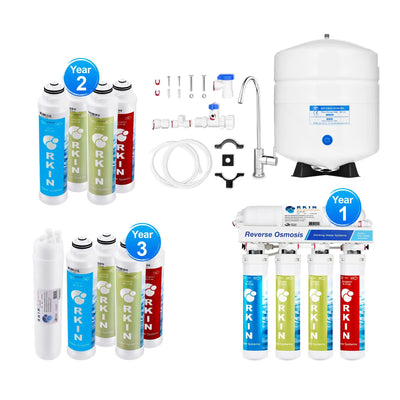
RKIN Flash Undersink RO System — This one goes under the sink, taps into your cold water line, and keeps a 3.2-gallon storage tank ready so you're not waiting for the membrane to produce water in real time. If you cook a lot, fill a kettle often, or want filtered water at the faucet without anything on the counter, this is the cleaner solution. It does require a bit of installation — connecting to the supply line and running a line to a dedicated faucet — but it's a one-time setup.
All three meaningfully reduce TDS. The right one depends on whether you want countertop convenience or an under-counter setup with a dedicated faucet.
Frequently Asked Questions
What is a good TDS level for drinking water?
The EPA's secondary recommendation is below 500 ppm, but most people find water with TDS below 150–200 ppm tastes noticeably cleaner. RO-filtered water often comes out below 50 ppm. There's no single "ideal" number — it depends on what's contributing to your TDS and your personal preference for taste.
How do I test TDS in my tap water?
A TDS meter is an inexpensive tool (typically a small handheld probe) that reads dissolved solids by measuring electrical conductivity. Dip it in a glass of water, wait a few seconds, and read the ppm on the display. For a breakdown of what is in your water — not just how much — you'll want a certified lab test. NSF-certified labs can test for specific contaminants at your request.
Does a high TDS reading mean my water is unsafe?
Not necessarily. High TDS often means high mineral content — calcium and magnesium in hard water areas are common contributors. The number alone doesn't indicate safety. Unsafe water can also have relatively low TDS if the contaminants (like certain pesticides or bacteria) don't significantly affect conductivity. TDS is a screening tool, not a safety certification.
Will a pitcher filter lower my TDS?
No. Pitcher filters use activated carbon, which reduces chlorine taste and odor and some contaminants. They do not remove dissolved minerals or salts. Your TDS reading will be essentially the same before and after pitcher filtration. For meaningful TDS reduction, reverse osmosis is the standard method.
How often should I test TDS after installing an RO system?
Monthly testing of your output water is a reasonable habit. A baseline reading right after installing gives you a reference point. If TDS starts climbing — say, from 20 ppm to 80 ppm or higher — that's a signal your membrane may be approaching the end of its effective life and should be replaced. Filter stage replacements (pre-filters, post-filters) are typically on a 6–12 month schedule depending on your water quality and usage.
Ready to Know What's in Your Water?
A TDS meter tells you a lot in about 30 seconds. If your reading is high, the next question is what's causing it — and whether the filtration you have can address it.
RO is the clearest path to meaningful TDS reduction. We build our systems for real homes, with options that don't require a plumber, a drill, or a weekend of YouTube tutorials. If you're not sure which one fits your setup, we're straightforward about the tradeoffs — the goal is getting you the right system, not the most expensive one.
See the Zero Installation Purifier | See the U1 4-in-1 System | See the Flash Undersink RO System





0 comments