


hard water calculator
What Size Water Softener Do I Need? Homeowner Guide

The size of water softener you need depends on three numbers: your water hardness, how many people use water in the home, and how much water the home uses per day. If you guess, you can undersize the system and run out of soft water.
A softener is not sized by square footage. A three-bath home with very hard water can need more capacity than a larger home with only moderate hardness.
What does water softener size actually mean?
Water softener size usually refers to grain capacity. One grain is a unit used to measure hardness minerals, mainly calcium and magnesium. The more hardness your home uses in a week, the more capacity the softener needs between regeneration cycles.
The U.S. Geological Survey defines water hardness as the amount of dissolved calcium and magnesium in water. USGS also notes that hard water is not usually a health concern, but it can be a nuisance: spots on dishes, soap scum, mineral buildup, and lower performance from soaps and detergents.
That is the everyday reason sizing matters. You are not just trying to hit a lab number. You are trying to keep the home from cycling between “soft enough” and “why are the glasses cloudy again?”
Seasonal use matters too. Summer guests, extra laundry, irrigation mistakes, and school breaks can raise water use for weeks at a time. A system sized only for the quietest month may feel fine in February and then struggle during the months when the house is full. That does not mean you need the biggest tank available. It means your estimate should reflect real use, not the smallest possible use.
Step 1: Find your hardness number
Start with a current hardness test. City-water customers can often find hardness in a water quality report or by calling the utility. Well-water customers should test because groundwater can change by property and by aquifer.
Hardness may be reported in milligrams per liter as calcium carbonate, parts per million, or grains per gallon. If your report gives mg/L or ppm, divide by 17.1 to estimate grains per gallon.
Use the USGS hardness ranges as a plain-English guide:
- 0 to 60 mg/L: soft
- 61 to 120 mg/L: moderately hard
- 121 to 180 mg/L: hard
- More than 180 mg/L: very hard
For sizing a softener, grains per gallon is the number you want. A home at 5 grains per gallon and a home at 20 grains per gallon should not be treated the same.
Step 2: Estimate daily water use
A simple planning number is 60 to 75 gallons per person per day. Your actual use may be lower or higher depending on showers, laundry, irrigation tied into the home, guests, and how often you run water-heavy appliances.
Here is the basic formula:
People in home × gallons per person per day × hardness in grains per gallon = grains used per day.
Example: four people × 75 gallons × 15 grains = 4,500 grains per day.
Then multiply by the number of days you want between regeneration cycles. Many homes are planned around about a week, but the right interval depends on the equipment and water profile.
Using the example above: 4,500 grains per day × 7 days = 31,500 grains of working demand.
This is why a “family of four” answer is incomplete. The family size matters, but hardness changes the whole calculation.
Step 3: Account for iron, manganese, and real-world margin
If you are on city water with hardness only, the formula may be fairly direct. If you are on a private well, sizing can get more layered.
Iron and manganese can affect softener performance and may need separate treatment. EPA’s private-well guidance says wells can be affected by naturally occurring sources, groundwater movement, surface water seepage, runoff, flooding, septic leakage, agriculture, and nearby residential or industrial activity.
That does not mean every well has a problem. It means well water deserves a test before equipment is selected.
Build in a margin so the system is not running at its edge. A softener that is too small may regenerate too often, waste salt and water, and still leave hard-water symptoms when demand spikes. A unit that is far oversized may not be the cleanest answer either.
The target is a system sized to the water and the household without excess capacity or frequent regeneration.
What if I want salt-free conditioning instead?
This is where wording matters. A traditional salt-based softener removes hardness minerals through ion exchange. A salt-free conditioner does not remove calcium and magnesium the same way. It is built to reduce scale behavior, not to make a lab report show “soft” water.
That distinction matters for homeowners comparing options.
If your goal is classic soft-water feel, reduced soap scum, and hardness removal, a salt-based softener is the usual fit. If your main goal is scale control with no salt handling and no regeneration cycle, a conditioner may be worth considering.
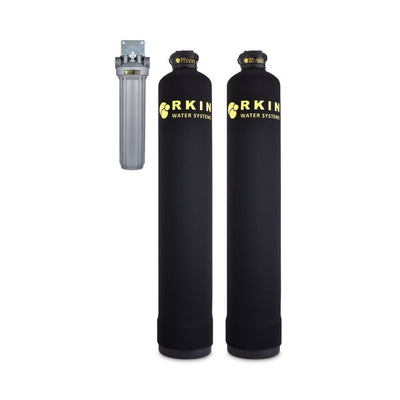
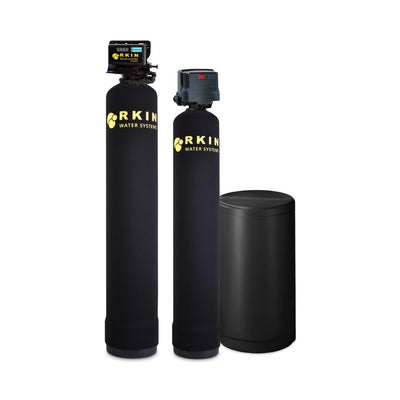
The RKIN Whole House Salt-Based Water Softener System is the classic softening path for hard water. The RKIN OnliSoft Pro Salt-Free + Carbon Combo is a different path for homeowners who want scale control plus whole-home carbon filtration without a salt-based softener.
Me personally, I would not choose between those two until I knew the hardness number and what the homeowner actually dislikes: spots, scale, chlorine taste, dry-feeling shower water, or all of it.
Common sizing mistakes homeowners make
The first mistake is using bedrooms instead of water use. Bedrooms are a rough proxy for occupancy, but they do not measure showers, laundry, or guests.
The second mistake is using a stale hardness number. If you moved in recently, inherited an old test, changed wells, or had plumbing work done, get a fresh number.
The third mistake is ignoring flow rate. Capacity tells you how much hardness the system can handle between cycles. Flow rate tells you whether the home can run showers and fixtures at the same time without pressure complaints.
The fourth mistake is treating well water like city water. Well water may include hardness, iron, manganese, sediment, sulfur odor, low pH, or other local concerns. A softener might be part of the answer, not the whole answer.
The fifth mistake is forgetting maintenance. Every softener needs the right settings, salt habits, and service access. If the system is sized well but set poorly, the home can still get poor results.
A simple sizing worksheet
Use this as a starting point before you talk to a water specialist.
- Household size: number of people using water daily.
- Daily use assumption: 60 to 75 gallons per person per day unless you have better data.
- Hardness: grains per gallon from a test or utility report.
- Daily grain demand: people × gallons × grains per gallon.
- Weekly demand: daily grain demand × 7.
- Other concerns: iron, manganese, sulfur odor, sediment, pH, chlorine taste, or staining.
If you can fill out those six lines, the conversation gets much easier. The reason I am asking for those details is because the right system is usually obvious once the water and usage are clear.
Frequently Asked Questions
What size water softener do I need for a family of four?
A family of four often starts by estimating daily use, then multiplying by hardness. For example, four people using 75 gallons per person per day with 15 grains per gallon hardness equals 4,500 grains per day. Multiply by your target days between regeneration cycles to estimate working demand.
Is a bigger water softener always better?
No. A too-small softener may regenerate too often or fail to keep up, but bigger is not automatically better. The better target is enough capacity for your hardness, household use, flow needs, and service plan.
How do I convert ppm hardness to grains per gallon?
Divide ppm or mg/L by 17.1. For example, 171 mg/L as calcium carbonate is about 10 grains per gallon. This conversion helps because many softener sizing formulas use grains per gallon.
Do I need a softener if I already have a whole-house carbon filter?
Maybe. Carbon filtration and softening solve different problems. Carbon is commonly used for taste, odor, and certain chemical reduction goals. A softener is built for hardness minerals. If you have scale or soap scum, check your hardness number.
Should well water be tested before sizing a softener?
Yes. CDC recommends annual private well testing for total coliform bacteria, nitrates, total dissolved solids, and pH, and local conditions may call for more tests. For softener sizing, you also need hardness and should check for iron or manganese.
Ready to Size the Right System?
If you know your hardness, household size, and daily water use, you are already most of the way there. The next step is matching those numbers to the system type that fits your home.
Start with the RKIN Whole House Salt-Based Water Softener System if your main issue is hard water, or compare it with RKIN OnliSoft Pro Salt-Free + Carbon Combo if scale control plus carbon filtration is the better fit.





0 comments