


countertop reverse osmosis
Does Reverse Osmosis Remove Nanoplastics from Water?

Reverse osmosis may reduce very small plastic particles, but exact nanoplastic performance requires testing of the specific system and particle-size range. Do not treat the technology name as a universal nanoplastics certification.
Why are homeowners asking about nanoplastics now?
Nanoplastics became a bigger search topic after a 2024 Columbia University summary of a PNAS study reported that researchers found an average of about 240,000 detectable plastic particles per liter in several bottled water samples. Most of those particles were in the nano-size range, which means they were far smaller than the microplastics people usually talk about. The source was bottled water, not every glass from every tap, but the headline changed how people think about "clean" water. If bottled water can carry tiny plastic particles, buying cases of it is not an automatic upgrade.
The timing matters because homeowners are also paying closer attention to PFAS, lead, chloramine, and taste issues. The EPA finalized enforceable drinking-water limits for several PFAS compounds in 2024, and that made water quality feel less theoretical. People are no longer asking only whether water looks clear. They are asking what a filter can actually remove.
That is the right question. A plain pitcher may help with chlorine taste. A refrigerator filter may improve odor. Reverse osmosis is different: it pushes water through a very tight membrane, then uses supporting filters to handle taste, odor, and certain chemicals before or after the membrane.
What are microplastics and nanoplastics?
The simple version: microplastics are small plastic pieces, often defined as smaller than five millimeters. Nanoplastics are smaller still. NOAA explains microplastics as tiny plastic pieces found in the environment, while the World Health Organization's 2019 drinking-water review noted that the science on plastic particles in drinking water was still developing.
That last point is important. Some content online frames nanoplastics like a fully solved home-filter claim. It is not that simple. Testing methods are improving, particle sizes vary, and not every certification label is built around nanoplastics specifically.
So the practical homeowner question is not, "Can I buy a filter with one magic nanoplastic badge?" It is this: "Which filtration approach gives me the strongest overall reduction path for very small particles and the other contaminants I care about?"
For many kitchens, that makes reverse osmosis a category worth comparing. Product-specific data still has to name the contaminant or particle range; a broad technology description cannot establish performance for dissolved chemicals and particles alike.
Does reverse osmosis remove nanoplastics?
Reverse osmosis can reduce many tiny particles because the membrane is far tighter than the pores used in basic carbon filters. The membrane is the main reason RO systems are used when people want broad contaminant reduction instead of only better taste.
Here is the careful wording: a reverse osmosis system should not be described as "certified for every nanoplastic particle" unless that exact system has that exact test. But if you are choosing between common home options, RO is the more serious tool for very small particle reduction.
Think of it this way. A carbon filter is like a sponge for certain chemicals and taste problems. It can do a very useful job, especially for chlorine taste and odor. A reverse osmosis membrane is more like a very fine gate. Water molecules pass through; many larger particles and dissolved contaminants are left behind and sent to the drain stream.
That does not make every RO unit equal. Flow rate, filter order, membrane quality, holding tank design, maintenance, and replacement filters all matter. If a system is old, unmaintained, or built with weak seals, performance drops. The label matters less than the full design.
What does not work well for this problem?
Boiling water is not a nanoplastic removal strategy. It can be part of an emergency boil-water notice, but boiling does not make plastic particles disappear from the water. If anything, boiling can concentrate non-volatile material as water evaporates.
Basic pitcher filters are useful for taste, but they are not the same as reverse osmosis. Some pitchers use activated carbon and ion exchange resin. That can be a good fit for chlorine taste or certain metals, depending on the model, but it is not the strongest path for broad particle and dissolved-solid reduction.
Bottled water is also not a clean answer. The 2024 bottled-water research is the reason many people are searching this topic in the first place. Bottled water can be useful during emergencies or travel, but using it every day creates storage, plastic waste, and replacement friction. Me personally, in my house I would rather filter the water where I use it than carry water home and hope the bottle is better.
That does kind of clarify the choice: if the concern is tiny particles plus a broader list of tap-water contaminants, start with RO, then check the details of the specific system.
What should you look for in a home RO system?
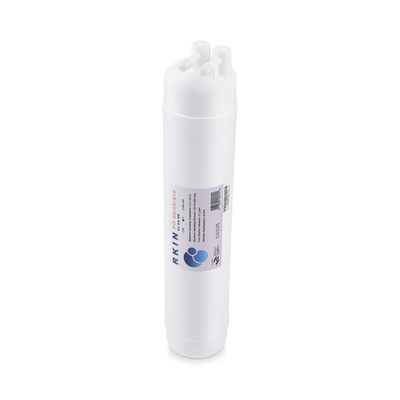
First, look for a real reverse osmosis membrane, not just a carbon block with "advanced" language around it. RO is a specific process. Marketing words are not a substitute for the membrane.
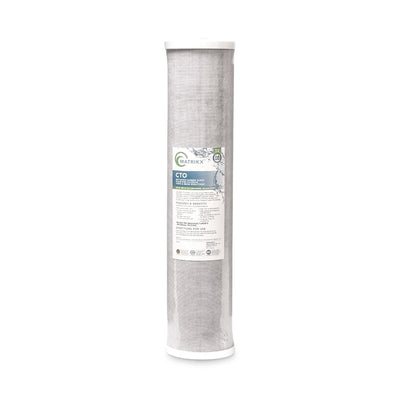
Second, look for supporting filtration. A carbon prefilter can help with chlorine and protect the membrane. A post-filter can improve taste after water leaves the storage tank or internal reservoir. Some systems add UV or remineralization, but the core RO path still matters most.
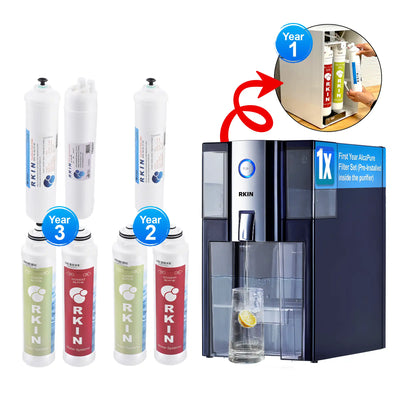
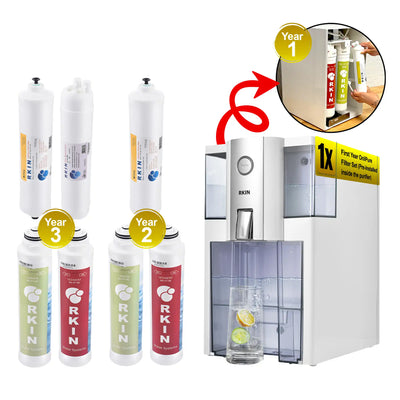
Third, check the product's actual contaminant claims. For example, RKIN's Zero Installation Purifier is certified by IAPMO R&T to NSF/ANSI 58 for reduction of TDS, fluoride, lead, hexavalent chromium, and trivalent chromium. That is a specific claim, not a vague "clean water" promise.
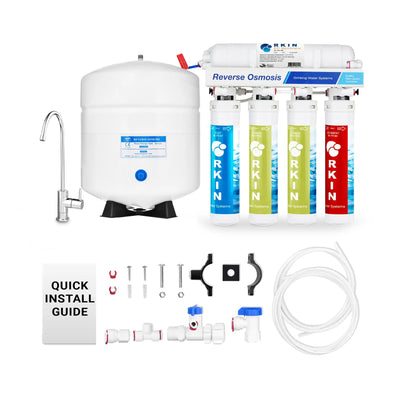
Fourth, match the system to your living situation. If you own the home and want a permanent under-sink setup, an under-sink RO system may make sense. If you rent, live in an apartment, or do not want plumbing changes, a countertop RO system is often the easier path.
Finally, keep maintenance realistic. A filter that never gets replaced is not a filter plan. Before you buy, check how replacement filters work, where the water is filled, and whether the system fits your daily routine.
Where RKIN fits
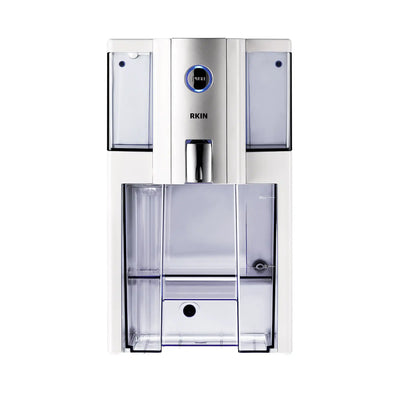
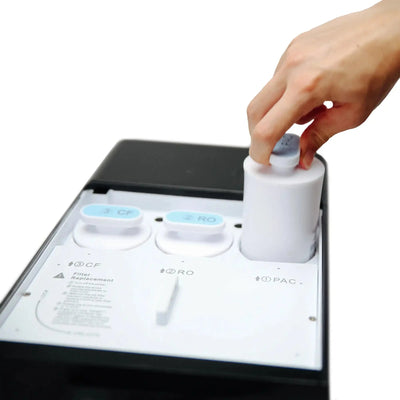
This is what the RKIN Zero Installation Purifier Countertop Reverse Osmosis Water Filter is designed for: people who want RO-quality drinking water without drilling into the sink cabinet. It sits on the counter, uses reverse osmosis, and gives renters or homeowners a no-plumbing option.
The front-fill design matters more than most people think. You are not lifting a heavy tank above shoulder height just to refill it. That is one of those daily-use details that decides whether a system becomes part of the kitchen or gets ignored after two weeks.
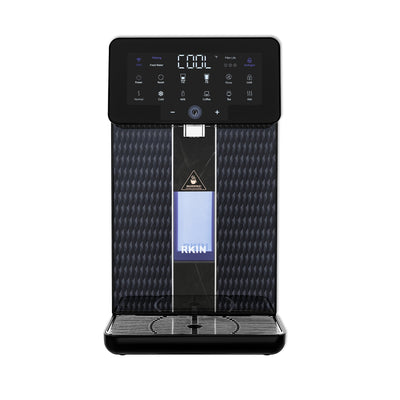
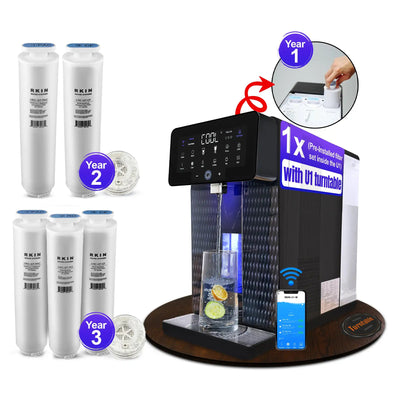
If you want app-enabled controls, UV storage-water treatment, remineralization, and hot and cold dispensing, the RKIN U1-W Space-Saving 4-in-1 Water Filter System is another no-plumbing countertop RO option. No current system certification or model-specific nanoplastics claim was verified for this article.
What about PFAS, lead, and taste?
Nanoplastics may be the new headline, but most homes have more than one concern. PFAS is a good example. The EPA's 2024 PFAS rule set maximum contaminant levels for several PFAS compounds, including PFOA and PFOS. If your city water report or private testing shows PFAS, you should choose a system based on that actual contaminant, not only on plastic-particle anxiety.
Lead is different again. It can come from plumbing, service lines, fixtures, or older components in the home. EPA's lead information page explains that lead in drinking water is commonly tied to corrosion of plumbing materials. A filter decision should be based on where the risk is coming from.
Taste and odor are a separate layer. Chlorine taste does not prove water is unsafe, and clear water does not prove it is free of contaminants. That is why a good home filter choice starts with the water problem, then matches the technology to the job.
Frequently Asked Questions
Does reverse osmosis remove microplastics?
Reverse osmosis may reduce many microplastic particles, but exact performance depends on the tested particle-size range, complete-system design, membrane condition, seals, and maintenance. Ask for particle-specific test data rather than assuming performance from the technology alone.
Does reverse osmosis remove nanoplastics?
RO is a practical category to investigate for very small particles, but only a system-specific test can establish nanoplastic performance and particle-size limits. Compare documented results instead of assuming every RO system performs the same way.
Is bottled water safer than filtered tap water?
Not automatically. A 2024 Columbia University summary of bottled-water research reported roughly 240,000 detectable plastic particles per liter in several bottled water samples. Bottled water can help in emergencies, but daily use is not a guaranteed upgrade. Filtering water at the point of use is often a more practical routine.
Do carbon filters remove nanoplastics?
Carbon filters can improve taste and reduce certain chemicals, depending on the design. They are not the same as reverse osmosis. If your main concern is very small particles plus dissolved contaminants, use carbon as part of a system, not as the whole plan.
Which RKIN system should I choose for this issue?
For no-plumbing reverse osmosis, compare the RKIN Zero Installation Purifier with the RKIN U1-W Space-Saving 4-in-1 Water Filter System by size, dispensing features, post-treatment, and current performance documents. Neither product should be described as a nanoplastics solution without model-specific test data.
Sources
- Columbia Climate School, 2024 bottled-water nanoplastics summary
- NOAA: What are microplastics?
- World Health Organization: Microplastics in drinking-water
- EPA: PFAS in drinking water
- EPA: Basic information about lead in drinking water
Ready to filter water where you actually use it?
If nanoplastics made you rethink bottled water, compare current particle-specific test data before choosing a kitchen system. Start with the RKIN Zero Installation Purifier Countertop Reverse Osmosis Water Filter if you want countertop RO without plumbing changes.





0 comentarios