




aquatru
Countertop RO Comparison: Zero Installation Purifier vs AquaTru Classic (2026)

If you're renting an apartment and want cleaner drinking water, you've probably spent too long reading conflicting specs and forum arguments. Most countertop RO comparisons either skip the products you're actually considering or bury the important differences in marketing copy.
This breaks down the two most common countertop RO systems — the RKIN Zero Installation Purifier and the AquaTru Classic — on the specs that actually matter for apartment living: footprint, certifications, PFAS removal, filter costs, and how they actually work day-to-day. One of those day-to-day differences — how you actually load water into each system — turns out to matter more than most reviews cover. We also address the Waterdrop X12, since it keeps coming up in comparison searches — and explain why it's in a completely different product category.
How Countertop Batch-Fill RO Systems Work
Both the Zero Installation Purifier and the AquaTru Classic are batch-fill systems. That means you fill a reservoir with tap water, press a button (or the system cycles automatically), and the RO membrane pushes purified water through into a clean tank. There's no continuous flow — you're producing and storing purified water in small batches.
This is different from under-sink tankless systems, which filter water on demand as you run the tap. Batch-fill countertop systems trade flow rate for installation simplicity — you get RO-quality water with no plumbing work and no cabinet modifications.
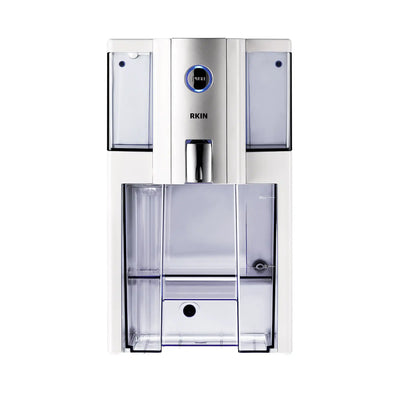
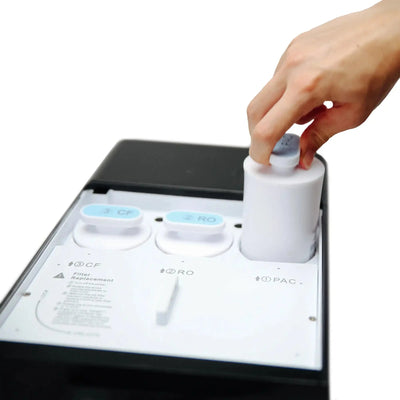
Where these two systems differ in daily use is how you refill the input reservoir. The Zero Installation Purifier uses a front-facing reservoir — you slide or pour water in from the front of the unit at counter height, no lifting required. The AquaTru Classic uses a top or rear reservoir that requires lifting a full gallon of water up and over the unit to fill it. That loading difference is small in description but significant in practice, especially for anyone with limited mobility, back pain, or who fills the unit multiple times per day.
The Side-by-Side
| Spec | RKIN Zero Installation Purifier | AquaTru Classic |
|---|---|---|
| Price | See rkin.com for current pricing | $475 |
| Water loading | Front-loading — no lifting required | Top/rear-loading — lift full gallon to shoulder height daily |
| Dimensions (W×D×H) | 9.5" × 14.5" × 16.25" | 15.5" × 14.5" × 16.5" |
| Clean water output per cycle | ~0.5 gal | 0.75 gal |
| Filtration stages | Multi-stage RO | 4-stage (pre-filter, carbon, RO, VOC carbon) |
| Certification | NSF/ANSI 58 (IAPMO R&T) | NSF/ANSI 58 |
| PFAS reduction | Yes — PFOA/PFOS certified | Yes — PFOA/PFOS certified |
| Other certified reductions | TDS, Fluoride, Lead, Chromium-6 | Lead, Chlorine, Fluoride, Nitrates, Arsenic, VOCs |
| Water recovery (drain ratio) | 1:1 (50% recovery) | ~50% or lower (varies by cycle) |
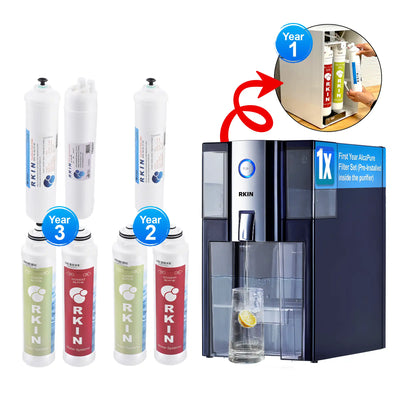
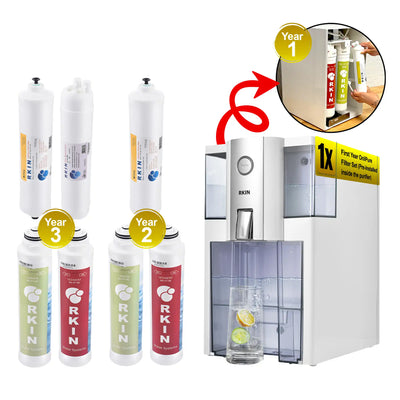
| Edition options | AlcaPure (alkaline pH, remineralized) or OnliPure (zero TDS) | Standard only |
| Power | 24W, standard outlet | Standard outlet |
| BPA-free | Yes | Yes |
| Warranty | 1-year satisfaction guarantee | Verify on aquatruwater.com |
Where the Zero Installation Purifier Has an Edge
Front-loading design — no heavy lifting. The Zero Installation Purifier loads water from the front of the unit at counter height. You simply slide or pour tap water into the front-facing reservoir without lifting, tilting, or hoisting anything over the unit. The AquaTru Classic requires you to lift a full gallon — roughly 8+ pounds — up and over the unit to pour it into a reservoir at the top or rear. That's near shoulder height, at least once per day.
That distinction matters a great deal for some users. Older adults and anyone with joint pain, arthritis, or limited upper body strength may find top-loading systems genuinely difficult to use consistently. Children can't safely fill a top-loading unit at all. People managing back injuries or recovering from surgery often cite the daily lifting requirement as the reason they stopped using a competing system. The Zero Installation Purifier's front-loading design eliminates that friction entirely — refilling takes the same effort as filling a glass of water from the tap.
Smaller footprint. At 9.5 inches wide, the Zero Installation Purifier is noticeably more compact than the AquaTru Classic at 15.5 inches. On a studio apartment counter where every inch matters, that difference is real. Both are the same depth and close to the same height, but the width gap means the Zero Installation Purifier fits in spaces where the AquaTru Classic won't.
Alkaline remineralized option. The AlcaPure edition adds a small amount of calcium and magnesium back into the purified water, bringing pH to 7–8 and making the water taste closer to bottled mineral water. AquaTru Classic doesn't offer this — it's standard RO output only. If you want the taste of alkaline water without a separate remineralization filter, this matters.
Price. The Zero Installation Purifier is priced well below the AquaTru Classic's $475. Given both are NSF/ANSI 58 certified for PFAS, fluoride, and lead reduction, you're getting the core filtration performance for significantly less. See rkin.com for current pricing.
Where AquaTru Classic Has an Edge
Slightly larger clean water reservoir. The AquaTru Classic stores 0.75 gallons of purified water versus approximately 0.5 gallons for the Zero Installation Purifier. If your household drinks a lot of water before the next cycle, that extra quarter-gallon matters.
4-stage filtration with dedicated VOC carbon. The AquaTru Classic adds a fourth stage specifically for VOCs (volatile organic compounds) — chemicals like benzene, toluene, and chloroform that can appear in municipal water from industrial sources. The Zero Installation Purifier's RO membrane reduces many VOCs as part of the filtration process, but a dedicated VOC post-filter gives the AquaTru a specific cert claim for that contaminant category.
Third-party press recognition. Esquire named the AquaTru Classic "Best Water Purifier 2025." That kind of independent validation carries weight for buyers who rely on editorial coverage alongside technical specs.
What About the Waterdrop X12?
The Waterdrop X12 keeps showing up in comparison searches for countertop RO systems — but it belongs in a different category. The X12 is an undersink tankless system priced at $1,099 that requires under-sink installation, a dedicated faucet hole, and connection to your cold water line.
It's an excellent product in its category — 1,200 GPD output, UV sterilization, NSF/ANSI 42, 58, and 372 certifications, smart TDS display. But if you're renting or don't want to modify plumbing, the X12 is the wrong product entirely. The relevant Waterdrop comparison for countertop renters is the K16 or D6, not the X12.
The confusion is common because Waterdrop markets the X12 aggressively and it surfaces in general "countertop RO" searches. It's worth knowing before you spend time comparing specs across incompatible product categories.
Which One to Choose
- Elderly, have kids, or deal with back/joint pain: Zero Installation Purifier — front-loading means no heavy lifting over the unit daily.
- Renting, counter space is tight, want alkaline water: Zero Installation Purifier — smaller footprint, AlcaPure edition, priced below AquaTru Classic's $475.
- Want a larger clean water tank and dedicated VOC carbon stage: AquaTru Classic.
- Ready to install under-sink, want maximum throughput: Neither of these — look at the RKIN Flash Undersink RO System or the Waterdrop X12.
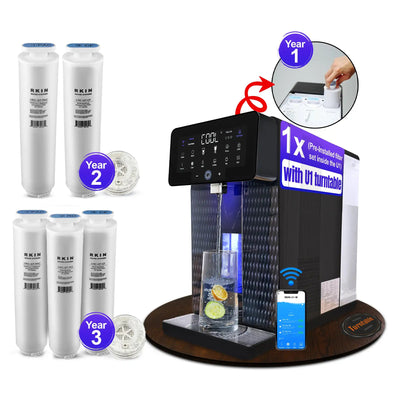
- Concerned specifically about PFAS: Both are NSF/ANSI 58 certified for PFOA and PFOS reduction. Either works. The RKIN U1 4-in-1 Water Filter System is also third-party tested for PFAS if you want a countertop system with app monitoring and UV.
If you want to see current pricing and configuration options for the Zero Installation Purifier, the RKIN product page has both AlcaPure and OnliPure editions. For questions about which system fits your specific water quality situation, the RKIN support team can help you think through it.
Frequently Asked Questions
Q: Is the Zero Installation Purifier easy to fill with water?
Yes. It uses a front-loading reservoir — pour water in from the front at counter height, no lifting required. Many competing systems require lifting a full gallon up and over the unit to reach a top or rear reservoir, which is a daily lift near shoulder height.
Q: Can I use a countertop RO system in an apartment?
Yes. Both the Zero Installation Purifier and AquaTru Classic need no plumbing — just fill the input tank and plug in.
Q: Does the Zero Installation Purifier reduce fluoride and PFAS?
Yes — NSF/ANSI 58 certified by IAPMO R&T for PFOA, PFOS, fluoride, lead, TDS, and chromium-6.
Q: What's the AlcaPure vs OnliPure difference?
AlcaPure adds Ca/Mg minerals back for alkaline pH 7–8 and mineral taste. OnliPure produces near-zero TDS, lab-grade purity. Same RO membrane and certifications for both.
Q: Is the Waterdrop X12 a countertop system?
No. The X12 is an undersink tankless RO at $1,099 — it requires under-sink installation. Not comparable to countertop batch-fill systems.
Q: Which has a bigger clean water tank — Zero Installation Purifier or AquaTru?
AquaTru Classic stores 0.75 gallons vs approximately 0.5 gallons for the Zero Installation Purifier. For high-volume households this may matter.





0 comments