








chlorine
Hard Water and Your Skin: What Dermatologists Are Starting to Say

A Reddit user recently posted something that stopped a lot of people: "My dermatologist asked if I have a water filter. I didn't. Now I do."
The full story — a patient went in thinking she had eczema. Her dermatologist, after the usual questions, asked one more: "Do you have a water filter?" When she said no, the doctor explained that chlorine and hard water minerals can disrupt the skin barrier, and that she now asks every patient with persistent dry skin or irritation.
Three weeks after installing a whole-house water system, the patient noticed her skin wasn't as tight after showers. Her wife's hair felt different. The dermatologist was right.
This isn't an outlier story.
What Hard Water Actually Does to Your Skin
Hard water contains high concentrations of dissolved calcium and magnesium minerals. When hard water hits your skin, those minerals don't rinse cleanly away — they leave a residue that interacts with soap to form a thin film called soap scum. That film sits on your skin.
Over time, that residue disrupts the skin's natural barrier function. The skin barrier — technically called the stratum corneum — is a protective layer that keeps moisture in and irritants out. When it's compromised, water evaporates faster from the skin surface, and irritants penetrate more easily.
A 2018 study published in the Journal of Investigative Dermatology found a significant association between hard water exposure and eczema risk in children. Researchers at King's College London concluded that hard water could damage the skin barrier and increase susceptibility to eczema-related conditions.
A separate 2021 clinical trial from the University of Sheffield compared participants who bathed in hard versus soft water over a four-week period. The soft water group showed measurably better skin hydration levels and a lower transepidermal water loss rate — a key marker of skin barrier health.
The Chlorine Factor
Mineral hardness isn't the only issue. Most municipal water contains chlorine or chloramines — disinfectants added to kill bacteria in the distribution system. Both are effective at their job. Both are also irritants.
Chlorine is a mild oxidizer. In the shower, where hot water opens pores and allows deeper skin penetration, chlorine exposure can strip natural oils from the skin. People with sensitive skin, rosacea, or a compromised skin barrier often notice the difference most acutely — tightness after showering, increased dryness in winter, or flare-ups that don't respond to lotion.
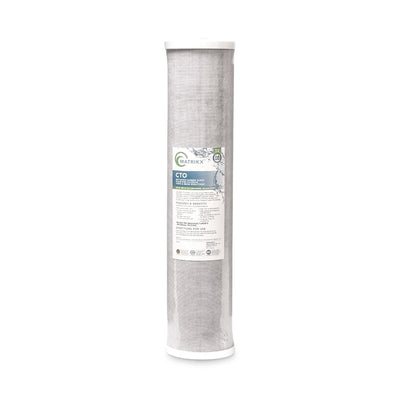
Chloramine (a compound of chlorine and ammonia now used by many municipalities) doesn't gas off like chlorine and is harder to remove with standard shower filters. A whole-house carbon filtration system handles both.
What the Research Shows About Soft Water and Skin
The King's College London research used a water softener intervention — switching participants from hard to soft water. The results were meaningful enough that the researchers called for further clinical investigation into water softening as an eczema management strategy.
It's worth being precise about what "soft water" means for skin. A salt-based water softener removes calcium and magnesium ions from the water entirely via ion exchange. The result is water that rinses cleanly, produces a good lather, and leaves no mineral film on skin or surfaces. This is the mechanism behind the improvements seen in clinical research.
A salt-free conditioner works differently — it restructures mineral crystals so they don't adhere to pipes and appliances, protecting your plumbing and water heater from scale buildup. What it does not do is remove minerals from the water. The mineral content stays the same, which means the soap scum effect on skin remains. A salt-free conditioner is a valuable plumbing protection tool, but it is not a skin solution.
Hard Water Levels in the US
Roughly 85% of US homes have hard water, according to the US Geological Survey. But hardness varies dramatically by region. The hardest water in the US tends to be in the Southwest, Midwest, and parts of the South — areas where groundwater passes through limestone and mineral-rich rock formations before it reaches your tap.
If you live in Florida, Texas, Arizona, Nevada, or the Great Plains states, your water hardness is almost certainly above the 120 mg/L threshold that starts showing noticeable effects on skin.
Your Options for Skin-Friendly Water
The right solution depends on what your water test shows. Hard water minerals and chlorine are two separate problems that may require different approaches — or a combination system that handles both.
If Your Main Problem Is Hard Water (High Mineral Content)
The RKIN Salt-Based Water Softener is the direct solution. It uses ion exchange to remove calcium and magnesium from your water supply before it reaches your showers, sinks, and washing machines. The result is true soft water — water that lathers easily, rinses completely, and leaves no mineral residue on your skin. This is the same mechanism used in the clinical research cited above.
This is important: a salt-free conditioner does not replicate these results. It protects pipes from scale, but it does not change the mineral content of your water or reduce the soap scum effect on skin. If the goal is skin improvement from hard water, a salt-based softener is what the evidence supports.
If You Want Soft Water Plus Chlorine Removal
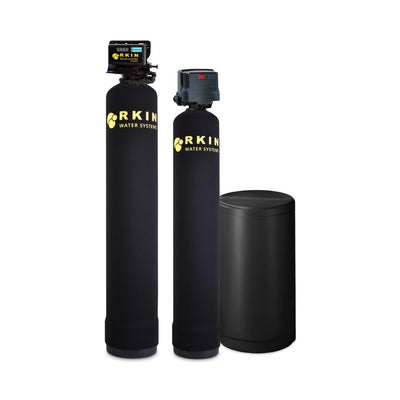
The RKIN Salt-Based Water Softener + Carbon Combo combines a salt-based softener with a whole-house carbon filter. The softener handles mineral removal. The carbon filter removes chlorine and chloramines before the water reaches your skin. This combination addresses both of the primary water-related skin irritants — hard water minerals and chemical disinfectants — in a single system.
If Your Water Is Soft but Chlorine Is the Issue
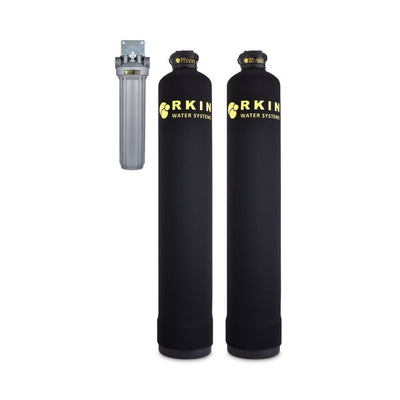
Some homes have naturally soft water or are already on a softener, but still deal with chlorine irritation from municipal treatment. In that case, a carbon filter alone may be enough. The RKIN CBS Dual Carbon Filter handles chlorine and chloramine removal for the entire home.
A Note on Salt-Free Conditioner Combos
If you already have the RKIN OnliSoft Pro — or are considering it for scale prevention — the carbon filtration component in that system does help with chlorine removal, which can benefit skin. What it will not do is soften your water. The salt-free conditioning portion prevents mineral scale on pipes and appliances, but the minerals remain in the water. If your primary concern is skin irritation from hard water minerals, a salt-based softener is the appropriate tool.
For Renters and Apartment Dwellers
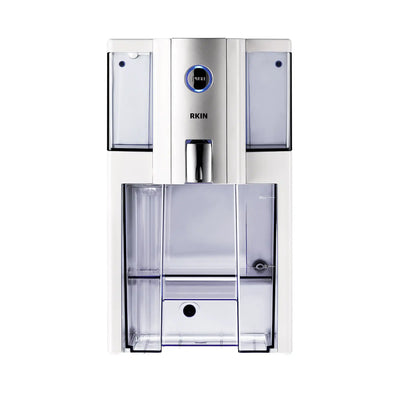
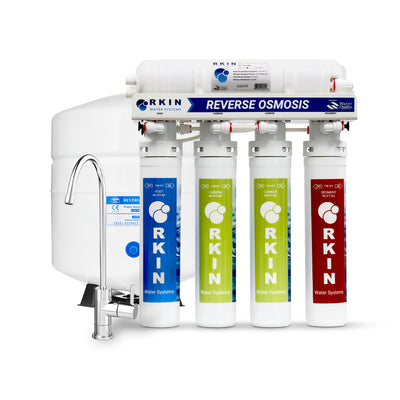
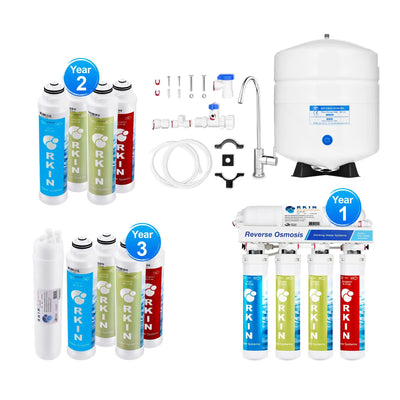
Whole-house systems aren't an option for everyone. If you can't modify your building's plumbing, a shower filter is worth exploring for direct chlorine reduction at the source. For drinking water quality, the RKIN Zero Installation Purifier provides countertop reverse osmosis filtration without any plumbing changes — it plugs into a standard outlet. Worth noting: it won't affect shower water, so it won't address the skin exposure that happens during bathing.
How to Know If Your Water Is the Problem
A few questions worth asking:
- Do you notice soap doesn't lather well in the shower?
- Do you see white mineral deposits on your showerhead or faucets?
- Does your skin feel tighter or drier after showering, even in warm months?
- Have moisturizers and topical treatments helped somewhat but not solved the problem?
If several of these apply, water quality is worth investigating. A basic home water test kit gives you hardness levels, chlorine content, and a baseline reading. Your city's annual water quality report — required by the EPA and posted online — tells you what's in your municipal supply.
What the Dermatologist Connection Means
The Reddit post that opened this article reflects a shift happening in clinical dermatology. Practitioners who see patients with chronic dry skin, unexplained eczema flares, or persistent barrier issues are increasingly asking about water quality — not as a cure, but as a contributing factor that's easy to address.
Water quality isn't a substitute for dermatological treatment. But it's a variable that most people have never considered, and one that costs nothing to investigate.
If your skin has been giving you trouble and you've tried the usual remedies, it might be worth looking at what's coming out of your showerhead.
See the RKIN Salt-Based Water Softener →
See the Salt-Based Softener + Carbon Combo →
Browse all whole-house water treatment systems →






0 comments