




kangen vs whole house filter
Kangen Water Machine vs RKIN U1: Which Is Better for Your Home?

Kangen Water Machine vs RKIN U1: Which Is Better for Your Home?
You've probably seen the pitch. A friend, a co-worker, maybe a neighbor — someone excited about their Kangen machine, quoting health benefits and showing you the colorful water demonstration. Then you check the price: $3,980 to $5,980. Before you hand over that kind of money, it's worth asking a simple question: what problem are you actually trying to solve?
If you want to remove contaminants from your water — PFAS, arsenic, chlorine, heavy metals — a Kangen machine won't do that. If you want alkaline water at a single kitchen tap, Kangen might fit. But for most homeowners who are genuinely concerned about what's actually in their drinking water, there's a more direct solution: the RKIN U1 — a countertop 4-in-1 reverse osmosis system that filters, remineralizes, and delivers alkaline water without requiring installation.
Water quality concerns are growing — and for good reason. The Environmental Working Group's Tap Water Database has flagged detected contaminants in municipal water supplies across every U.S. state. PFAS contamination alone affects an estimated 200 million Americans. So when people search for "kangen water alternative" or "kangen water vs whole house filter," they're often not asking about pH. They're asking about safety. That's the distinction this article is built around.
This article breaks down both systems honestly — how they work, what they actually do, what they cost over time, and who each one is right for.
What Is Kangen Water?
Kangen is a brand name owned by Enagic, a Japanese company that sells water ionizers through a multi-level marketing distribution model. The flagship unit, the SD501, produces what Enagic calls "Kangen water" — ionized alkaline water with a pH above 7.
Here's how it works: tap water passes over electrically charged platinum-coated titanium plates. This process, called electrolysis, splits water into two streams — one alkaline (higher pH) and one acidic (lower pH). The alkaline stream is what you drink.
Proponents claim alkaline water helps with everything from acid reflux to cancer prevention. It's worth being direct about the science here: there is limited peer-reviewed evidence supporting most of these health claims. The FDA does not recognize alkaline water as a treatment or cure for any disease. Some small studies show potential benefits for acid reflux and hydration during intense exercise, but the broader claims are not backed by clinical evidence at scale.
Critically — and this is the point most Kangen demonstrations skip — electrolysis does not remove contaminants. Kangen machines use a basic carbon pre-filter. That filter may reduce chlorine taste and some sediment, but it does not remove PFAS ("forever chemicals"), lead, arsenic, nitrates, pharmaceuticals, or heavy metals. You're still drinking those — just at a higher pH.
Kangen machines are also not independently certified by NSF International for contaminant removal. NSF certification requires rigorous third-party testing and public disclosure of what's been reduced and by how much. Kangen doesn't have it.
What Is the RKIN U1?
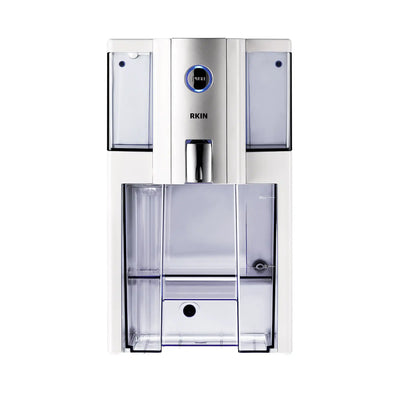
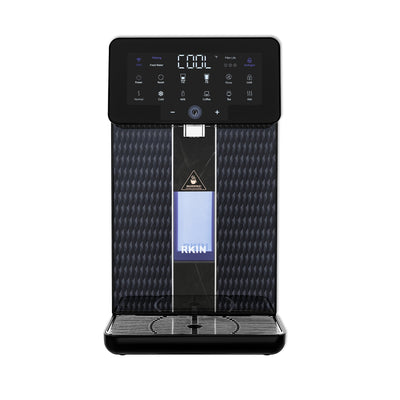
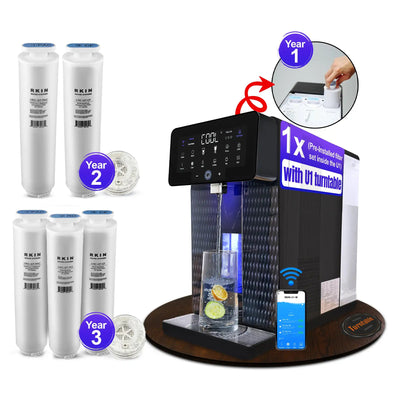
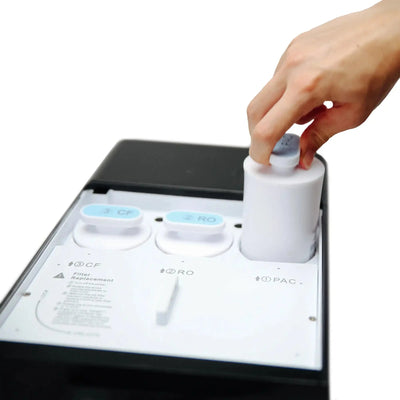
The RKIN U1 is a countertop 4-in-1 reverse osmosis system. It sits on your counter — no plumbing, no installation, no tools. Plug it in, fill the tank, and you're drinking purified, remineralized alkaline water.
Reverse osmosis works by forcing water through a semi-permeable membrane under pressure. The membrane's pores are small enough to block dissolved contaminants: PFAS, arsenic, lead, chlorine, chromium-6, nitrates, pharmaceuticals, and hundreds of other substances. The RKIN U1 removes 99.9%+ of contaminants using NSF-certified filtration components — and then passes the water through a remineralizer post-filter that adds beneficial minerals back and raises the pH to alkaline levels.
Because it's a countertop unit with zero installation, you can set it up in minutes and start drinking purified water the same day. No plumber, no modifications to your home, no landlord approval needed — just counter space and a power outlet.
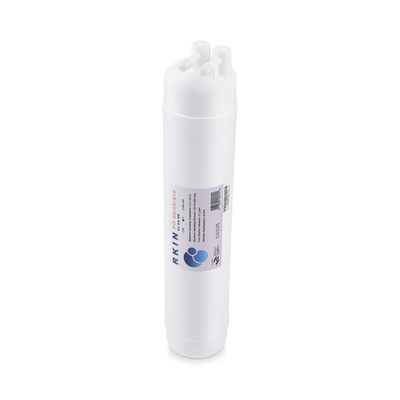
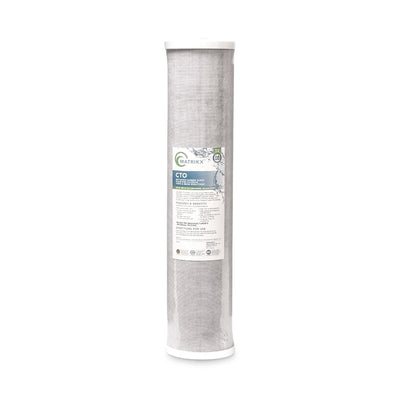
That matters more than most people realize. Most of the contaminants in tap water — PFAS, lead, arsenic, chlorine byproducts — go straight through a Kangen machine's basic carbon filter. The U1's 4-stage process (sediment + carbon + RO membrane + alkaline remineralizer) removes them and delivers water that's both clean and naturally alkaline.
The U1 uses NSF-certified filtration components, which means the removal claims are backed by independent laboratory testing — not manufacturer marketing materials. That's a meaningful distinction when you're making a decision about your family's water.
That's the core difference in what these machines actually do. Both sit on your counter. But one changes the pH of unfiltered water. The other removes the contaminants first, then remineralizes to alkaline — in a single compact unit.
Side-by-Side Comparison
| Feature | Kangen SD501 | RKIN U1 |
|---|---|---|
| Price | $3,980 – $5,980 retail | See current pricing at rkin.com |
| Distribution | MLM (multi-level marketing) | Direct-to-consumer |
| Filtration Method | Electrolysis + basic carbon filter | Reverse osmosis membrane + multi-stage filtration |
| Removes PFAS | No | Yes (99.9%+) |
| Removes Heavy Metals | No | Yes |
| Removes Arsenic | No | Yes |
| NSF Certified | No independent NSF certification for contaminant removal | NSF-certified components |
| Coverage | Single countertop or under-sink tap | Countertop — purified alkaline drinking water on demand |
| Installation | Countertop or under-sink (DIY) | Countertop (zero installation — plug in and go) |
| Primary Benefit | Produces alkaline ionized water | Removes 99.9%+ of contaminants throughout home |
| Maintenance | Replace carbon filter; periodic plate cleaning | Periodic membrane and filter replacement |
| Warranty | 3 years (Enagic) | Varies — check rkin.com for current warranty terms |
Kangen: Pros and Cons
Pros
- Produces consistent alkaline water — if alkaline pH is your specific goal, the SD501 does that reliably.
- Multiple pH settings — can produce acidic water (used for cleaning and skincare) and strong alkaline water for cooking.
- Countertop convenience — no major plumbing work required for basic installation.
- Long brand history — Enagic has been in business since 1974.
Cons
- Very high price — $3,980–$5,980 for a countertop appliance is steep, and part of that cost funds the MLM distributor chain.
- Does not remove serious contaminants — PFAS, arsenic, lead, nitrates, pharmaceuticals are not removed by electrolysis.
- No NSF certification for contaminant reduction — independent verification of what's actually being removed is absent.
- Single-tap coverage only — your shower, laundry, and dishwasher still get unfiltered tap water.
- Health claims are largely unsupported — the scientific evidence for most marketed benefits is thin.
- MLM distribution — pricing includes distributor commissions at multiple levels. You're partially paying for the sales structure.
RKIN U1: Pros and Cons
Pros
- 4-in-1 system — RO filtration, sediment removal, carbon block, and alkaline remineralization in one countertop unit.
- Removes the contaminants that matter most — PFAS, arsenic, lead, chlorine, chromium-6, nitrates, and hundreds more at 99.9%+ removal rates.
- NSF-certified components — independently validated filtration performance.
- Direct-to-consumer pricing — no MLM middlemen. You pay for the system, not the sales chain.
- Zero installation — no plumber, no tools, no plumbing modifications. Sits on your counter, plugs into a standard outlet.
- Produces alkaline water — the built-in remineralizer post-filter adds beneficial minerals and raises pH to alkaline levels. You get the alkaline water Kangen promises, plus actual contaminant removal.
Cons
- Countertop only — filters your drinking water, not every tap in the house. For whole-home protection (showers, laundry, appliances), you'd need a separate whole-home system.
- Requires counter space — the U1 is compact but does take up counter real estate. It's about the same footprint as a Keurig.
- RO systems produce some reject water — like all reverse osmosis systems, there is some water used in the filtration process. Modern systems have improved this ratio significantly.
Who Is Kangen Right For?
Honestly? A narrow group. If your municipal water is already well-regulated, you've tested it and know it's clean, and you specifically want to experiment with drinking alkaline water — then Kangen does what it says. You get adjustable pH water at one tap.
But at $4,000–$6,000, you're paying a premium that's largely driven by the distributor model, not the technology. There are water ionizers from other brands that produce comparable alkaline water for $300–$800. If alkaline water is your only goal, there are less expensive ways to get it.
Kangen is a poor fit for anyone whose primary concern is water safety — removing what's actually in their water.
Who Is the RKIN U1 Right For?
The RKIN U1 is built for homeowners who want to know their water is genuinely clean — not just pH-adjusted. If you're in an area with known PFAS contamination, older plumbing with lead risk, agricultural runoff concerns, or you simply want the peace of mind that every tap in your home is protected, the U1 addresses that at the source.
It's also the right choice if you want alkaline water without paying $4,000+ for a machine that doesn't actually filter your water. The U1 does both — removes contaminants and remineralizes to alkaline — in one unit, on your counter, for a fraction of the price.
If you have kids, pets, or anyone in your household with concerns about what's in the tap water, the U1 gives you certified contaminant removal plus alkaline remineralization — no installation, no plumber, no waiting.
Real Talk: Cost-Per-Gallon Breakdown
Let's put the numbers in perspective.
Kangen SD501
- Upfront cost: ~$3,980–$5,980
- Replacement filters: Approximately $100–$120/year for carbon pre-filters
- Daily output: Limited to what you drink/cook with at one tap
- Estimated lifetime: 15–20 years with proper maintenance
If you assume a $4,500 purchase price, $110/year in filters, and 15 years of use, your total spend is roughly $6,150. If you drink 1 gallon of Kangen water per day per household member (family of 4 = ~4 gallons/day), that's about 21,900 gallons over 15 years. Cost per gallon: ~$0.28. That doesn't include the opportunity cost of what else you could have done with $4,500 upfront, or the fact that your shower and every other tap is still unfiltered.
RKIN U1
- Upfront cost: See rkin.com for current pricing
- Coverage: Countertop — purified alkaline drinking water for the household
- Maintenance: Periodic membrane and filter replacements
The U1 handles a family's drinking and cooking water — which is what matters most for health. When you compare per-gallon cost for clean drinking water, the U1 comes out significantly lower than a Kangen machine. And you're actually removing contaminants, not just changing pH. Plus you're getting alkaline water as well.
Compared to buying bottled water (average $1.00–$1.50/gallon), both systems win on cost. But only one of them actually removes the contaminants you're trying to avoid — and delivers alkaline water as part of the process.
The Verdict
Kangen machines are well-built appliances that do one specific thing: produce alkaline ionized water at a single tap. If that's your goal and you're aware the health claims are mostly unverified, it's a legitimate (if expensive) product.
But Kangen is not a water filtration system. It does not remove PFAS. It does not remove arsenic or lead. It has no NSF certification for contaminant reduction. If your house has old pipes, if you're on municipal water with known issues, if you have kids who drink from every tap, or if you've ever looked at an EWG Tap Water Database report and been unsettled by what it showed — Kangen doesn't solve that problem.
The RKIN U1 does. It filters your drinking water through a 4-stage process (sediment, carbon, RO membrane, alkaline remineralizer) that actually removes what you're trying to get rid of — and delivers alkaline water as a result. No installation required.
There's also a pricing honesty gap worth naming. Kangen's high retail price is partially a function of its MLM structure — distributors at multiple levels earn commissions, and those commissions are baked into what you pay. The technology inside those machines is not inherently worth $4,000–$6,000. You're paying for a distribution chain as much as a product.
The RKIN U1, sold direct-to-consumer, doesn't carry that overhead. What you pay goes toward the system itself.
For most homeowners who care about water quality, the choice is straightforward: filter what's actually in your water, get alkaline water as part of the process, and do it without paying $4,000+ for a machine that doesn't filter anything.
Frequently Asked Questions
Does a Kangen machine remove PFAS or heavy metals?
No. Kangen machines use electrolysis to change water pH, paired with a basic carbon pre-filter. That carbon filter may reduce chlorine taste and some sediment, but it is not designed to remove PFAS ("forever chemicals"), lead, arsenic, or other heavy metals. If contaminant removal is your goal, you need a system with a reverse osmosis membrane — like the RKIN U1, a countertop 4-in-1 system that also remineralizes to alkaline.
Why is a Kangen water machine so expensive?
Kangen machines retail for $3,980 to $5,980. A significant portion of that price reflects the multi-level marketing (MLM) distribution model — commissions are paid to distributors at multiple levels, and those costs are built into the retail price. The electrolysis technology itself is not inherently a $4,000+ product. Direct-to-consumer brands like RKIN avoid that overhead, so more of what you pay goes toward the system.
Is alkaline water actually healthier than filtered water?
There is limited peer-reviewed evidence supporting most alkaline water health claims. Some small studies suggest potential benefits for acid reflux and exercise hydration, but the FDA does not recognize alkaline water as a treatment or cure for any disease. What the science does support: removing contaminants like PFAS, lead, and arsenic from your drinking water directly reduces health risks. That requires filtration — not pH adjustment.
What is the difference between a water ionizer and a reverse osmosis system?
A water ionizer (like Kangen) uses electrolysis to split water into alkaline and acidic streams. It changes pH but does not filter out dissolved contaminants. A reverse osmosis system forces water through a semi-permeable membrane that blocks dissolved solids, heavy metals, PFAS, and hundreds of other substances. The RKIN U1 is a countertop 4-in-1 RO system — it removes contaminants and remineralizes to alkaline, with zero installation required.
Does a Kangen machine have NSF certification?
No. Kangen machines do not hold independent NSF certification for contaminant removal. NSF certification requires rigorous third-party laboratory testing and public disclosure of what contaminants are reduced and by how much. The RKIN U1 uses NSF-certified filtration components, meaning its removal claims are backed by independent testing — not just manufacturer marketing.
Can a Kangen machine filter water for my whole house?
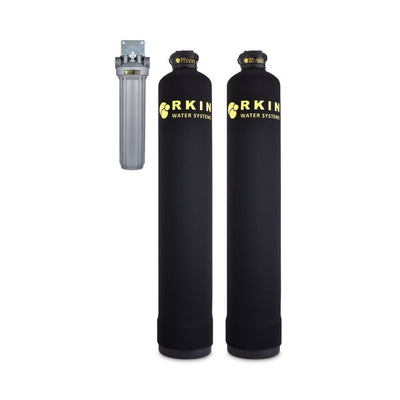
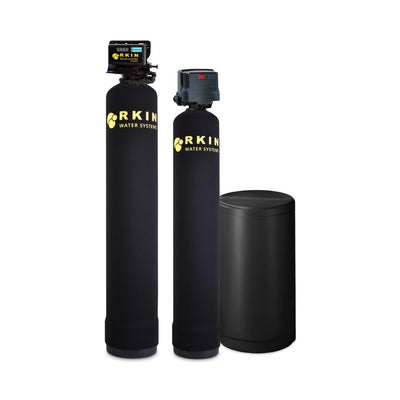
No. Kangen machines are single-point countertop or under-sink units that serve one tap. The RKIN U1 is also a countertop unit — but unlike Kangen, it actually removes contaminants through reverse osmosis and delivers alkaline water through its built-in remineralizer. Neither machine filters your whole house. For whole-home protection, RKIN offers separate whole-house water treatment systems.
What does the RKIN U1 remove from water?
The RKIN U1 removes 99.9%+ of contaminants through reverse osmosis, including PFAS, lead, arsenic, chlorine, chromium-6, nitrates, pharmaceuticals, and hundreds of other dissolved substances. It uses NSF-certified filtration components and then remineralizes the water to alkaline pH through its built-in post-filter. It's a countertop system — no installation required.
See the RKIN U1 Countertop 4-in-1 Water Filter
Ready to drink purified alkaline water from a system that actually removes contaminants — with zero installation? Learn more about how the RKIN U1 works and what it costs.
Explore the RKIN U1 →



0 comments