
countertop
TFC-435 Replacement Filter: When Upgrading Makes More Sense

Your RO system stopped producing water at the right rate. You pulled the membrane and Googled the part number: TFC-435. Now you're comparing prices across three websites, checking if your housing takes a standard 1/4-inch fitting, and wondering if it's even the right membrane for your system. Sound familiar?
Before you spend $30–$60 on a replacement and reassemble the whole unit, it's worth understanding what the TFC-435 actually is, why it wears out, and whether replacing it — or the system around it — is the better call for your situation.
What Is the TFC-435 Membrane?
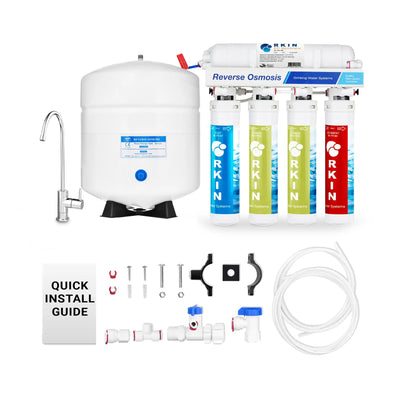
The TFC-435 is a thin-film composite (TFC) reverse osmosis membrane commonly found in budget-tier and mid-range under-sink RO systems from various manufacturers. It's a 50 GPD (gallons per day) membrane built for standard 10-inch housing configurations.
TFC membranes work by forcing water through a semi-permeable membrane at high pressure, stripping out dissolved solids, heavy metals, chlorine byproducts, and other contaminants. The TFC-435 is one of the most widely used formats because it's inexpensive to produce and fits a common housing size — which is exactly why so many budget RO systems ship with it from the factory.
Compatibility varies. The TFC-435 originated as an Axeon membrane spec, but the name has since been applied to membranes from multiple manufacturers. Before ordering a replacement, confirm:
- Your housing size (10" standard or 12"?)
- Your inlet/outlet fitting size (1/4" push-to-connect or compression?)
- Your system's rated GPD (gallons per day)
- Whether your system uses a tank-based or tankless configuration
Getting any of these wrong means the replacement won't seat correctly or won't perform to spec.
Why TFC-435 Membranes Wear Out Faster Than You Expect
A standard TFC membrane is rated for 2–3 years under ideal conditions. Real-world lifespans are often shorter. Here's why:
- Chlorinated tap water: Chlorine and chloramines degrade TFC membrane material over time. Most municipal water contains one or both. If your pre-filters aren't catching all of it, the membrane takes the damage.
- High TDS source water: The higher your incoming total dissolved solids, the faster the membrane works — and wears. Areas with hard water, high mineral content, or older infrastructure see shorter membrane life.
- Low water pressure: TFC membranes need adequate pressure (typically 60–80 PSI) to operate correctly. Low-pressure households see slower production, more strain on the membrane, and faster fouling.
- Infrequent pre-filter changes: The sediment and carbon pre-filters exist to protect the membrane. When they're overdue, unfiltered contaminants hit the membrane directly. The membrane compensates — and degrades faster.
None of these factors are flaws in the TFC-435 specifically. They're inherent to tank-based under-sink RO design.
The Honest Cost of Maintaining a Tank-Based RO System
Most homeowners think about RO maintenance as "just change the membrane every couple of years." The actual maintenance list is longer:
- Sediment pre-filter: every 6–12 months
- Carbon pre-filter(s): every 6–12 months
- RO membrane (TFC-435 or similar): every 2–3 years
- Post-filter (polishing carbon): every 12 months
- Pressure tank sanitization: annually
- Pressure tank replacement: every 5–7 years (bladder failures are common)
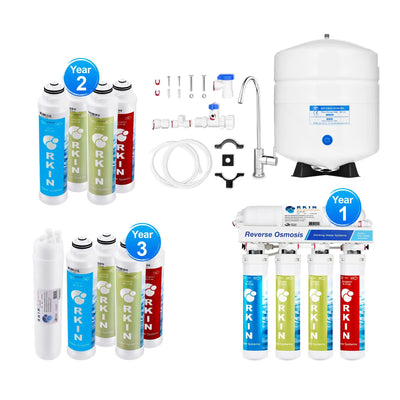
On a budget system, those parts add up to $80–$160 per year on average, not counting the time spent ordering, replacing, and disposing of used filters. And that's before a tank bladder fails — a replacement pressure tank typically runs $40–$100 on its own.
The pressure tank itself is where many homeowners hit unexpected trouble. Bacteria can accumulate in the storage tank over time, particularly when water sits stagnant for extended periods. Annual sanitization with diluted bleach is the standard recommendation, but it's a step most owners skip.
What Tankless RO Changes About This Equation
Tankless reverse osmosis systems eliminate the pressure tank entirely. Water is produced on-demand through a high-efficiency membrane, dispensed immediately, and never stored in a vessel where bacterial growth is a concern.
The practical differences:
- No tank bladder to replace — a consistent failure point in tank-based systems is gone
- Fewer filter stages in most designs — streamlined configurations mean less to track and replace
- Faster water production — modern high-flow membranes in tankless systems produce water significantly faster than legacy 50 GPD membranes like the TFC-435
- Smaller footprint — no tank means the unit fits in spaces where a full under-sink system won't
- No installation required (countertop configurations) — some tankless RO systems sit on the counter and connect to a standard faucet with no plumbing work
The tradeoff: tankless systems typically cost more upfront than a budget under-sink unit. But for homeowners who are already budgeting $80–$160 per year in replacement parts and tracking multiple filter change schedules, the long-term math often favors the upgrade.
How RKIN U1 4-in-1 Water Filter System Compares
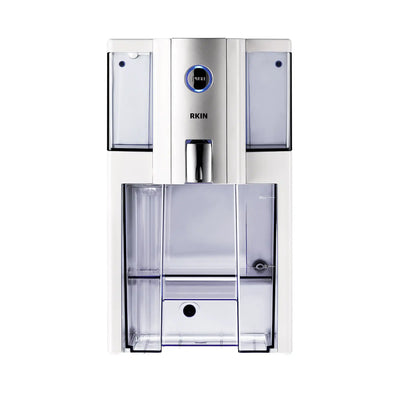
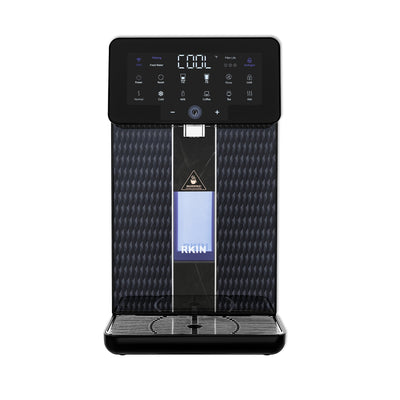
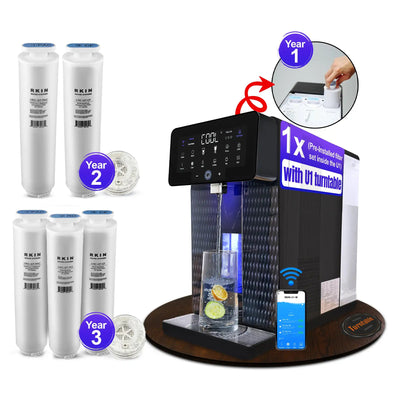
The RKIN U1 4-in-1 Water Filter System is a countertop, tankless system designed around a different approach to filtration maintenance.
Instead of the tank-based configuration that requires a TFC-435 replacement cycle, the U1 uses a five-stage filtration process — RO membrane, sediment pre-filter, two carbon stages, and an alkaline post-filter — in a self-contained countertop unit. There's no under-sink housing to maintain, no pressure tank to sanitize, and no plumbing knowledge required to set it up.
Key specs worth knowing:
- Removes up to 99% of common contaminants including chlorine, lead, fluoride, and dissolved solids
- UV light stage keeps stored water fresh between uses
- Alkaline post-filter returns beneficial minerals and targets a balanced 7–8 pH
- Hot and cold water dispensing built in — no separate kettle needed
- App-enabled monitoring on the U1-W model — filter status and water quality from your phone
- Filter replacement is a one-piece annual kit — one order, one swap
It won't fit every situation. If you're on a well with high sediment load, or you have unusually high TDS source water, a whole-home pre-treatment approach may be needed first. But for the typical municipal water user replacing a TFC-435 in a budget under-sink system, the U1 is worth putting in the comparison.
See current specs and availability at rkin.com.
Should You Replace the TFC-435 or Upgrade?
This isn't a universal answer — it depends on your situation. Here's a quick framework:
Replace the TFC-435 if:
- Your system is less than 3 years old and otherwise performing well
- All your pre-filters are current and in good condition
- You're satisfied with your water production rate and taste
- Your pressure tank is healthy (no waterlogging, holds pressure correctly)
Consider upgrading if:
- This is your second or third membrane replacement in the same system
- You've had pressure tank issues or suspect bladder failure
- You find yourself tracking and ordering multiple filter types every year
- You want a countertop option that moves with you (renters, people who relocate)
- Your under-sink setup has been unreliable and you want to start fresh
Either path is valid. What matters is making the decision with accurate information about what ongoing maintenance actually costs — in time and money — for the option you choose.
Frequently Asked Questions
Is the TFC-435 compatible with all RO systems?
Not universally. The TFC-435 is an Axeon membrane spec that fits standard 10-inch housings with 1/4-inch push-to-connect fittings, but compatibility depends on your specific system's housing size, fitting type, and GPD rating. Always confirm specs before ordering. Some manufacturers use proprietary membranes that look similar but aren't interchangeable.
How long does a TFC-435 membrane last?
Under ideal conditions — consistent water pressure (60–80 PSI), pre-filters replaced on schedule, chlorine-free source water — a TFC-435 typically lasts 2–3 years. Real-world lifespans are often shorter due to high-chlorine municipal water, infrequent pre-filter changes, or low water pressure. If you're replacing it more frequently than every 2 years, the issue is likely upstream.
What's the difference between TFC and RO membrane performance?
TFC (thin-film composite) is the membrane material type; RO (reverse osmosis) describes the filtration process. All modern RO membranes use TFC construction. Performance differences come from GPD rating, rejection percentage, and housing configuration — not the TFC designation itself. A 50 GPD membrane like the TFC-435 produces less water per day than a high-flow membrane used in tankless systems.
Do tankless RO systems still need filter replacements?
Yes, but the schedule is simplified. Most tankless countertop RO systems use annual filter kits that combine all filter stages in one replacement rather than tracking multiple individual filters on different schedules. The RO membrane itself typically lasts longer in tankless configurations because there's no storage tank creating back-pressure or stagnation.
Can I use a TFC-435 replacement in a countertop RO system?
Generally no. Countertop and tankless RO systems use different membrane form factors than traditional under-sink 10-inch housings. Countertop systems are designed as closed systems with proprietary or standardized-but-different membrane formats. Check your specific unit's documentation for the correct replacement membrane.
What happens if I don't replace a worn RO membrane?
A worn TFC membrane produces water more slowly and with lower contaminant rejection. In practical terms: slower dispensing, higher TDS readings in your filtered water, and potential taste changes. Running a membrane past its service life doesn't damage your system, but the filtered water quality degrades progressively. A basic TDS meter ($10–$15) lets you monitor rejection performance over time.
Ready to Stop Tracking Filter Part Numbers?
If replacing the TFC-435 is part of a longer pattern of chasing parts for an aging system, it may be the right moment to evaluate what a fresh start looks like. The RKIN U1 4-in-1 Water Filter System is designed for people who want consistently filtered water without the system becoming a maintenance project. No under-sink plumbing, no separate tank, no multi-filter replacement schedule — just one annual kit and a single point of contact.
See current availability and full specs at rkin.com.






0 comments