

Why Does My Tap Water Smell Like Chlorine? Causes & Fixes
Share
You turn on the kitchen faucet to fill a glass and it hits you — that unmistakable swimming-pool smell. The water is clear. It looks fine. But the chlorine bite is sharp enough that you put the glass down and reach for the bottled stuff. According to the EPA's most recent national compliance data, more than 270 million Americans receive water disinfected with chlorine or chloramine — and seasonal spikes in disinfectant levels are the rule, not the exception.
The smell isn't your imagination. It also isn't necessarily dangerous. But once you can taste your tap water, you're not going to drink it — and that's the real cost. Here's what's actually happening, why it gets worse in spring and summer, and what filters actually fix it.
What Causes the Chlorine Smell in Tap Water?
Municipal utilities add chlorine (or chloramine, a chlorine-ammonia blend) to drinking water to kill bacteria as it travels from the treatment plant to your house. The EPA caps the residual at 4 mg/L, which is the same level used in most public swimming pools. So when your kitchen tap smells like the YMCA, it's because chemically, it kind of is.
A few specific things drive that smell from "background note" to "I can't drink this":
- Spring and summer dosing increases. Warmer water in distribution mains lets bacteria grow faster, so utilities raise the chlorine residual from roughly April through September. The 2024 USGS drinking water analysis flagged seasonal disinfectant spikes as one of the top consumer complaint drivers nationwide.
- System flushing. Twice a year most utilities flush their mains with a higher chlorine concentration to clear biofilm. If your water suddenly smells like a pool for a few days, check your utility's website — there's usually a notice.
- Chloramine instead of chlorine. About one in five U.S. systems use chloramine, which is more stable in pipes but creates a more persistent smell that ordinary pitcher filters struggle with.
- Hot water amplifies it. Heating accelerates the release of chlorine gas. A shower will smell stronger than a glass of cold water from the same tap.
- Old plumbing. Galvanized or aging copper pipes can react with disinfectants and create off-tastes that read as "chlorine" even when the chlorine level itself is normal.
Is Chlorinated Tap Water Actually Safe?
At EPA-allowed levels, yes — chlorine in drinking water is regulated and monitored. The bigger concern most water-quality researchers point to isn't the chlorine itself, but the disinfection byproducts (DBPs) it creates when it reacts with organic matter in the source water. The two main groups are trihalomethanes (THMs) and haloacetic acids (HAAs). The EPA's Stage 2 D/DBP rule regulates them, and an EWG analysis published in 2024 found measurable DBPs in roughly 60 percent of U.S. utility samples.
That doesn't mean your water is unsafe to drink. It means the smell often signals byproducts that most consumers prefer to filter out — and that's a reasonable preference, not paranoia. It also means boiling the water won't fix it. Boiling will release some free chlorine as a gas, but it won't touch chloramine and it actually concentrates DBPs.
What Doesn't Work (Or Only Half-Works)
Before you spend money on a filter, here's what tends to disappoint:
Letting water sit on the counter. Free chlorine will dissipate over a few hours. Chloramine won't — it's specifically designed to be more stable. If your utility uses chloramine (call them or check the annual water quality report), this approach gets you nowhere.
Boiling. Same problem. Chloramine is heat-stable. You also lose dissolved oxygen, which makes the water taste flat.
Basic pitcher filters. A standard pitcher filter uses a thin layer of activated carbon and removes some free chlorine and taste. Chloramine, lead, fluoride, PFAS, and disinfection byproducts mostly pass through. The filter also exhausts faster than the schedule on the box if your municipal water has any meaningful chlorine residual.
Refrigerator filters. Better than a pitcher, but they're sized for taste improvement, not deep contaminant removal. They also don't help with the shower, the washing machine, or the dishwasher — which is where chlorine smell hits you the hardest.
What Actually Removes Chlorine and Chloramine
Two technologies do the heavy lifting:
Activated carbon block filters. A solid block of compressed coconut-shell carbon physically and chemically binds free chlorine. For chloramine, you need catalytic carbon — a denser, treated form that breaks the chlorine-ammonia bond. Both are very effective when sized correctly (typical capacity: 6 months to a year on a household-scale filter).
Reverse osmosis (RO). A multi-stage RO system uses carbon as a pre-filter (to protect the membrane from chlorine damage) plus a semi-permeable membrane that strips out dissolved solids, lead, fluoride, PFAS, and most disinfection byproducts. RO is the most thorough option for drinking water and is what most third-party labs (NSF, WQA) consider the benchmark for whole-spectrum contaminant reduction.
For drinking water, an RO system on the counter or under the sink solves the problem completely. For shower and laundry chlorine — which is where most of the smell complaints come from in chlorinated cities — a whole-house carbon filter is the right tool.
Look for these certifications when shopping: - NSF/ANSI 42 — chlorine taste and odor reduction - NSF/ANSI 53 — health-related contaminants (lead, cysts, VOCs) - NSF/ANSI 58 — reverse osmosis performance - NSF/ANSI 401 — emerging contaminants (pharmaceuticals, PFAS precursors)
A filter that carries 42 alone removes the smell. A system that carries 53, 58, and 401 removes the smell and most of what you can't smell.
How RKIN Solves the Chlorine-Smell Problem
For most households dealing with city chlorine, a countertop or undersink RO system gives you clean drinking water without rebuilding the plumbing.
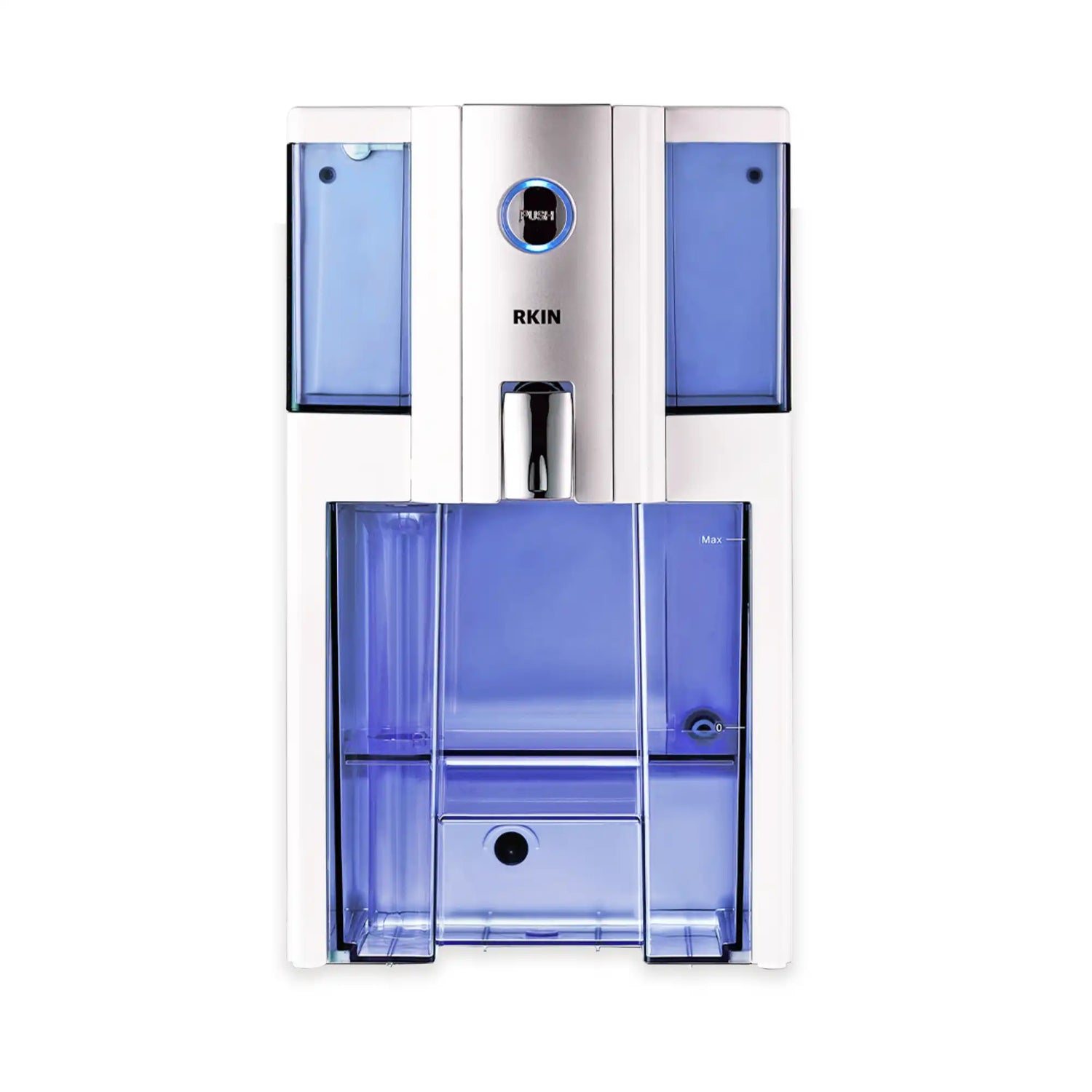
The RKIN Zero Installation Purifier sits on the counter, plugs into a standard outlet, and runs municipal tap water through a 5-stage process — pre-filter, sediment, two carbon stages, RO membrane, and a final polish. No drilling, no countertop install, no plumber. It removes free chlorine, chloramine (with catalytic carbon), lead, fluoride, PFAS, and the disinfection byproducts that survive most lesser filters.
If you'd rather have it tucked under the sink with a dedicated faucet, the RKIN Flash Undersink RO System does the same job with a smaller footprint and a tankless design that delivers fresh water on demand. Both systems are 3rd-party tested for chlorine taste and odor reduction, lead, and PFAS removal.
For the shower-and-laundry side of the chlorine problem, a whole-house carbon filter handles every fixture in the home with a single install on the main water line.
Frequently Asked Questions
Why does my tap water smell stronger in summer?
Utilities increase chlorine residual in warmer months because warm water in the distribution mains supports faster bacterial growth. From roughly April through September, residuals run 30–50 percent higher than the winter baseline. Twice-a-year main flushing also concentrates the smell for a few days at a time.
How do I know if my city uses chlorine or chloramine?
Check your utility's annual Consumer Confidence Report — every U.S. water provider publishes one online by July 1. It will say "chlorine" or "chloramine" under the disinfectant section. About 80 percent of systems use plain chlorine; the rest use chloramine, which requires a catalytic carbon filter to remove.
Will boiling my water remove the chlorine smell?
For free chlorine, partially — it off-gases over about 15 minutes of vigorous boiling. For chloramine, no, because chloramine is heat-stable. Boiling also concentrates dissolved solids and disinfection byproducts. It's not a substitute for filtration.
Does a refrigerator filter remove chlorine?
A standard refrigerator filter removes free chlorine taste and odor at the start of its life and gradually loses capacity. Most are not certified for chloramine, lead, fluoride, or PFAS. They handle drinking water at the fridge but do nothing for the kitchen tap, shower, or dishwasher.
Is chlorine in tap water dangerous to drink?
At EPA-allowed levels (up to 4 mg/L), chlorine itself is not considered a health risk. The concern most researchers focus on is disinfection byproducts (THMs, HAAs) that form when chlorine reacts with organic matter. Reverse osmosis filtration removes both the chlorine and the byproducts, which is why most labs treat RO as the benchmark for residential drinking water.
How long do RO filters last before they need replacement?
On a quality residential RO system, the carbon and sediment stages typically last 6–12 months and the RO membrane lasts 2–3 years, depending on water hardness and usage. Always follow the schedule on your specific system's product page rather than a generic industry estimate.
Ready to Stop Drinking Pool Water?
You shouldn't have to smell your tap water before you drink it. A multi-stage filter — countertop or undersink — solves the chlorine problem in an afternoon, and a whole-house carbon system extends the same fix to your shower and laundry.
The RKIN Zero Installation Purifier is the simplest place to start: plug it in, fill the tank, get clean water at your kitchen counter. No plumbing, no drilling, no contractor.


