




carbon-filter
How to Remove Chlorine from Drinking Water at Home

Most people assume that if water is safe to drink, it should taste and smell clean. Chlorine in tap water makes that assumption complicated.
Chlorine is intentionally added to municipal water as a disinfectant — and it does its job. But once the water reaches your tap, that same chemical leaves behind an unmistakable bleach-like odor, a flat or bitter taste, and a trail of chemical byproducts called disinfection byproducts (DBPs). According to the EPA's Disinfectants and Disinfection Byproducts Rule, DBPs form when chlorine reacts with naturally occurring organic matter in water. These compounds are regulated, but they're present in virtually every chlorinated water supply in the country.
If your water smells like a swimming pool or tastes flat, chlorine is almost certainly the reason. Here's what you need to know about how it gets there, why some removal methods don't work, and what actually does.
Why Municipalities Add Chlorine to Tap Water
Chlorine has been used to disinfect municipal water supplies in the United States since the early 1900s. Before widespread water treatment, waterborne diseases like typhoid fever and cholera killed tens of thousands of people annually. Chlorination changed that. The CDC credits water fluoridation and chlorination among the ten great public health achievements of the 20th century.
So the disinfection piece is genuinely important. The problem is that chlorine doesn't stay neatly contained to the treatment plant. It travels through miles of distribution pipes to maintain what's called a "residual" — enough chlorine in the water to prevent bacterial growth along the way. By the time water reaches your home, you're getting the tail end of that residual. That's what you taste and smell.
Chloramine: A Harder-to-Remove Cousin
Many water utilities have switched from chlorine to chloramine — a compound of chlorine and ammonia — because it produces fewer regulated DBPs and maintains a more stable residual over long pipe runs. According to the EPA, over 1 in 5 Americans drink chloraminated water.
Chloramine is more stable than free chlorine, which matters a lot when you're trying to remove it. It doesn't off-gas the way chlorine does. You can't boil it out. You can't leave it sitting on the counter overnight. Standard carbon filtration slows it down but doesn't always fully remove it. That's worth understanding before you choose a filtration method.
The Byproduct Problem
When chlorine reacts with organic compounds in source water — things like decaying leaves, algae, and sediment — it forms disinfection byproducts. The most studied class is trihalomethanes (THMs), which include chloroform. A second class, haloacetic acids (HAAs), forms under different conditions.
The EPA's Stage 2 DBP rule limits total THMs to 80 parts per billion (ppb) and HAAs to 60 ppb. Most municipal water stays within these limits, but "within limits" and "zero" are not the same thing. If you're looking to remove chlorine from water, you're also eliminating these associated byproducts at the same time — which is one of the main reasons people seek filtration beyond what the tap delivers.
What Doesn't Actually Work
Before spending money on a filter, it helps to understand which popular approaches fall short.
Boiling
Boiling water at a rolling boil for a few minutes will drive off free chlorine. Chlorine is volatile — it evaporates when heated, the same way it off-gasses when you leave a glass of tap water sitting out. This works reasonably well for free chlorine.
It does not work for chloramine. Chloramine requires sustained boiling for 20 minutes or more to dissipate meaningfully, which is impractical for drinking water. If your utility uses chloramine, boiling is the wrong tool.
Letting Water Sit Out
Leaving an open pitcher on the counter overnight will reduce free chlorine through natural off-gassing. Again, this requires time and works only for free chlorine. Chloramine barely dissipates this way. And at room temperature, leaving water uncovered for hours creates its own concerns about airborne contamination.
This approach also does nothing for DBPs already formed in the water. The chlorine is gone; the byproducts remain.
Pitcher Filters
Activated carbon pitcher filters — the kind you fill from the top and pour from the bottom — do remove some chlorine. Many are NSF 42 certified for chlorine taste and odor reduction. But they have real limitations:
- Small carbon beds mean limited contact time with the water
- Most are not certified for chloramine removal
- Flow rate is slow, and capacity is typically 40 gallons before replacement
- They treat drinking water only — not your shower, cooking water, or ice maker
For occasional filtered drinking water, a pitcher is better than nothing. For whole-house chlorine removal or high-volume use, it's the wrong scale.
What Actually Works: Activated Carbon Filtration
Activated carbon is the gold standard for removing chlorine in tap water. It works through a process called adsorption — chlorine molecules stick to the surface of the carbon as water passes through. High-quality activated carbon has an enormous surface area: a single gram can have the equivalent of several tennis courts of surface area thanks to its porous structure.
The result is water that tastes noticeably different. The flat, bleach-forward quality disappears. This is why activated carbon is one of the most widely certified filtration technologies on the market.
Catalytic Carbon for Chloramine
Standard activated carbon reduces free chlorine effectively but struggles with chloramine. Catalytic carbon — a specially processed form with higher surface reactivity — handles both. If you're on a municipal supply that uses chloramine, look specifically for a filter that uses catalytic carbon or is NSF 42 certified for chloramine reduction.
What to Look for in a Carbon Filter Chlorine System
NSF/ANSI 42 certification — This is the benchmark standard for aesthetic effects, specifically chlorine taste and odor. Any filter making chlorine removal claims should be tested to this standard. NSF 58 covers broader contaminant reduction (relevant for RO systems).
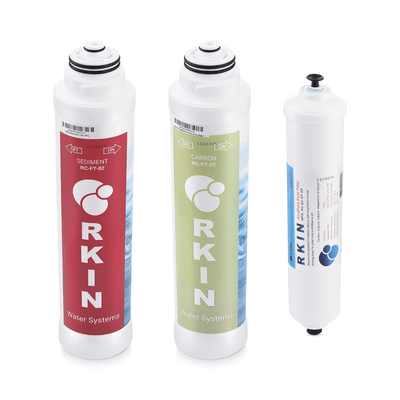
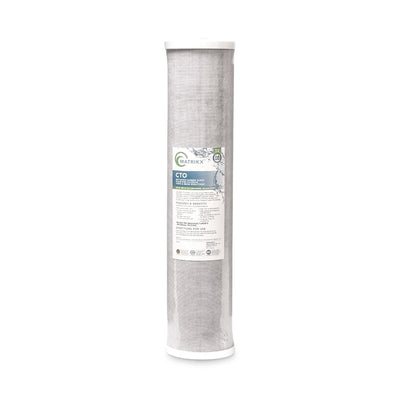
Carbon type — Granular activated carbon (GAC) and carbon block both work. Carbon block typically has longer contact time and finer filtration, making it more effective per gallon. For chloramine specifically, catalytic carbon block is worth the upgrade.
Contact time — The slower water moves through the carbon bed, the more effective the removal. Undersink and whole-house filters with larger carbon tanks outperform pitcher-style filters on this metric.
Whole-house vs. point-of-use — A point-of-use filter (countertop, undersink) addresses your drinking and cooking water. A whole-house filter treats every tap, shower, and appliance in the home. Both are valid depending on what problem you're solving.
RKIN Products That Remove Chlorine
There's no single right answer here — it depends on whether you want to treat drinking water only, or every faucet in the house.
For Whole-House Chlorine Removal
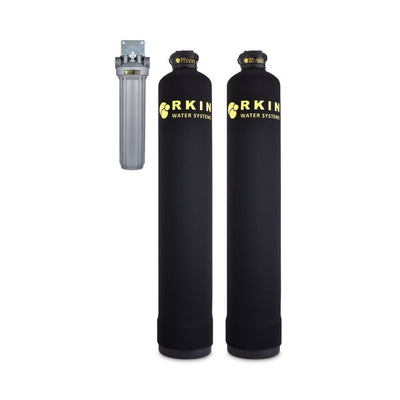
The CBS Dual Carbon Whole House Filter uses two stages of carbon filtration — sediment pre-filter followed by a carbon media tank — to treat water at the point of entry before it reaches any fixture in your home. It handles both free chlorine and chloramine, and the carbon cartridges are replaced every 6–12 months depending on water usage and chlorine load.
This is the right choice if you want to address chlorine for showers, laundry, ice makers, and all drinking water at once. A single whole-house system means you're not managing multiple point-of-use filters throughout the house.
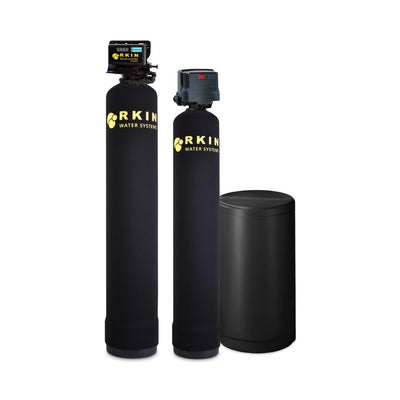
If you're also dealing with hard water, the RKIN OnliSoft Pro pairs TAC conditioning media (lifetime media, no replacement needed) with carbon filtration in one whole-house unit — covering both scale prevention and chlorine removal in the same footprint.
For Drinking Water Only
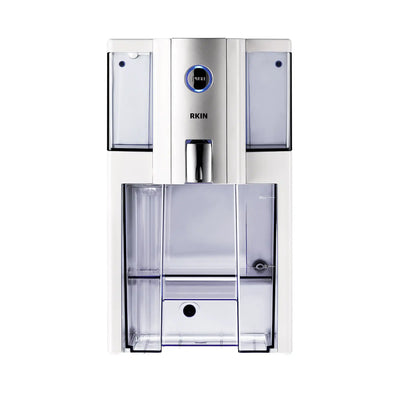
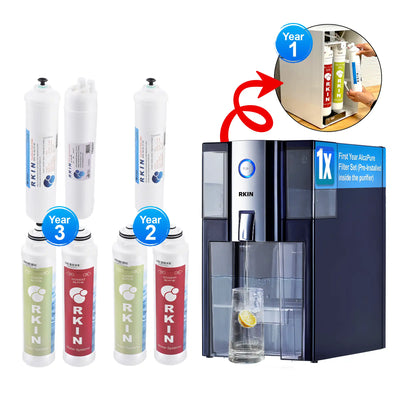
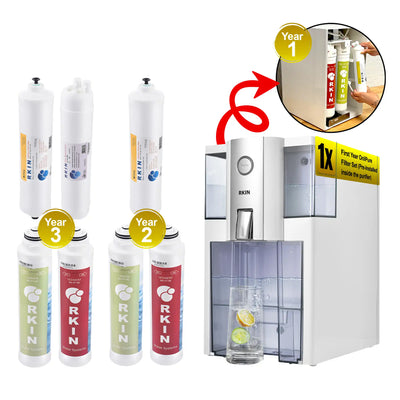
The RKIN Zero Installation Purifier is a countertop reverse osmosis system — no plumber, no drilling under the sink. It runs five filtration stages: sediment, carbon, RO membrane, UV, and a post-filter polish. The carbon stage handles chlorine and chloramine; the RO membrane takes care of everything the carbon misses. Setup takes about 15 minutes.
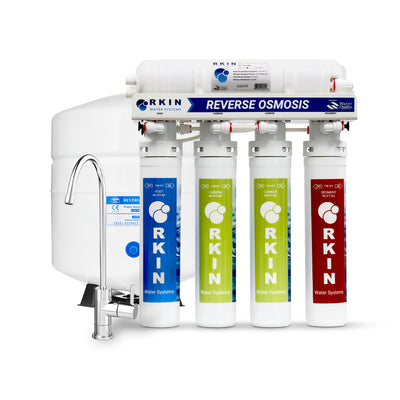
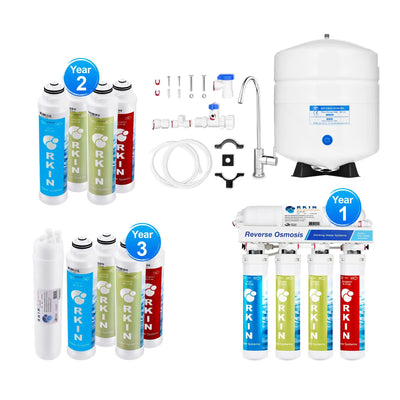
If you prefer an undersink setup, the RKIN Flash delivers the same multi-stage RO filtration from a dedicated faucet, keeping countertops clear. Both the Zero Installation Purifier and the Flash produce filtered water that's noticeably different from tap — no chlorine taste, no flat smell.
The choice between countertop and undersink comes down to whether you rent or own, how much counter space you have, and whether you want a dedicated filtered faucet or a portable unit you can take with you.
Frequently Asked Questions
Does a Brita filter remove chlorine? Standard Brita pitcher filters use activated carbon and are NSF 42 certified for chlorine taste and odor reduction. They do reduce free chlorine, though not as thoroughly as a dedicated undersink or whole-house carbon filter. Most Brita filters are not certified for chloramine removal, which matters if your utility has switched to chloramine as a disinfectant.
How do I know if my water has chlorine or chloramine? Contact your water utility and ask — they're required to publish an annual Consumer Confidence Report (CCR) that lists disinfection methods. You can also use an inexpensive test kit from a hardware store. Free chlorine test strips are widely available; chloramine requires a specific test kit that measures total chlorine and free chlorine (the difference indicates chloramine).
Can I use a carbon filter if I have a whole-house softener? Yes. Carbon filtration and water softening address different problems. Softeners exchange hardness minerals; carbon removes chlorine and DBPs. Many homeowners use both — typically with carbon filtration before the softener to protect the resin bed from chlorine degradation over time.
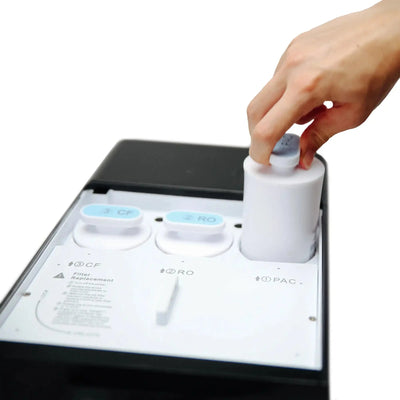
How long do carbon filter cartridges last? For whole-house carbon systems like the CBS, cartridges typically need replacement every 6–12 months depending on household water usage and chlorine concentration. For point-of-use systems, replacement schedules vary by model — check the manufacturer's specs. Most RO systems have a carbon pre-filter that's replaced on a similar schedule, with the RO membrane lasting 2–3 years under normal use.
Does reverse osmosis remove chlorine? Yes. RO systems include a carbon pre-filter specifically to remove chlorine before water contacts the RO membrane — chlorine degrades thin-film composite RO membranes over time. The carbon stage handles chlorine removal; the RO membrane handles dissolved solids, heavy metals, and other contaminants. The combination is more thorough than carbon alone.
Is chlorinated tap water safe to drink? Municipal water that meets EPA standards is considered safe to drink. Chlorine in tap water at regulated levels is not classified as a health hazard. The reason most people filter it out is taste, odor, and personal preference — chlorine affects the flavor of water and anything you cook or brew with it, including coffee and tea.
Start with the Right Filter for Your Situation
If chlorine taste or smell is the main issue at your tap, carbon filtration is the direct fix. The question is scale: are you solving a drinking water problem, or a whole-house problem?
For drinking water, the Zero Installation Purifier gets you up and running without any plumbing work. For whole-house treatment, the CBS Dual Carbon system handles it at the point of entry before chlorine reaches any fixture.
Either way, the difference in water quality is immediate and noticeable. No more pool smell at the kitchen faucet. No more flat-tasting coffee. Just clean water that tastes the way it should.





0 comments