




florida-water-quality
PFAS in Florida Drinking Water: What Homeowners Need to Know

If you've been following the news, you already know Florida has a PFAS problem. What the headlines don't always spell out is how serious it is, or how close it might be to your tap.
A 2023 U.S. Geological Survey study estimated that nearly half of all U.S. tap water contains detectable PFAS. Florida ranks among the most affected states, with contamination tied to military installations, airports, and industrial sites spread across the peninsula. The EPA's 2024 national standard set enforceable limits at 4 parts per trillion (ppt) for PFOA and PFOS — but utilities have until 2029 to comply. That gap matters. For Florida homeowners, it means taking matters into your own hands is the most reliable path to cleaner water right now.
What PFAS Are and Why Florida Has So Much of It
PFAS stands for per- and polyfluoroalkyl substances — a family of more than 15,000 synthetic chemicals manufactured since the 1950s. You've encountered them without realizing it: nonstick pans, stain-resistant carpet, waterproof clothing, food packaging, and the foam firefighters use to put out fuel fires. What makes them useful also makes them dangerous. The carbon-fluorine bond at their core is one of the strongest in organic chemistry. These compounds don't break down in the environment. They don't break down in the human body. They accumulate — which is why researchers started calling them "forever chemicals."
Florida's contamination problem has three main drivers:
Military bases and civilian airports. Aqueous film-forming foam (AFFF) — the standard firefighting agent used at military installations and airports for decades — is saturated with PFAS. Bases like Naval Air Station Pensacola, Tyndall Air Force Base, MacDill Air Force Base in Tampa, and Patrick Space Force Base near Cocoa Beach have all been identified as PFAS contamination sources. Decades of training exercises allowed AFFF to soak into sandy Florida soil and migrate into groundwater. Communities drawing from shallow aquifers near these bases are among the most exposed in the country.
Industrial discharge. Manufacturers, electroplating facilities, and chemical plants operating in Florida's industrial corridors have released PFAS into surface water and groundwater over decades. Unlike a single contamination event, these releases were often chronic — small amounts over long periods that built up in local water sources.
Florida's geology. The state sits on a highly porous limestone aquifer system — the Floridan Aquifer, which supplies drinking water to millions of residents. That permeability, ideal for drawing water, also means contaminants from the surface move downward quickly. Once PFAS enters the aquifer, it travels. Testing conducted under the EPA's Unregulated Contaminant Monitoring Rule (UCMR 5) program found PFAS in public water systems well beyond the immediate vicinity of contamination sources.
The health picture is still developing, but research from the EPA and the Agency for Toxic Substances and Disease Registry (ATSDR) has linked PFAS exposure to increased cholesterol, thyroid disruption, immune system effects (including reduced vaccine response in children), and elevated risks of certain cancers. These associations are based on population-level research — individual risk depends on exposure levels and duration.
What Doesn't Work
Before getting to solutions, it's worth clearing up what won't solve the problem, because a lot of Florida homeowners are spending money on things that give a false sense of security.
Boiling water. Boiling kills bacteria and some viruses. It does nothing for PFAS. In fact, as water evaporates from a pot, the PFAS left behind become more concentrated. If your concern is forever chemicals, boiling makes things worse, not better.
Standard pitcher filters. Brita, PUR, and similar carbon-based pitchers were designed to improve taste by reducing chlorine. They were never engineered for PFAS. A 2020 Duke University and NC State study published in Environmental Science & Technology Letters tested common household water filters and found that standard pitcher filters reduced PFAS levels by anywhere from zero to 73%, with no reliable consistency. For shorter-chain PFAS compounds — the ones that don't bind as well to carbon — many pitchers showed no meaningful reduction at all.
Bottled water. It's expensive, environmentally wasteful, and not necessarily cleaner than tap water. Testing by the Environmental Working Group and independent researchers has found PFAS in some bottled water brands. Beyond that, bottled water is regulated by the FDA, not the EPA, and the reporting requirements are less stringent than those for public utilities. You may not know what's in it.
Refrigerator filters and faucet-mounted carbon filters. These are useful for improving taste and reducing chlorine. They are not designed to remove PFAS and typically aren't tested or certified for that purpose.
What Actually Works: Reverse Osmosis
Reverse osmosis is the most effective point-of-use technology for removing PFAS from drinking water, and the research on this is consistent. The same Duke University study found that RO systems reduced PFAS levels by 90–99% across the board — including for shorter-chain PFAS compounds that activated carbon handles poorly.
Here's the mechanism: an RO membrane has pores small enough to physically block PFAS molecules. The water is pushed through under pressure; the dissolved contaminants, including PFAS, are separated and flushed away. It's a physical rejection process, not just adsorption. That's why the performance is more consistent and reliable than carbon-based alternatives.
For Florida homeowners, this matters for a few practical reasons:
You're dealing with aquifer water. Florida's groundwater sources move slowly and are difficult to remediate once contaminated. Even if your utility's treatment process catches some PFAS, a point-of-use RO system at your kitchen tap is insurance against whatever the plant misses.
The compliance deadline isn't today. Utilities have until 2029 to meet the EPA's 4 ppt limit. Testing results published under UCMR 5 show some Florida systems with PFAS levels above those limits right now. That's not a failure — utilities are aware and working on it — but if you're drinking that water in the interim, an at-home RO system gives you coverage that regulatory timelines don't.
RO removes more than PFAS. Florida's water isn't just a PFAS story. Depending on where you are in the state, your tap water may also contain elevated chloramines (used for disinfection in the distribution system), trihalomethanes (formed when chlorine reacts with organic matter), fluoride, and in some areas, elevated levels of radium or other naturally occurring minerals. A reverse osmosis system addresses all of these at once.
The NSF/ANSI 58 standard is what to look for when evaluating any RO system for PFAS. It's the certification specifically covering reverse osmosis systems and now includes PFAS reduction testing protocols. A system certified to NSF/ANSI 58 with explicit PFOA/PFOS claims has been independently verified by a third-party lab — not just tested in-house by the manufacturer.
RKIN RO Systems for Florida Homeowners
There's no single right answer for every household, but there are three systems worth considering depending on your living situation.
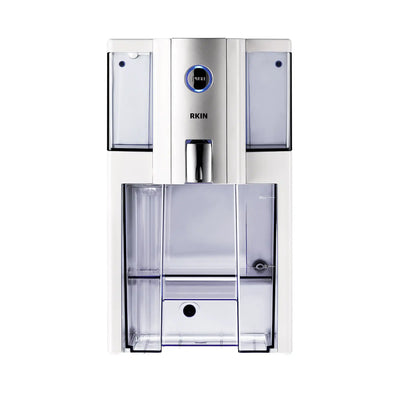
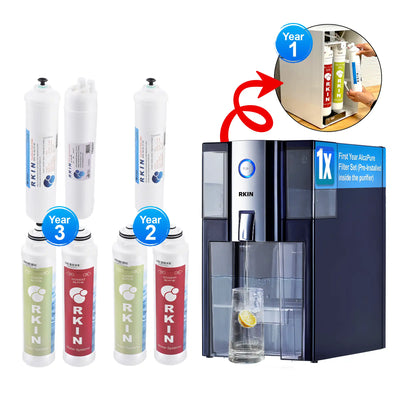
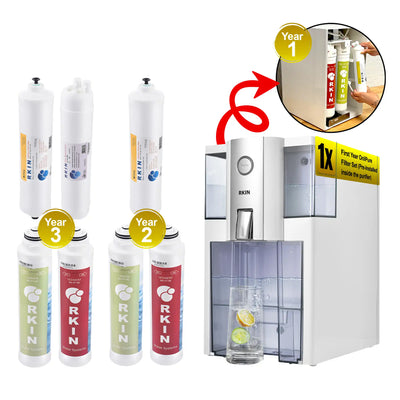
RKIN Zero Installation Purifier — If you rent, live in a condo, or don't want to touch your plumbing, this is the starting point. It's a countertop RO that requires no installation — fill the bottom tank with tap water, press a button, and the system purifies it through a multi-stage RO process. No drilling, no hoses, no landlord conversation needed. The Zero Installation Purifier is certified by IAPMO R&T to NSF/ANSI 58 for reduction of PFOA, PFOS, TDS, fluoride, lead, and hexavalent chromium. You can verify the certification on the IAPMO product listing directory (File No. 0012496).
RKIN U1 4-in-1 Water Filter System — Also a countertop unit with a fill tank, the U1 adds hot and cold water dispensing through a 5-stage filtration process that includes UV sterilization. It's 3rd-party tested for PFAS removal and well-suited for families who want purified water for cooking and drinking without dedicated under-sink plumbing. The UV stage adds a layer of protection against biological contaminants — useful in Florida, where aging distribution infrastructure can occasionally introduce bacterial concerns.
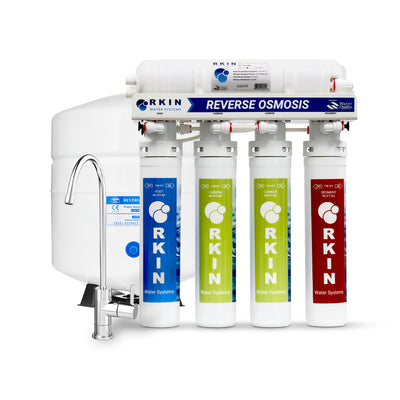
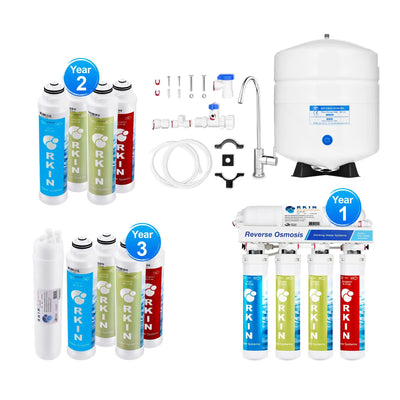
RKIN Flash Undersink RO System — For homeowners who prefer a clean counter, the Flash installs under the kitchen sink with its own dedicated faucet and a 3.2-gallon tank for pressurized, on-demand flow. Higher daily output makes it practical for larger households or those who cook frequently. Installation takes about 30 minutes with basic tools.
All three use reverse osmosis membranes as their core filtration stage — the technology that actually moves the needle on PFAS. The right choice depends primarily on your living situation and how much counter space you're working with, not on filtration performance.
Frequently Asked Questions
Does Florida tap water contain PFAS?
Yes. Testing conducted under the EPA's UCMR 5 program found detectable PFAS levels in numerous Florida public water systems, with several exceeding the EPA's 2024 limit of 4 parts per trillion for PFOA and PFOS. Communities near military installations, airports, and industrial sites are at the highest risk, but PFAS has been detected well beyond those immediate areas.
What is the main source of PFAS contamination in Florida water?
The largest documented source in Florida is aqueous film-forming foam (AFFF) used at military bases and civilian airports. Decades of firefighting training exercises allowed PFAS to soak into the soil and leach into groundwater. Industrial discharge and certain agricultural practices have also contributed to contamination across the state.
Does boiling water remove PFAS?
No. Boiling water does not remove PFAS — it actually concentrates them. When water evaporates, the PFAS molecules remain behind in a smaller volume of water, increasing their concentration. Reverse osmosis is the most effective household method for PFAS removal.
Do standard pitcher filters remove PFAS?
Not reliably. Standard pitcher filters with activated carbon are not designed for PFAS removal and show inconsistent results — ranging from minimal reduction to none at all for shorter-chain PFAS compounds. A 2020 Duke University study found that pitcher filters reduced PFAS levels by anywhere from 0% to 73%, with no consistent performance guarantee. Reverse osmosis is the proven alternative.
How do I know if my Florida water has PFAS?
Start with your utility's Consumer Confidence Report (CCR), published annually. Look for PFAS test results — specifically PFOA, PFOS, PFNA, PFHxS, PFBS, and GenX. If your utility hasn't published PFAS data, contact them directly or order an independent lab test from a state-certified facility. The EWG Tap Water Database (ewg.org/tapwater) is also a useful starting point.
What water filter actually removes PFAS?
Reverse osmosis is the most effective point-of-use technology for PFAS removal, with independent studies showing 90–99% reduction rates for both long-chain and short-chain PFAS compounds. RO systems push water through a semipermeable membrane that physically blocks PFAS molecules along with other dissolved contaminants like lead, arsenic, and fluoride. Look for systems certified to NSF/ANSI 58 with specific PFOA/PFOS claims.
Take Control of Your Drinking Water
Florida's PFAS problem is real, documented, and unlikely to be fully resolved at the utility level before the end of this decade. The good news: the solution at the household level is straightforward, affordable, and doesn't require a plumber or a lease clause.
An RO system at your kitchen tap — whether countertop or under-sink — puts a verified, third-party-tested barrier between whatever is in your municipal supply and the water you drink and cook with every day. Check your water report, identify your situation, and pick a system that fits your home. The decision is simpler than the contamination problem that makes it necessary.
Sources: EPA PFAS National Primary Drinking Water Regulation (2024); USGS Tap Water Study (2023); Herkert N.J. et al., "Assessing the Effectiveness of Point-of-Use Residential Drinking Water Filters for Perfluoroalkyl Substances," Environmental Science & Technology Letters (2020, Duke University / NC State); EPA Unregulated Contaminant Monitoring Rule 5 (UCMR 5) data; ATSDR PFAS Toxicological Profiles; Environmental Working Group PFAS Contamination Site Tracker.






0 comments