




municipal-water
Why Is My Tap Water Suddenly Harder? City Source Switches Explained

Your shower feels filmy. Glasses come out of the dishwasher cloudy. The coffee tastes off. Nothing in your house has changed — but your water has.
Across the country, municipalities are quietly shifting which aquifers, reservoirs, and wellfields they draw from. In the Southwest, reservoirs that have supplied cities for decades are running low, and utilities are drilling into backup aquifers on short timelines. In coastal regions, saltwater intrusion forces operators to blend sources. In the Northeast and Midwest, cities are rotating between surface and groundwater as treatment plants go offline for upgrades. When the source changes, the mineral profile of what comes out of your tap can flip in a week — and most homeowners blame the plumbing, the appliance, or themselves.
What actually changed in your water
Hardness is a measure of dissolved calcium and magnesium, typically reported in grains per gallon (gpg) or parts per million (ppm). Surface water from reservoirs tends to run 3–7 gpg. Groundwater from limestone or dolomite aquifers can jump to 15–25 gpg, with some Southwest aquifers pushing 30+. That is not a plumbing issue — that is a geology issue arriving at your faucet.
Alongside hardness, a source switch can shift:
- Total dissolved solids (TDS) — the umbrella measure of everything dissolved in the water, often doubling when aquifers replace reservoirs.
- Sulfates — a rotten-egg odor or bitter aftertaste can appear when sulfate-heavy groundwater enters the system.
- Iron and manganese — responsible for orange or black staining on fixtures, laundry, and appliances.
- Chloride and sodium — common in aquifers experiencing saltwater intrusion or ion exchange with native rock.
- Chlorine and chloramine dose — utilities often increase disinfectant levels when switching sources to keep biofilm in check during the transition.
The 2024 EPA Consumer Confidence Report summaries (published in each utility's annual report) document these shifts, but most residents never read them. The first sign is usually cloudy glassware, skin tightness after showering, or a coffee machine that starts throwing error codes earlier than expected.
Why utilities change sources
Source switches are rarely arbitrary. A 2024 U.S. Geological Survey assessment of groundwater availability flagged aquifer stress in 19 states, with the most acute pressure in Texas, Arizona, California, and the Great Plains. Cities respond by:
- Activating emergency aquifer wells when reservoir levels drop below operating thresholds
- Blending groundwater with surface water to stretch reservoirs across dry months
- Switching from seasonal rivers that freeze, flood, or run low
- Rotating around PFAS-contaminated wells that require taking wellfields offline
None of these decisions reach the homeowner as a bold alert. They show up in a footnote in the annual Consumer Confidence Report, a small notice in a utility bill, or a press release no one shares.
How to tell if your source actually changed
Before spending a dollar on equipment, confirm what you are dealing with. Three steps:
1. Check your utility's Consumer Confidence Report
Every U.S. water utility publishes an annual report listing source water, contaminant averages, and any detected violations. Most are online at the utility's website or via the EPA's CCR locator. Compare this year's report to last year's. Look specifically at:
- Source name changes (new wells, new reservoir names, new treatment plants)
- Hardness (if reported)
- TDS
- Sulfates, chloride, sodium
- Disinfectant levels and type (chlorine vs. chloramine)
2. Test your water at home
A simple hardness test strip gives you a reading in seconds. For a fuller picture, an inexpensive TDS meter shows total dissolved solids — a jump from 150 ppm to 350 ppm is a strong signal the source shifted. Laboratory mail-in tests (Tap Score, Simple Lab) give you a 70- to 100-contaminant breakdown for under a hundred dollars.
3. Watch the physical evidence
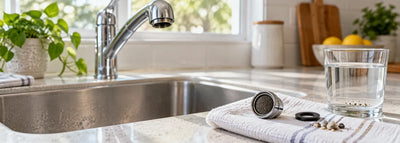
The fastest signal is mineral crust on your faucet aerators. Unscrew one, rinse it, and watch how quickly scale rebuilds. If it crusts over in weeks when it used to take months, your water got harder. White rings around shower heads, spotting on stainless steel, and a film on shower walls all confirm the same thing.
What does not work
People faced with a source change usually reach for familiar fixes that do not match the problem:
- Pitcher filters reduce chlorine taste and some metals but do nothing for hardness. A filter pitcher in a house with 20 gpg water is not a hardness solution.
- Descaling appliances individually buys time but does not address the water reaching everything else — the shower, the laundry, the water heater, the ice maker.
- Boiling concentrates minerals rather than removing them. The sediment in the kettle is the evidence.
- Buying softened bottled water for drinking only leaves the rest of the house untreated, and the cost compounds fast.
The right response depends on what shifted, not on what is easiest to buy.
What actually works
A source-driven hardness jump usually calls for a whole-house response, because the minerals affect every fixture — not just your drinking glass. Two tools do the job:
Whole-house salt-free conditioning uses template-assisted crystallization (TAC) media to turn dissolved calcium and magnesium into microscopic crystals that flow through plumbing without depositing scale. It does not reduce the hardness number on a test strip, but it prevents the scale buildup that damages heaters, valves, and appliances. It uses no salt, no backwash cycle, and no electricity. A good choice for homes with moderate hardness (up to roughly 25 gpg) and for anyone who does not want to handle salt bags.
Whole-house salt-based softening actually removes calcium and magnesium through ion exchange, replacing them with sodium. It handles very hard water (25+ gpg), iron-heavy water, and high-TDS water where crystallization alone will not keep up. The tradeoff is a monthly salt refill and a regeneration cycle that sends brine to the drain.
For drinking and cooking, a reverse osmosis system at the point of use handles the dissolved solids, sulfates, and anything else the source switch brought with it. Hardness-heavy water also shortens RO membrane life, so pairing whole-house conditioning or softening with a point-of-use RO is how most households handle a source shift correctly.
The RKIN approach to a changed source
For most homes reacting to a source switch, a two-stage setup works: treat the whole house, then polish the drinking water.
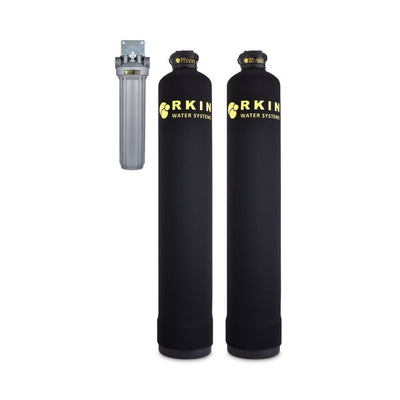
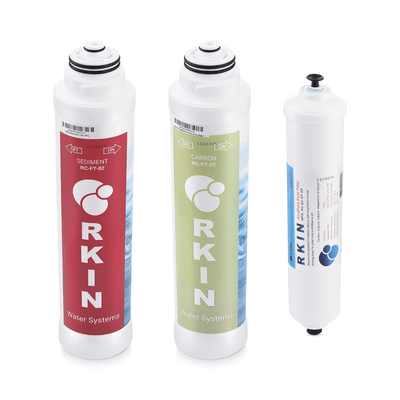
The RKIN OnliSoft Pro Salt-Free + Carbon Combo pairs TAC scale prevention with a dual-carbon bed that knocks down chlorine, chloramine, and many VOCs in one unit. No salt, no backwash, no brine discharge — useful when a utility has both shifted source and increased disinfectant dose. The TAC media carries a lifetime rating; the carbon cartridges and sediment prefilter follow a 6–12 month replacement schedule.
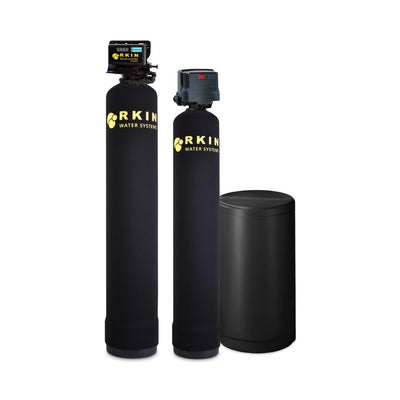
For very hard water above ~25 gpg or iron-heavy groundwater, the RKIN Whole House Salt-Based Water Softener actually strips calcium and magnesium out of the water rather than conditioning them. It is the right call when a utility switched to a deep-limestone aquifer and crystallization alone will not keep appliances safe.
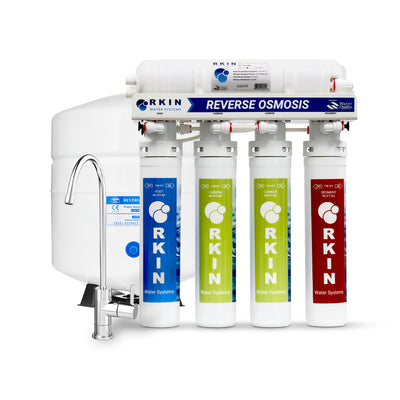
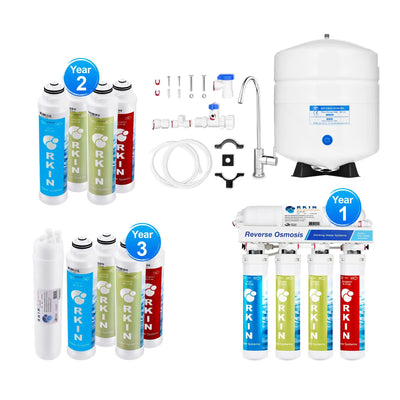
For drinking water, the RKIN Flash Undersink Reverse Osmosis System handles the dissolved solids and residual contaminants at the kitchen tap. Its 3.2-gallon storage tank means you are not waiting on production every time you fill a pot.
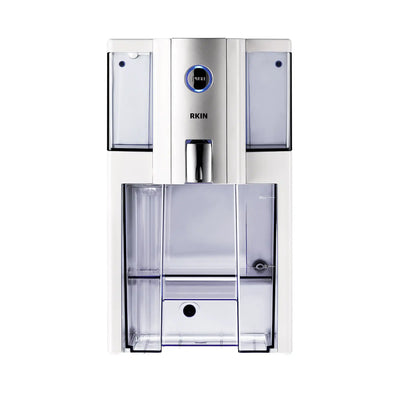
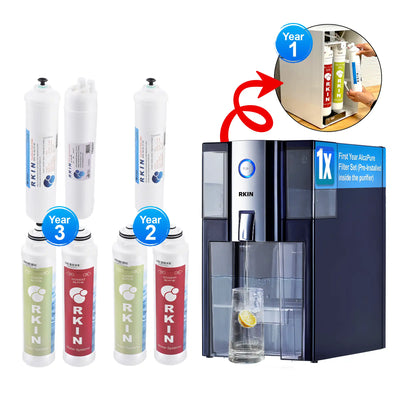
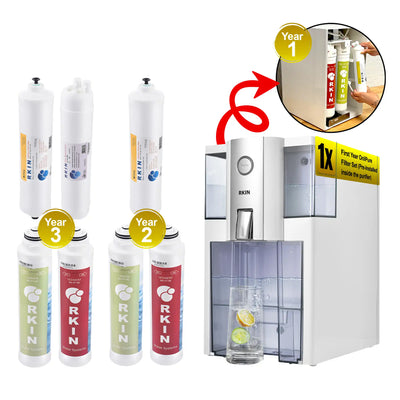
If you rent or cannot modify plumbing, the Zero Installation Purifier delivers RO-grade water at the countertop with no installation — it connects to your faucet and runs on its own.
Frequently Asked Questions
Can my city really change water sources without telling me?
Utilities are required to document source changes in their annual Consumer Confidence Report and to notify customers of violations, but routine source rotations — especially seasonal blending between reservoirs and wells — often happen without direct notice. The shift shows up in your water before it shows up in your mailbox.
How fast does the water change when a city switches sources?
Within a few days to a week. Distribution pipes hold a buffer of the old water, so the transition is gradual rather than instant. Homes nearest the treatment plant notice first; homes at the end of the distribution line lag by a few days.
Is harder water from an aquifer less safe than reservoir water?
Not inherently. Groundwater is often naturally cleaner microbiologically but carries more dissolved minerals. Safety depends on the specific contaminants present — which the utility's Consumer Confidence Report documents. The concern is usually scale damage, taste, and appliance life rather than acute health risk.
Do I need to replace my water heater if it is already scaled from the harder water?
Not always. A scaled heater can be descaled with a professional flush if the tank is otherwise sound. Preventing future buildup is where whole-house conditioning or softening pays back — a scaled heater loses 10–30% efficiency and often fails years early.
How often do RKIN whole-house filter cartridges need replacement?
On the OnliSoft Pro Combo, carbon cartridges and sediment prefilters replace every 6–12 months depending on water use and source quality. The TAC scale-prevention media is rated for the life of the system and does not require replacement.
Will a salt-free conditioner fix my cloudy glassware?
It prevents new scale buildup on glassware and fixtures but will not dissolve existing deposits. Expect a few weeks of cleanup — running the dishwasher with a citric-acid cycle, descaling faucet aerators, wiping fixtures — before the new baseline takes hold.
Ready to Match Your Water to What Comes Out of the Tap
A source switch is not your fault and not your plumber's problem. It is a new water profile arriving at your house, and the right response depends on what actually changed.
Start with the Consumer Confidence Report, run a simple hardness and TDS test, and match the equipment to the data. The RKIN OnliSoft Pro Combo handles moderate hardness plus disinfectant in one whole-house unit, and a point-of-use RO polishes drinking water at the kitchen sink. Ships free and sized to your household at rkin.com.





0 comments