



cloudy glasses dishwasher
Why Your Dishes Have White Spots After the Dishwasher

You unload the dishwasher and every glass has a chalky film. The plates look dull. The flatware has tiny white dots that wipe off with your thumb but come right back next cycle. You swap detergent brands. You add rinse aid. You run the cleaning cycle. The spots keep coming.
A 2023 Water Quality Association study found that 85% of U.S. homes have hard water, with most testing between 7 and 15 grains per gallon. At those levels, every dishwasher cycle deposits calcium and magnesium on whatever's inside the rack. The detergent never had a chance. The rinse aid isn't broken. Your water is doing exactly what hard water does — leaving minerals behind every time it evaporates.
What Those White Spots Actually Are
The chalky residue on your glasses isn't soap. It isn't food. It's mineral scale — the same stuff that builds up on faucet aerators and shower heads. When hard water heats up inside the dishwasher, calcium carbonate and magnesium come out of solution and bond to whatever surface they touch. The hotter and longer the cycle, the worse the deposit.
You can confirm it in 30 seconds. Soak a spotted glass in white vinegar for 10 minutes. If the spots dissolve, it's hard water scale. If they don't, you may be dealing with a separate issue (etching from soft water, food residue from a clogged spray arm, or a degraded heating element).
Most homeowners get told to "use more rinse aid" or "switch to a gel detergent." Those tactics mask the symptom for a few weeks. The minerals never stop coming out of the tap, so the deposits never stop forming.
Why Rinse Aid and Detergent Pods Don't Solve It
Rinse aid lowers the surface tension of water so it sheets off dishes instead of forming droplets. That helps in soft-water homes. In hard-water homes, it slows down spotting by a couple of cycles. It doesn't remove the minerals — it just helps them spread thinner.
Detergent pods with built-in water softeners (the ones marketed as "for hard water") use chelating agents like sodium citrate to grab calcium ions before they precipitate. They work, briefly. The catch:
- The dose is calibrated for moderately hard water (around 7–10 gpg). If your water tests above that, the chelators run out before the cycle finishes.
- They're more expensive per load — often double the cost of standard detergent.
- They don't address the buildup happening inside the dishwasher's heating element, pump, and spray arms.
A 2024 study from the American Cleaning Institute found that dishwashers running on water above 10 grains per gallon lose roughly 30% efficiency over five years, mainly from internal mineral buildup. The pump strains. The heater takes longer to reach temperature. Cycles run longer. Spotting gets worse year over year.
What Doesn't Work (and Why People Keep Trying It)
A few internet remedies show up in every "white spots on dishes" thread. Here's the honest reality on each:
- Vinegar in the rinse cup: Dissolves some existing spots, but vinegar damages rubber gaskets and seals over time. Most dishwasher manufacturers explicitly recommend against it.
- Citric acid powder: Works as a one-off cleaning cycle. Doesn't prevent next-cycle spotting.
- Lemi Shine or "booster" additives: Helpful as a short-term band-aid. You're still paying for a workaround every load.
- Hotter water: Counterintuitively, hotter water makes hard-water spotting worse because more minerals precipitate at higher temperatures.
- Pre-rinsing dishes: Doesn't matter. The spots come from minerals in the wash water itself, not from food residue.
None of these address the root cause: minerals dissolved in your incoming water. Treat the water and the spots disappear on their own.
The Real Fix — Treat the Water, Not the Dishes
Spotting is one of the cheapest symptoms of hard water to fix because the solution also pays for itself in other ways. Once you remove or condition the calcium and magnesium before it reaches the dishwasher:
- Dishes come out clean with standard detergent and no rinse aid
- Glassware stays clear instead of fogging up over time
- The dishwasher's heating element and pump last years longer
- You stop buying booster powders and specialty pods
- Soap scum on tile, shower glass, and faucets clears up at the same time
There are two paths, depending on what you want from your water.
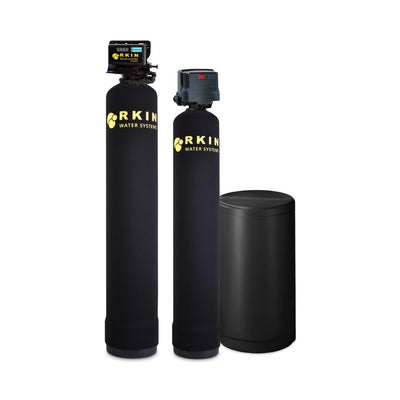
Salt-based water softener: The traditional solution. Ion exchange swaps calcium and magnesium for sodium, removing the minerals entirely. Dishes come out perfectly clear. You'll need to add salt every few weeks and the system uses a small amount of water to regenerate. Best for households with very hard water (above 15 gpg) or anyone who wants the cleanest possible result on dishes, glassware, and laundry.
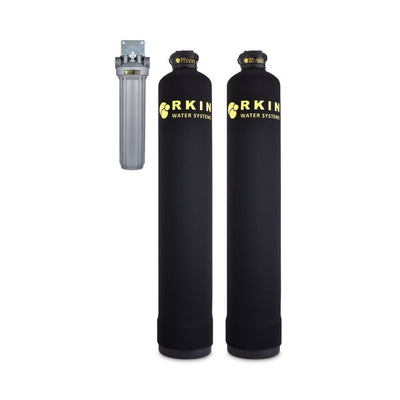
Salt-free water conditioner: Uses template-assisted crystallization (TAC) to convert dissolved minerals into a stable crystal form that won't bond to surfaces. The minerals are still in the water, but they don't deposit on dishes, fixtures, or pipes. No salt, no electricity, no wastewater. A good middle-ground for homes on city water with moderate hardness, or anyone who doesn't want the maintenance of a salt-based system.
How RKIN Approaches the Problem
The RKIN Whole House Salt-Based Water Softener is the right call for homes with very hard water or anyone who wants the spotless-glass result that only true softening delivers. It removes minerals at the source, so every fixture in the house — dishwasher, washing machine, shower, ice maker, water heater — runs on softened water. Dishes come out clear without rinse aid. Soap scum stops forming. Appliance lifespans go up.
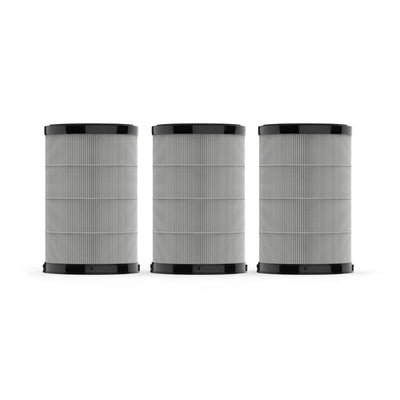
For homes that want the spot-free dishes without adding salt, the RKIN OnliSoft Salt-Free Water Conditioner uses TAC media to neutralize scale-forming minerals. No salt to buy, no regeneration cycles, no wastewater. Easier maintenance, and a good fit for households on municipal water with hardness in the 7–15 gpg range.
Both systems pay for themselves through longer appliance life, less detergent, and the end of the chalky-glass problem.
Frequently Asked Questions
How do I know if my dishwasher spots are from hard water?
Soak a spotted glass in white vinegar for 10 minutes. If the spots dissolve, it's hard water scale (calcium and magnesium). If they don't, the cause is something else — possibly etching from soft water that's too aggressive, a clogged spray arm, or food residue from incomplete cycles.
Will rinse aid stop white spots on glasses?
Rinse aid helps water sheet off dishes instead of forming droplets, which slows down spotting. It doesn't remove the minerals causing the spots. In hard-water homes, rinse aid stretches the time between visible spotting but doesn't eliminate it.
Is it safe to put vinegar in my dishwasher to remove hard water deposits?
A one-time cleaning cycle is usually fine, but most dishwasher manufacturers recommend against repeated vinegar use because acetic acid degrades rubber gaskets, seals, and hoses over time. Citric acid powder is a safer alternative for occasional descaling.
Does a water softener really fix dishwasher spots?
Yes. Salt-based softeners remove the calcium and magnesium that cause spotting before water enters the dishwasher. Most users see spot-free dishes within one cycle of installation and stop using rinse aid entirely. Salt-free conditioners reduce spotting significantly but don't fully eliminate it the way salt-based softening does.
How often do dishwasher spots damage glassware permanently?
Tempered glass and most everyday glassware survive years of hard-water exposure without permanent damage. Crystal, hand-blown, and decorative glass can develop permanent etching from prolonged hard-water cycles — usually after 2–3 years of daily use. Once etched, the cloudiness cannot be polished out.
Can I just buy harder detergent to fix this?
Stronger detergents and "hard water" pod formulations help with mild hard water (under 10 gpg) but become expensive workarounds at higher hardness levels. The math usually favors treating the water once — every appliance benefits, not just the dishwasher.
Ready to Get Spot-Free Dishes for Good?
You now know why rinse aid isn't fixing it and why the booster powders are a workaround, not a solution. Hard water is the cause. Treating the water at the source is the fix.
The RKIN Whole House Salt-Based Water Softener delivers true spot-free results for homes that want the cleanest possible glassware. Prefer no salt? The RKIN OnliSoft Salt-Free Water Conditioner stops scale buildup without ongoing salt maintenance. Either way, your dishwasher stops being a problem to manage and goes back to being something you don't think about.




0 comments