




agua con TDS bajos
What Should TDS Be After Reverse Osmosis? RKIN Guide

There is no universal “good” TDS number after reverse osmosis. Compare the feed-water and product-water readings to calculate rejection rate, then account for any remineralization stage that intentionally raises the final reading. TDS measures dissolved ions; it does not prove that water is safe or show which contaminants are present.
If you searched “what should TDS be after reverse osmosis,” you probably want a simple answer: a properly operating RO system should lower TDS substantially compared with incoming tap water, but there is no universal finished-water number. The better question is how to read that number in context, so you can tell normal break-in behavior from a system that needs attention.
The Problem: TDS Is Useful, but Easy to Misread
TDS stands for total dissolved solids. It is an estimate of dissolved minerals, salts, metals, and other charged particles in water. A handheld TDS meter measures electrical conductivity, then converts that reading into parts per million. It does not identify what those solids are.
That distinction matters. A reading of 35 ppm after reverse osmosis does not tell you which minerals remain. A reading of 250 ppm from tap water does not prove the water is poor. Dissolved solids can come from natural rock and soil contact, road salts, plumbing, and treatment chemicals. The EPA’s secondary drinking water standards guidance treats TDS as an aesthetic concern tied to taste, scaling, and overall water quality. In other words, TDS is a broad indicator, not a full lab report.
The EPA lists TDS under secondary drinking water standards, which focus on taste, odor, color, and scaling rather than primary contaminant limits. The secondary standard for TDS is 500 ppm, according to the EPA’s secondary drinking water standards guidance. That number helps explain why water can be “allowed” by a public system and still taste mineral-heavy, leave spots, or make you want better filtration at home.
After reverse osmosis installation, homeowners often expect a perfect zero. That is not the right benchmark for every system. RO membranes reject dissolved solids very well, but the final reading depends on source water, water pressure, membrane condition, filter design, storage tank behavior, and whether the system includes remineralization or alkaline post-treatment.
What Doesn’t Work: Chasing Zero Without Context
The most common mistake is testing only once, right after installation. New filters and membranes may need flushing before readings settle. If you test the first cup from a new system, the number may be higher than it will be after the recommended flush.
Another mistake is comparing your water to a neighbor’s without checking incoming TDS. If your tap water starts at 120 ppm and your filtered water reads 12 ppm, that is a 90 percent reduction. If someone else starts at 600 ppm and reads 45 ppm, their final number is higher, but the rejection rate may still be strong.
Boiling is not a fix for high TDS. When water boils, steam leaves while many dissolved solids stay behind, so the remaining water can become more concentrated. Basic carbon pitcher filters can improve taste and reduce some contaminants, but they are not designed to reduce dissolved solids the way reverse osmosis does. Bottled water also does not solve the testing question; its TDS varies by source and treatment method.
A TDS meter is best used as a quick trend tool. It can tell you whether your RO system is reducing dissolved solids, but it cannot replace certified contaminant testing when you need exact results.
The Solution: Calculate RO Rejection Rate
Instead of asking for one universal TDS number, start with a simple comparison: tap water TDS versus RO water TDS. Use this formula:
RO rejection rate = (tap TDS minus RO TDS) divided by tap TDS, multiplied by 100.
For example, if your tap water reads 300 ppm and your RO water reads 24 ppm, the reduction is 92 percent. That is a strong result for many residential reverse osmosis systems.
There is no universal post-RO ppm range because feed-water TDS, membrane performance, pressure, temperature, and post-treatment all affect the result. If incoming water is very low, post-RO water may read near single digits. If incoming water is high, the finished water may still be above 50 ppm while showing a good reduction percentage. Systems with remineralization may intentionally add selected minerals after the membrane, raising the final TDS reading while improving taste.
Here is a simple way to interpret common results:
- Very low TDS, strong reduction: Often expected after a flushed RO system with standard post-filtration.
- Moderate TDS with high reduction: Usually normal when source water starts high or when remineralization is included.
- High TDS with weak reduction: May point to a membrane not seated correctly, insufficient flushing, low pressure, or a filter that needs service.
- TDS suddenly rises after months of stable readings: Check filter life, membrane condition, and storage tank behavior.
The NSF consumer guide to reverse osmosis explains that RO systems use pressure to push water through a membrane that can reduce many dissolved substances. Look for clear performance information, accurate product instructions, and a filter replacement schedule you can follow.
When testing, flush the system as directed, use a clean glass, and test tap and RO water at the same time. Let the meter stabilize. Rinse the probe between samples. If your system uses a storage tank, test after the tank has filled and again after drawing several cups. Tank water can read differently than water produced directly from the membrane because of normal mixing and post-filter contact.
How RKIN RO systems fit the TDS question
RKIN’s RO systems use different installation and post-treatment designs, so their finished-water readings should not be treated as interchangeable.
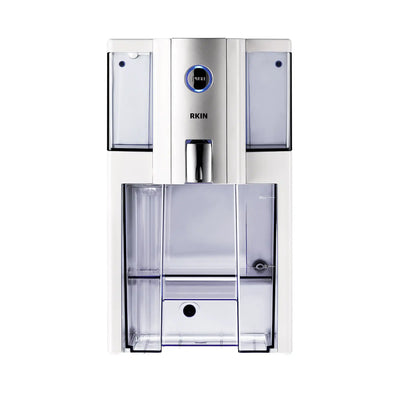
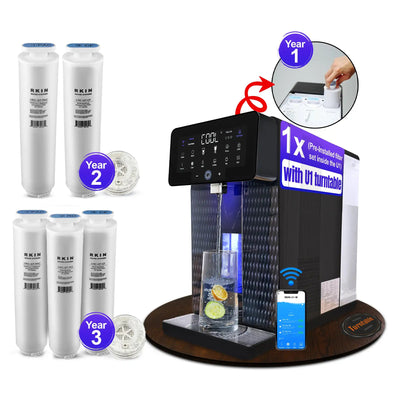
The RKIN U1-W Space-Saving 4-in-1 Water Filter System is a no-plumbing countertop RO system with a refill tank and remineralization. Remineralization can raise the final TDS reading after the RO membrane, so compare readings with the current manual rather than assuming a zero-TDS target.
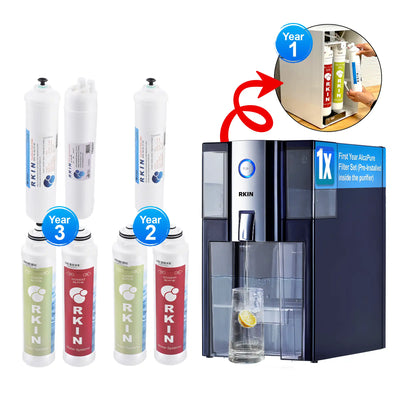
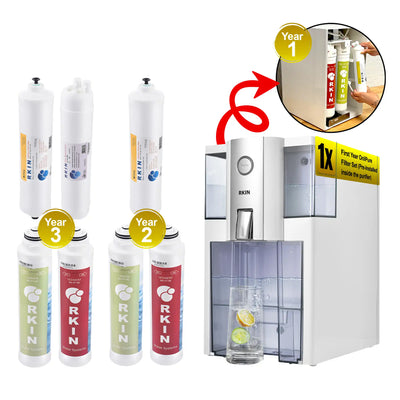
The Zero Installation Purifier has two editions: AlcaPure returns calcium and magnesium and targets pH 7–8, while OnliPure targets zero TDS. The edition changes how the finished-water reading should be interpreted.
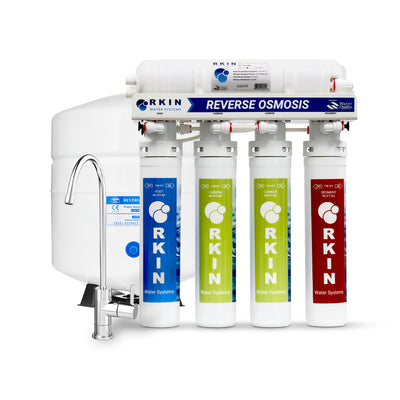
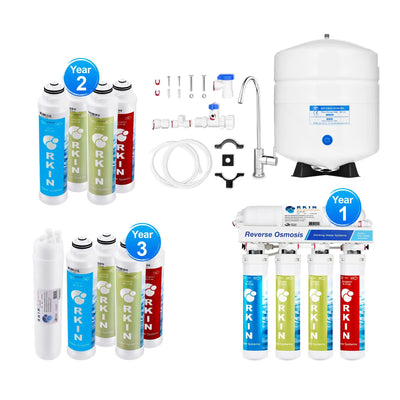
The RKIN Flash Undersink RO System connects to the cold-water line, uses a 75 GPD membrane and a 3.2-gallon storage tank, and offers AlcaPure and OnliPure postfilter options. Its NSF/ANSI 58 certification applies to the RO membrane, not the complete system.
What Your Reading May Mean After Installation
If your TDS is higher than expected right after installation, do not assume the system is failing. First, confirm the system was flushed exactly as the manual says. New carbon fines, preservative rinse-out, and initial membrane wetting can all affect early readings. Testing before the system has completed its first proper flush can create unnecessary concern.
Second, calculate the rejection rate. A raw number without the tap-water baseline is incomplete. If tap water is 450 ppm and RO water is 35 ppm, the system is reducing TDS by more than 90 percent. If tap water is 180 ppm and RO water is 90 ppm, the final number is lower, but the reduction is weak and worth checking.
Third, consider the system design. Some post-filters can add a small amount of dissolved material back to the water for taste. That can raise the meter reading while the RO membrane is still doing its work. This is why TDS meters are helpful for system trends, not for identifying every substance in the water.
Fourth, repeat the test after a full day of normal use. Stable readings are more useful than one first-cup measurement. If the result stays high and the rejection rate remains low, inspect installation steps, filter seating, and replacement timing. If you are unsure, contact RKIN support with both tap and filtered readings so the team can help interpret the numbers.
Frequently Asked Questions
What should TDS be after reverse osmosis?
There is no universal finished-water TDS target. Compare tap-water TDS with RO-water TDS, then check the model’s documented range and post-treatment design. Judge performance by the change from feed water to finished water, the manufacturer’s documented range, and whether the system has been flushed and maintained correctly.
Is zero TDS the goal after RO filtration?
Not always. A near-zero reading can happen, especially with low source-water TDS, but it is not the only sign of good performance. If the system includes remineralization or a taste-focused post-filter, the final TDS may be higher by design.
Why is my RO TDS high after installation?
Common reasons include not flushing the system fully, testing too soon, low water pressure, a membrane that is not seated correctly, or very high incoming TDS. Test tap and RO water together, calculate rejection rate, then retest after normal use.
Does a TDS meter show if water is safe?
No. A TDS meter estimates dissolved solids by conductivity. It does not identify lead, PFAS, nitrate, microbes, or other specific concerns. The CDC recommends using appropriate testing when you need details about specific water quality issues.
How often should I test RO TDS?
Test after installation, after filter changes, and whenever taste or flow changes noticeably. Many homeowners also test monthly to learn their system’s normal range. A sudden rise from your usual reading is more useful than comparing your number to someone else’s.
Which RKIN RO system should I choose for lower TDS?
Choose based on installation preference and space. The RKIN U1-W Space-Saving 4-in-1 Water Filter System and RKIN Zero Installation Purifier are countertop RO options. The RKIN Flash Undersink RO System is for under-sink installation with a storage tank.
Ready to Understand Your RO Water?
A TDS meter is a helpful starting point when you know how to use it: test tap water, test filtered water, calculate the reduction, and watch for changes over time.
Compare the RKIN U1-W Space-Saving 4-in-1 Water Filter System if you want no-plumbing countertop RO with a refill tank and remineralization, then use the current manual to interpret TDS readings.






0 comentarios