




forever chemicals home filter
How to Remove PFAS From Drinking Water at Home

If you've watched the news in the last 18 months, you've heard the phrase "forever chemicals." PFAS — per- and polyfluoroalkyl substances — are a class of about 15,000 synthetic compounds used in everything from non-stick pans to firefighting foam to fast-food wrappers since the 1940s. They're called "forever" because they don't break down. Once they're in groundwater, they stay.
The U.S. Geological Survey's July 2023 study detected at least one PFAS chemical in 45% of U.S. tap water samples. The Environmental Protection Agency finalized its first-ever federal PFAS drinking water standard in April 2024, setting limits of 4 parts per trillion for PFOA and PFOS, with a 2029 utility compliance deadline. Translation: most utilities won't be in compliance for years, and the legal limit is set so low because the chemicals are biologically active at almost any detectable level.
If you're not waiting until 2029, here's what works at home — and what to ignore.
What PFAS Actually Are and Why They're Hard to Filter
PFAS molecules are built around a chain of carbon atoms bonded to fluorine — one of the strongest chemical bonds in nature. That bond is what makes them useful (water-repellent, heat-resistant, slippery) and what makes them nearly impossible to break down naturally.
Two facts matter for filtration:
- They're tiny. PFOA and PFOS molecules are smaller than most filter pore sizes. Standard sediment filters and basic activated carbon don't reliably remove them.
- They don't degrade. Most filtration relies on chemical or physical breakdown. PFAS resist both, which is why they accumulate in the body — the CDC's NHANES data shows PFAS in the blood of nearly every American tested.
Common health concerns flagged in peer-reviewed research include altered cholesterol, immune effects, and developmental impacts in children. We're not making medical claims here — go to your doctor if you have specific exposure concerns. We're describing what the regulators have written into the rules.
What Doesn't Reliably Remove PFAS
Save your money. The following do not remove PFAS at meaningful rates:
- Standard pitcher filters (basic activated carbon) — most are not certified for PFAS reduction. Some newer specialty pitchers claim PFAS reduction but require frequent cartridge changes.
- Refrigerator water filters — most are NSF/ANSI 42 (chlorine, taste) certified only. They are not certified for PFAS unless the spec sheet says NSF/ANSI 53 or NSF/ANSI 58 with a P473 designation.
- Boiling water — does nothing. PFAS are non-volatile. Boiling concentrates them as water evaporates.
- Water softeners — they exchange calcium and magnesium ions for sodium. They do not address PFAS at all.
- UV purifiers — kill bacteria. They do not remove dissolved chemicals.
- Bottled water — a 2024 PNAS study found roughly 240,000 plastic fragments per liter of bottled water on average, and PFAS testing of major brands has found detectable levels in many.
What Actually Removes PFAS at Home
Three technologies consistently reduce PFAS to below the EPA's 4-ppt limit when properly certified and maintained:
1. Reverse Osmosis (RO)
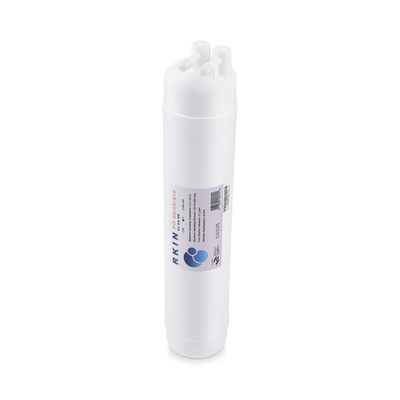
The most reliable home option. RO uses a semi-permeable membrane with pores roughly 0.0001 microns — small enough to block PFOA, PFOS, GenX, PFBS, and most other PFAS species along with lead, arsenic, fluoride, nitrates, and microplastics.
Look for systems certified to NSF/ANSI 58 for reverse osmosis, with a specific P473 protocol designation for PFOA/PFOS reduction. Or, where formal certification doesn't exist, third-party lab data showing PFAS reduction below detection limits.
RO systems come in two formats:
- Countertop RO — sits on the counter, fills from the tap, no plumbing required
- Under-sink RO — plumbed into the cold supply line, dedicated faucet, permanent install
Both filter the same way. The difference is install permanence.
2. Activated Carbon Block (NSF/ANSI 53 P473)
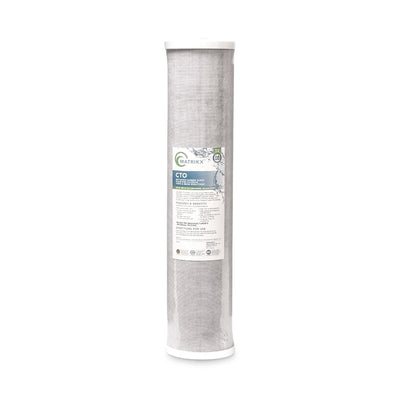
Specialty activated carbon block filters with sufficient surface area can reduce certain PFAS species. The key is certification — NSF/ANSI 53 with a P473 designation specifically tests for PFOA and PFOS reduction. Generic carbon filters are not certified for this.
Limitations:
- Only effective against the specific PFAS species the manufacturer tested
- Performance drops as the filter saturates — replacement timelines are critical
- Less effective against shorter-chain PFAS (GenX, PFBS) than RO
3. Ion Exchange Resins (Anion Exchange)
Used in commercial-scale treatment and some specialty home systems. Highly effective for PFAS but requires careful media disposal (the spent resin holds the chemicals). Less common in residential systems and typically more expensive than RO.
What to Look For When Choosing a PFAS Filter
Six things to verify before you buy:
- NSF/ANSI 53 P473 OR NSF/ANSI 58 certification, with PFAS specifically called out on the spec sheet — not just on marketing copy
- Third-party test data — reputable manufacturers publish reduction rates by contaminant. Ask for it.
- Multi-stage configuration — single-cartridge filters are easier to overload. 4–5 stages give you redundancy.
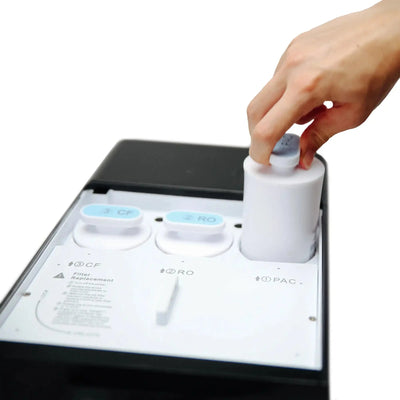
- Reasonable replacement schedule — sediment and carbon stages every 6–12 months, RO membrane every 18–24 months
- Whole-system flow rate that matches your household — undersized systems get pushed past their tested capacity
- U.S. or EU manufacturing with traceable supply chain and customer support — when something fails, you want answers
What to ignore: "alkaline water" claims, hydrogen-rich water claims, structured water claims. None of those address PFAS. Most are pseudoscience layered on top of basic filtration.
What RKIN Recommends for PFAS
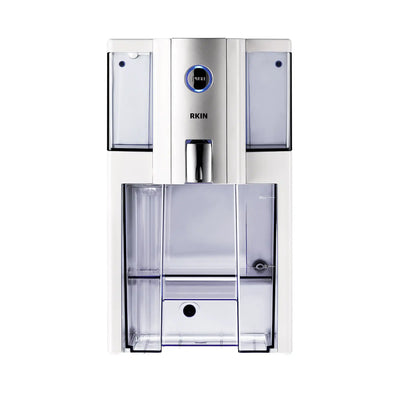
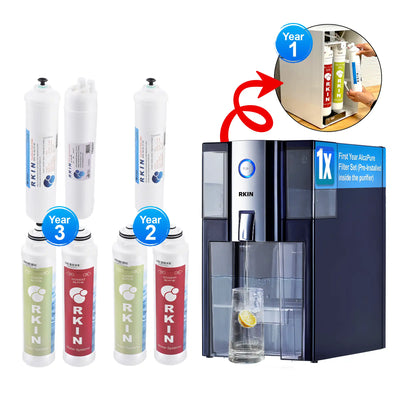
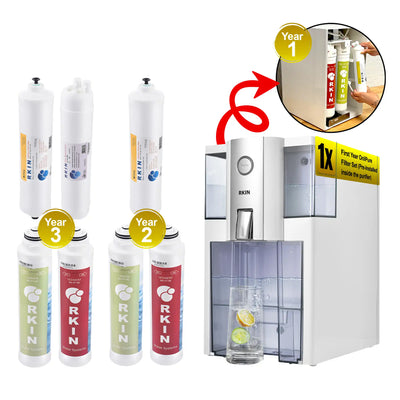
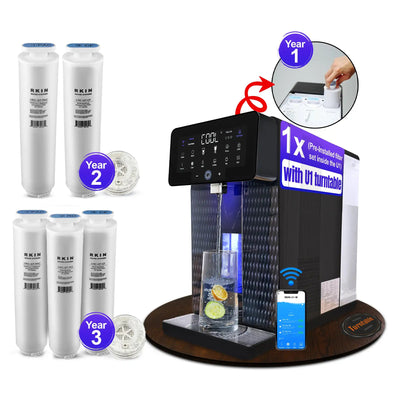
For most households, the RKIN Zero Installation Purifier is the simplest path. It's a 5-stage countertop reverse osmosis system, third-party tested for PFOA, PFOS, lead, fluoride, arsenic, and microplastics. No plumbing, plug-and-go setup, fits on a standard counter. For renters, this is the only realistic option that hits RO-grade reduction without modifying the home.
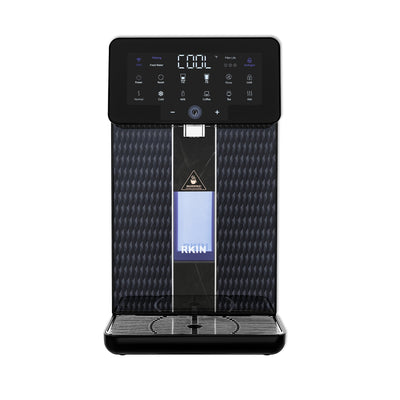
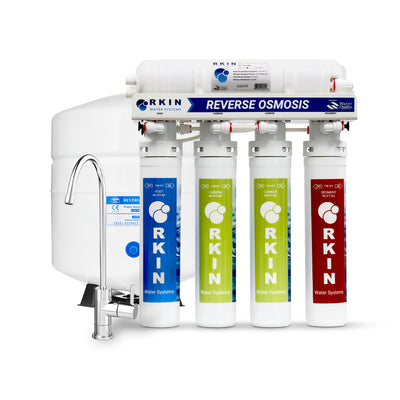
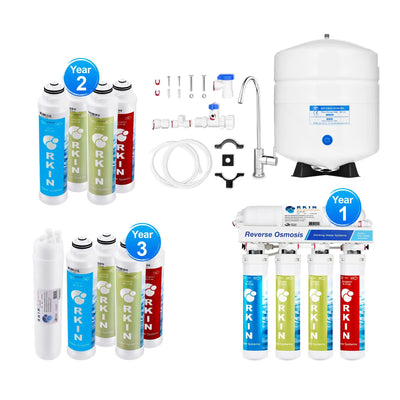
For homeowners who want a permanent installation, the RKIN Flash Undersink RO System is the same filtration logic in an under-sink format, with a dedicated faucet at the kitchen sink and higher daily output. Most owners install it themselves with the included quick-connect fittings.
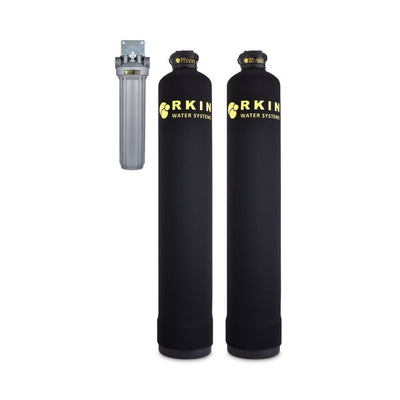
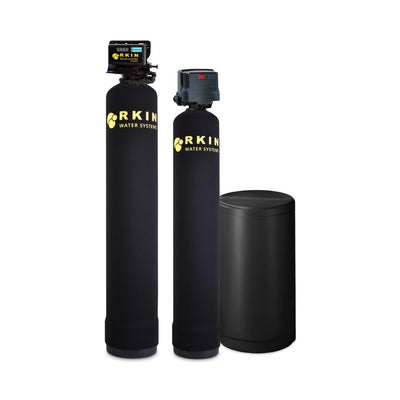
If you're concerned about PFAS in cooking water, laundry, and showers — not just drinking — a whole-home reverse osmosis system treats every tap in the house. This is heavier infrastructure and should be sized to a tested water profile, but it's the answer when PFAS exposure beyond drinking water is the concern.
A Practical Path Forward
You don't have to wait for the EPA's 2029 compliance deadline. You don't have to read every PFAS study published in the last decade. Here's the short version:
- Test your water. Order an EPA-certified lab test ($75–$200) or check your utility's Consumer Confidence Report for PFAS data.
- Match the filter to the problem. PFAS confirmed → reverse osmosis (countertop or under-sink). Multiple contaminants → multi-stage RO is the universal answer.
- Verify certifications, not slogans. NSF/ANSI 53 P473 or NSF/ANSI 58 — those are the certifications that matter for PFAS.
- Stay on the maintenance schedule. A great filter past its replacement date is a worse filter than a basic one in spec.
Filtration isn't a one-time purchase. It's a habit. The household that swaps cartridges on schedule gets the protection. The one that buys a system and forgets it for three years doesn't.
Frequently Asked Questions
Does reverse osmosis remove PFAS from drinking water?
Yes. Reverse osmosis systems certified to NSF/ANSI 58 with a P473 protocol designation are tested to reduce PFOA and PFOS below detection limits. The RO membrane's pore size — roughly 0.0001 microns — is smaller than PFAS molecules, so they're physically blocked rather than chemically broken down. RO is currently the most reliable home option for the broadest range of PFAS species.
Will a Brita or PUR pitcher filter remove PFAS?
Most standard activated-carbon pitcher filters are NSF/ANSI 42 certified for chlorine and taste only — not for PFAS. Some newer specialty pitchers claim PFAS reduction with NSF/ANSI 53 P473 certification, but cartridge life is short and reduction rates drop as the filter saturates. Always check the specific certification, not the marketing copy.
Is bottled water safer than tap water for PFAS?
Not necessarily. A 2024 PNAS study found bottled water contains an average of 240,000 plastic fragments per liter, and independent testing has found detectable PFAS in many major brands. Bottled water is also unregulated for PFAS at the federal level, while public tap water now has enforceable EPA limits (in effect through 2029 compliance). Filtering tap water at home is more reliable than buying bottles.
How will I know if my tap water has PFAS?
Two ways. First, check your local utility's annual Consumer Confidence Report — utilities are now required to publish PFAS testing data. Second, order an EPA-certified PFAS test through a lab like Cyclopure, SimpleLab Tap Score, or your state environmental agency. Tests run $75–$200 and analyze for the most common PFAS species.
Do I need a whole-house filter for PFAS or is a kitchen filter enough?
For drinking and cooking, a point-of-use reverse osmosis system at the kitchen sink covers the highest-exposure pathways (drinking, ice, food prep, beverages). For shower exposure and laundry, a whole-home reverse osmosis system or specialty whole-home PFAS filtration is needed. The decision comes down to your specific water test results and what you're optimizing for.
How often do I need to replace filters in a PFAS removal system?
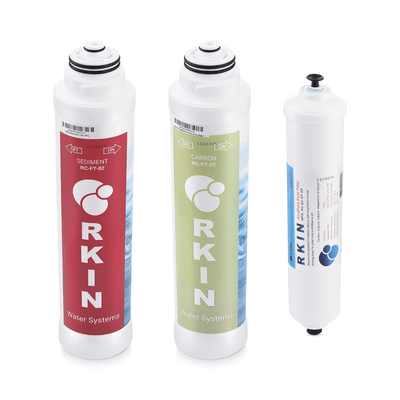
For multi-stage countertop or under-sink reverse osmosis: sediment pre-filters every 6–12 months, carbon pre-filters every 12 months, the RO membrane every 18–24 months, and post-carbon polishing filters every 12 months. Filter life depends on incoming water quality and household usage. Skipping replacement past the schedule reduces PFAS performance — set a calendar reminder.
Ready to Get PFAS Out of Your Water?
You don't need to wait for utility compliance, panic over headlines, or guess at certifications. You need a filter built for the contaminants in your specific water.
Start with the RKIN Zero Installation Purifier — 5-stage countertop reverse osmosis, third-party tested for PFAS, lead, arsenic, fluoride, and microplastics. No plumbing, no installer, no callback fee. Or explore our full whole-house water treatment lineup if PFAS exposure beyond the kitchen tap is the concern.





0 comments