




bottled water vs filtered
PFAS in Bottled Water: Why a Filter Beats the Bottle

For years, the assumption was simple. If you didn't trust your tap, you bought bottled. Recent independent testing has flipped that logic on its head. A growing list of studies — from Consumer Reports' 2020 investigation through more recent peer-reviewed work in 2024 — has found per- and polyfluoroalkyl substances (PFAS) in bottled water samples across dozens of brands, often at concentrations that match or exceed what comes out of a typical municipal tap.
The numbers matter because the EPA's 2024 final drinking water standard set enforceable limits of 4 parts per trillion (ppt) for PFOA and PFOS — levels so low they were considered detection-only thresholds a decade ago. That rule applies to public water utilities. It does not apply to bottled water sold under FDA jurisdiction. The result is an asymmetry: tap water now has the strictest PFAS rules in U.S. history, while bottled water sits under softer guidance from a different agency.
What the Testing Has Found
Several lines of independent research have converged on the same conclusion:
- Consumer Reports (2020): Detected PFAS in 39 of 47 bottled water brands tested. Seven non-carbonated brands and 12 carbonated brands had levels above 1 ppt for total PFAS.
- Johns Hopkins (2021): Found measurable PFAS in 39 of 101 bottled water samples sourced globally, with U.S. brands tracking close to the international average.
- Peer-reviewed analysis published in Environmental Pollution (2024): Reported PFAS detection in roughly 40% of bottled water samples surveyed, with several exceeding the EPA's new 4 ppt threshold for PFOA or PFOS individually.
- EWG bottled water scorecard (updated 2024): Documented brand-by-brand contaminant data showing PFAS, arsenic, and disinfection byproducts in mainstream products.
Bottled water isn't uniformly worse than tap. Some brands test cleaner. The point is that the assumption "bottled = pure" doesn't hold up. Once you know the bottle isn't a guarantee, the question becomes whether there's a better option than rolling the dice on whichever brand happens to be on sale.
Why PFAS Get Into Bottled Water
Three pathways:
- Source water. Most bottled water comes from municipal supplies or springs that may already contain low-level PFAS contamination from industrial sites, firefighting foam, or wastewater discharge upstream. The USGS estimated in a 2023 nationwide study that at least 45% of U.S. tap water sources contain measurable PFAS.
- Processing equipment. Some bottling lines use Teflon-lined fittings, gaskets, and membranes that can leach trace PFAS into the product.
- The packaging itself. Plastic bottles can contribute small amounts of fluorinated compounds, particularly if exposed to heat during transport or storage.
None of these are necessarily violations of federal rules. They're a structural reality of an industry where the source water is often only required to meet the same standards as tap water — and where there's no public reporting requirement equivalent to a municipal Consumer Confidence Report.
The Cost Comparison Most People Skip
A typical American household spends roughly $100–$300 per month on bottled water if it's a primary drinking source, according to data summarized in a 2023 environmental analysis. Even at the low end, that's $1,200 a year for a product whose contaminant profile is — at best — unverified, and at worst comparable to the tap.
By contrast, a properly chosen home filtration system addresses the root cause once and produces unlimited filtered water on demand. The math gets one-sided fast.
Why Reverse Osmosis Beats the Bottle for PFAS
Reverse osmosis (RO) is the most thoroughly studied technology for PFAS removal in residential water treatment. The EPA's drinking water treatability database ranks RO as one of the highest-performance options for both long-chain and short-chain PFAS, often achieving 95%+ rejection.
The mechanism is physical, not chemical. RO membranes have pores measured in angstroms — small enough that PFAS molecules, which are larger than water molecules, can't pass through. The contaminants are flushed away with the reject stream while clean water passes to the storage tank.
Three things make RO particularly effective for the PFAS problem:
- It works on a wide range of PFAS variants, not just the two regulated by the EPA. There are thousands of PFAS compounds; RO doesn't care about the specific chemistry.
- It addresses other contaminants in the same pass — chlorine, lead, fluoride, arsenic, nitrates, dissolved solids — so you're not solving one problem and ignoring others.
- Performance is verifiable. NSF/ANSI 58 certification for PFAS reduction is a published, third-party-tested standard. Bottled water has no equivalent transparency.
What Doesn't Reliably Remove PFAS
If you've considered cheaper alternatives, here's what the EPA database and independent studies actually show:
- Pitcher filters: Most are designed for taste and chlorine. Only a handful of pitcher products carry NSF certification for PFAS reduction, and those typically have very short cartridge life.
- Refrigerator filters: Same story. A few specific cartridges are certified, most are not.
- Boiling water: Has zero effect on PFAS. They're chemically stable at boiling temperatures (which is why they're called "forever chemicals").
- Letting water sit out: Removes chlorine via off-gassing. Does nothing for PFAS.
- Activated carbon alone: Reduces some PFAS variants but performance varies dramatically by carbon type and contact time. RO + carbon together is the standard.
Where the RKIN U1 and Flash Fit
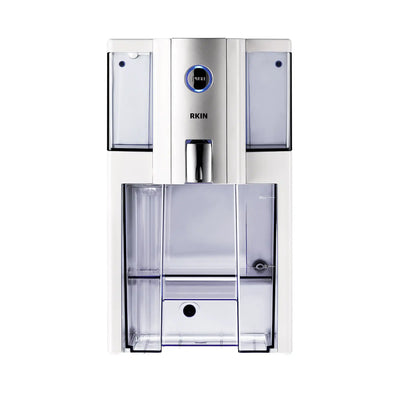
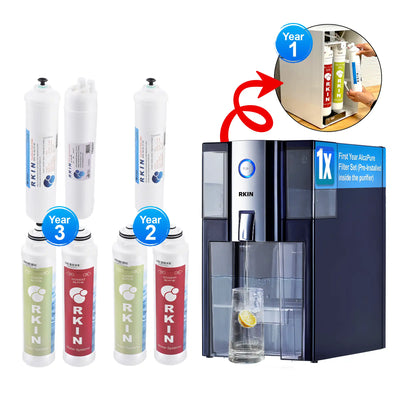
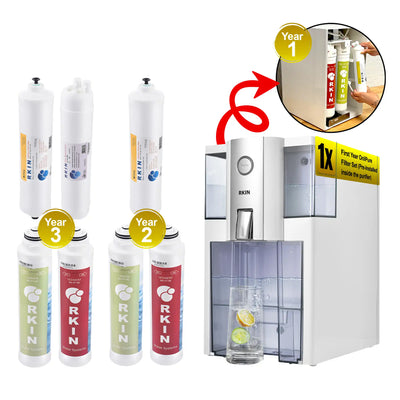
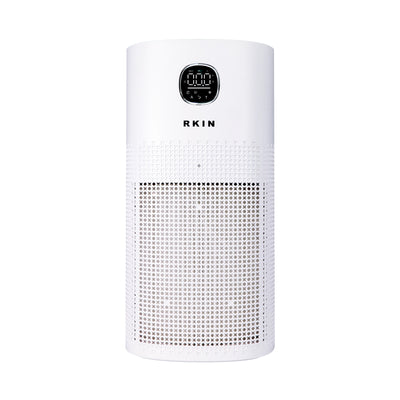
The RKIN U1 4-in-1 Water Filter System is a countertop reverse osmosis unit designed for renters, apartments, and homes that want PFAS-grade filtration without plumbing modifications. It's 3rd-party tested for contaminant reduction including PFAS, lead, arsenic, fluoride, and TDS. You fill the tank, plug it in, and use the dedicated dispenser. No installation, no permanent fixture.
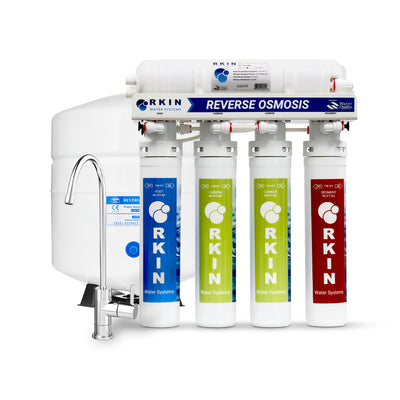
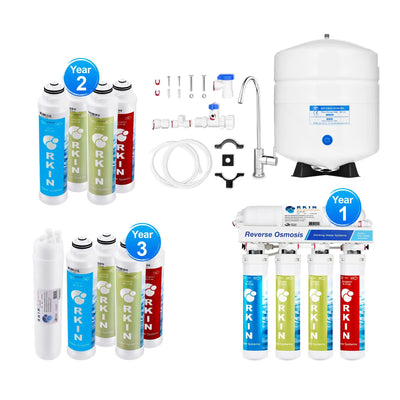
For homes with the option of a permanent install, the RKIN Flash Undersink RO System mounts under the kitchen sink, connects to the cold water line, and stores filtered water in a 3.2-gallon tank for on-demand dispensing through the included faucet. It produces 75 gallons per day and uses no electricity.
Both systems address the same fundamental issue: when you control the filtration, you don't have to trust someone else's bottling line, packaging, and supply chain to do it for you. You verify the certification once, replace cartridges on schedule, and pour what comes out of the tap.
Frequently Asked Questions
Is bottled water actually safer than tap water?
Not necessarily. Recent testing has found measurable PFAS in many bottled water brands, and the FDA standards governing bottled water are generally less strict than the EPA's new 2024 PFAS rules for tap water. Some bottled brands test cleaner than tap; some test worse. There's no consistent label or certification that lets a consumer tell which is which.
What level of PFAS is considered safe in drinking water?
The EPA's 2024 enforceable limits are 4 parts per trillion for PFOA and 4 ppt for PFOS, with additional limits on a few other PFAS variants. Some health organizations advocate for even lower limits. The EPA's health advisory goal is essentially zero — meaning no level has been identified as having no risk.
Do all reverse osmosis systems remove PFAS?
Most quality residential RO systems remove the majority of PFAS by design, but for verified performance look for NSF/ANSI 58 certification or independent third-party testing specifically listing PFAS reduction. RKIN systems publish their third-party test results.
How long does an RO filter last?
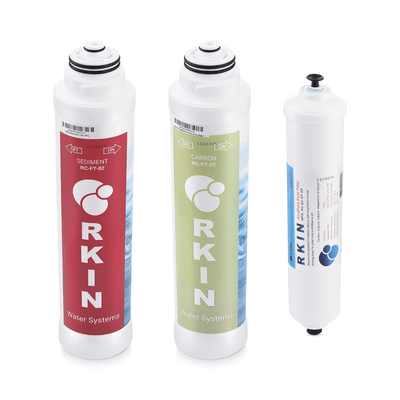
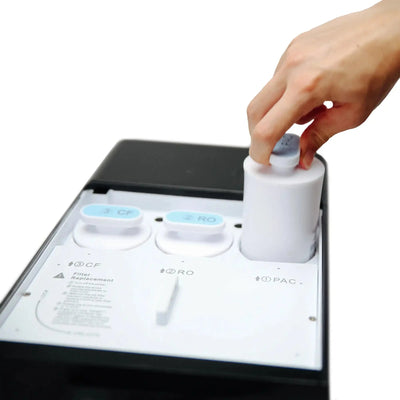
It depends on the stage. Sediment and carbon prefilters typically last 6–12 months. The RO membrane itself usually lasts 2–3 years for the U1 and Flash systems. Replacement cartridges are scheduled by gallons or months, whichever comes first.
Does RO remove healthy minerals along with the contaminants?
Yes — RO is a non-selective filtration. It removes calcium, magnesium, and trace minerals along with the contaminants. Most adults get the bulk of their dietary minerals from food, not water, and the amounts in tap water are nutritionally minor. If you want a remineralization stage, RKIN systems offer alkaline post-filter options that add back beneficial minerals after RO.
Is bottled water better in an emergency?
Bottled water has shelf-life advantages in true emergencies (hurricanes, boil notices, infrastructure failures). For day-to-day drinking, a home RO system produces equivalent or better water at a fraction of the recurring cost — and reduces the plastic waste stream by hundreds of bottles per year per household.
Stop Buying What You Can Make at Home
If your reason for buying bottled water is to avoid contaminants, the testing data has caught up to that strategy. A reverse osmosis system at the point of use gives you transparent, third-party-verified filtration that doesn't depend on whichever brand happens to be on the shelf this week.
See the RKIN U1 4-in-1 Water Filter System — countertop reverse osmosis, 3rd-party tested for PFAS, lead, arsenic, fluoride, and TDS. No installation, no plumbing modifications, no monthly bottle deliveries. Ships free.





0 comments