
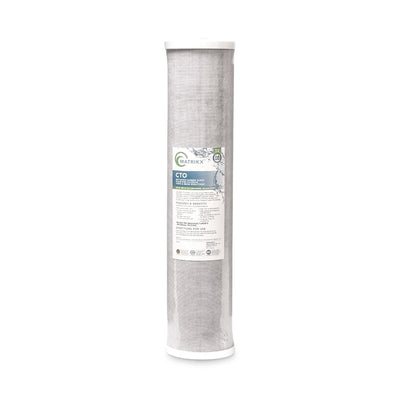
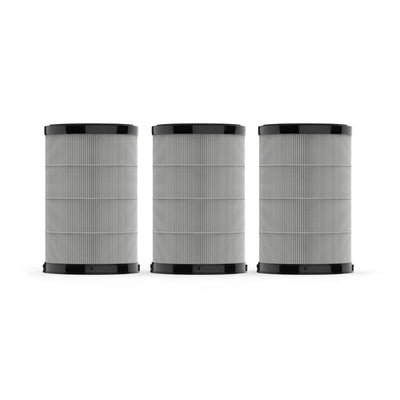




crusty buildup around toilet
White Powder at the Base of Your Toilet? Here's Why

You wipe it up. A week later it's back. A crusty white or yellowish powder, sometimes a little damp, pooling around the base of your toilet where the porcelain meets the floor. You blame the wax ring. You call a plumber. He shrugs, swaps the seal, charges you for the visit — and three months later, the powder is back again.
That powder isn't a plumbing failure. It's your water leaving behind evidence. According to the U.S. Geological Survey, roughly 85% of American homes have hard water, and the mineral concentration in the average U.S. supply has been climbing alongside groundwater depletion. Once you understand what's actually creating that buildup, the fix becomes obvious — and it's not another wax ring.
What That White Powder Actually Is
The crusty deposit is almost always mineral scale — a mix of calcium carbonate, magnesium carbonate, and trace silicates left behind when hard water evaporates. When even a tiny amount of water seeps from a toilet's tank-to-bowl gasket, supply line connection, or floor flange seal, it doesn't pool noticeably. It wicks out slowly, evaporates, and deposits its dissolved minerals on the porcelain and flooring.
Over weeks, those microscopic deposits stack up into the visible powder you keep wiping away. The water itself is gone. The minerals stay.
Three telltale signs you're dealing with mineral scale, not a leak:
- The powder is dry and crumbly, not wet
- It's white, off-white, or pale yellow (not brown — brown points to iron or sewage)
- It reappears on the same spots after cleaning, on a predictable cycle
If you scrape it off and dissolve it in white vinegar, it fizzes. That fizz is calcium carbonate reacting with acetic acid — a quick at-home confirmation.
Why "Fixing the Toilet" Doesn't Stop It
Plumbers default to mechanical answers: new wax ring, new supply line, re-seat the toilet, replace the tank gasket. Those fixes can help if there's a true visible leak. But when the seepage is microscopic — measured in drops per day, not per hour — even a perfect seal won't fully stop it. Toilets flex slightly every time you sit on them. Supply lines breathe with pressure changes. Tiny amounts of water find their way out.
In a home with soft, low-mineral water, those drops would evaporate without leaving a trace. In a hard-water home, every drop deposits a few milligrams of dissolved solids. Multiply by hundreds of evaporation cycles per month, and you get visible buildup.
The same physics explains the other hard-water symptoms you're probably ignoring:
- Cloudy spots on glassware fresh out of the dishwasher
- White crust around faucet aerators and showerheads
- A chalky ring inside the kettle
- Soap that won't lather, and dry, itchy skin after showering
If you have powder at the toilet, you almost certainly have at least one of those too.
What's Actually Coming Through Your Pipes
Hardness is measured in grains per gallon (gpg) or parts per million (ppm). The Water Quality Association classifies water as:
- Soft: under 1 gpg (under 17 ppm)
- Slightly hard: 1–3.5 gpg
- Moderately hard: 3.5–7 gpg
- Hard: 7–10.5 gpg
- Very hard: over 10.5 gpg
Most American municipal supplies fall in the moderately hard to very hard range. Florida, Texas, Arizona, the Midwest, and large parts of the Southwest routinely report water at 15–25 gpg. Well water can run even higher, especially in areas with limestone bedrock.
A simple test strip from the hardware store gives you a number in 60 seconds. If you're above 7 gpg, you have a hard-water problem — and the powder at your toilet base is one of the cheaper symptoms. The expensive ones are coming.
The Damage You Don't See Yet
Mineral scale at the toilet is cosmetic. The same minerals doing more serious damage where you can't see them are not.
Inside your water heater, calcium carbonate precipitates onto the heating element and tank bottom as the water warms. A 2019 study from the New Mexico State University Engineering Research Center found that just a quarter-inch of scale on a water heater element can cut efficiency by 20–25%. Most water heaters in hard-water homes accumulate that much in three to five years.
Inside your pipes, scale narrows the interior diameter, restricting flow. Inside your dishwasher and washing machine, it gums up valves and pumps. Inside your fixtures, it cements aerators and shower heads into low-flow misery.
The American Water Works Association estimates that hard water raises the average homeowner's annual appliance and plumbing maintenance cost by $325–$650 per year, with replacement cycles for water heaters, dishwashers, and washing machines shortened by 30–50%.
That powder at the toilet base is the canary. The water heater is the coal mine.
Why Pitcher Filters and Softening Salts Aren't the Answer
Most people's first instinct is to filter what they drink. A pitcher filter or refrigerator filter helps with taste and chlorine, but it doesn't touch the water going to your toilets, washing machine, or water heater. The minerals are still doing damage everywhere else in the house.
The traditional answer has been a salt-based water softener — a tank that uses ion exchange to swap calcium and magnesium for sodium. It works, but it has trade-offs:
- Adds sodium to your drinking water (a concern for low-sodium diets)
- Requires regular salt purchases and bag-hauling
- Wastes water during regeneration cycles (typically 50–150 gallons per week)
- Discharges brine, which is banned or restricted in some U.S. states
For homeowners who want the protection without the salt, template-assisted crystallization (TAC) technology is the modern alternative. TAC media converts the dissolved calcium and magnesium into harmless microscopic crystals that pass through your plumbing without sticking. The minerals stay in the water (so it's still healthy to drink), but they no longer form scale.
Solving the Problem at the Source
The cleanest fix is to treat the water before it reaches the toilet — and before it reaches your water heater, dishwasher, washing machine, and showerheads. That means a whole-house treatment system installed where the main water line enters your home.
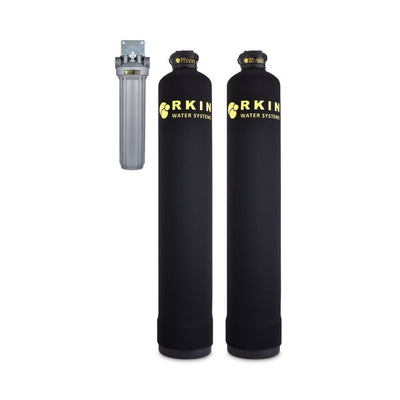
The RKIN OnliSoft Pro Salt-Free + Carbon Combo is designed for exactly this scenario: hard water plus chlorinated municipal supply. It pairs salt-free TAC scale control with a high-capacity carbon filter that removes chlorine, chloramines, sediment, and most common taste and odor compounds. No salt, no electricity, no wastewater discharge, no monthly upkeep beyond a sediment prefilter change every 6–12 months.
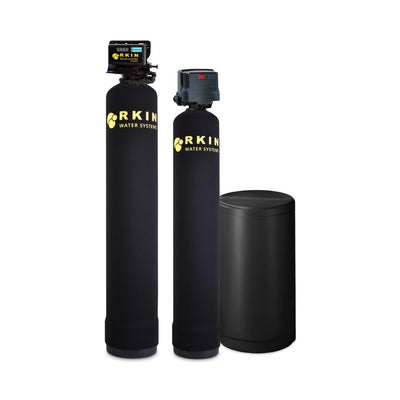
For homes on well water or with iron and sulfur issues alongside hardness, the RKIN Whole House Well Water Filter handles iron, sulfur, manganese, and sediment in a single tank. For homes that want true softening with salt, the RKIN Whole House Salt-Based Water Softener covers the classic ion-exchange approach.
All three install at the main water line and treat every tap, shower, toilet, and appliance. The powder at the toilet base stops appearing within a few weeks as residual scale slowly dissolves. The longer-term win is the appliances and pipes you stop replacing.
How to Confirm It's Hard Water Before You Spend
If you've never tested your water, do it before you buy anything. Three options:
- Hardware store test strip — under $10, gives you a hardness reading in a minute. Good for a baseline.
- Free RKIN water test kit — RKIN offers a free home test for hardness, chlorine, TDS, and several common contaminants. Request one from the contact page.
- EPA-certified lab test — most thorough; useful if you also suspect lead, PFAS, or nitrates. Look for a state-certified lab through the EPA Safe Drinking Water Hotline.
Knowing your hardness number lets you pick the right system and predict the payback. A home at 15 gpg saves dramatically more on appliance lifespan than a home at 5 gpg.
Frequently Asked Questions
Is the white powder at the base of my toilet dangerous?
The mineral scale itself isn't a health risk — it's the same calcium carbonate that's already dissolved in your drinking water. The concern is what it indicates: hard water that's quietly damaging your appliances, water heater, and plumbing. The powder is cosmetic. The hidden corrosion is expensive.
How do I clean white mineral buildup off a toilet?
Spray the buildup with undiluted white vinegar, let it sit for 10–15 minutes, then scrub with a soft brush or non-abrasive sponge. For stubborn deposits, soak a paper towel in vinegar and lay it directly on the spot for an hour. Avoid steel wool, which scratches porcelain. The buildup will return until you treat the water itself.
Could the powder be coming from a slow leak?
A visible leak would leave a damp spot or water trail, not dry powder. If you have any doubt, dry the area completely, then tape a single sheet of toilet paper to the floor at the base overnight. If the paper is dry in the morning, you don't have a meaningful leak — you have hard-water deposits from microscopic seepage and condensation.
Will a refrigerator water filter or pitcher filter help?
Not for this. Pitcher and refrigerator filters only treat the water you drink. The hard water reaching your toilet, washing machine, and water heater is untouched. You need treatment at the main water line — a whole-house system — to address scale throughout the home.
Does salt-free water treatment really work as well as a softener?
For scale prevention, modern TAC (template-assisted crystallization) systems perform comparably to traditional softeners in independent testing. They don't make water feel "slippery" the way ion-exchange softeners do, because the minerals are still present (just neutralized). For households with very hard water who specifically want that softened feel, salt-based remains the gold standard. For most homes, salt-free is lower maintenance and avoids sodium.
How long before I notice a difference?
New scale stops forming immediately once the system is online. Visible deposits — the powder at the toilet, crust on faucets, spots on dishes — fade over 4–8 weeks as residual scale dissolves under normal water flow. Showers and skin usually feel different within the first week.
Stop Wiping Up the Same Powder Every Month
The powder is a symptom. The water heater corroding from the inside is the actual problem. Treating your water at the main line stops the cycle everywhere in the house at once — toilet base, dishwasher, shower glass, kettle, and the appliances you don't think about until they fail.
The RKIN OnliSoft Pro Salt-Free + Carbon Combo handles hard water and chlorine in one system — no salt, no electricity, no monthly upkeep. Pair it with a free home water test to confirm your hardness level and lock in the right configuration.


0 comments