
water filter sizing by bathroom
Whole House Water Filter Sizing: Flow Rate by Home

A whole house water filter can solve the right problem and create a new one if it is undersized. The usual complaint is simple: the water tastes better, but the shower pressure drops when the washer starts.
That is a sizing problem, not a brand problem. Whole house water filter sizing is about peak flow, water chemistry, treatment media, and where the system sits on the main line. The filter has to process water fast enough for the busiest few minutes of the day, not just the average glass of water.
This matters even more when homeowners are shopping after a test result, a hard-water problem, a remodel, or a whole-home consultation. The correct answer is not “buy the biggest tank.” The correct answer is: test the water, count real fixture demand, then match the equipment to both.
Why Flow Rate Comes First
Flow rate is how much water moves through the system per minute. In home water treatment, it is usually shown as gallons per minute, or GPM. A point-of-use filter only has to serve one faucet. A whole house filter may have to serve two showers, a washing machine, a dishwasher, and a kitchen sink at the same time.
The EPA's WaterSense program notes that standard showerheads use 2.5 gallons per minute, while WaterSense labeled showerheads use no more than 2.0 GPM. Showering also accounts for nearly 17 percent of residential indoor water use. That gives you a real-world anchor: two showers alone can ask for roughly 4 to 5 GPM before a washer or sink joins in.
This is why sizing by square footage alone is weak. A large house with two careful occupants may use less peak water than a smaller house with five people, three bathrooms, and back-to-back laundry. Count the fixtures that may run together during your real routine.
Pressure matters too. A filter can be rated for a flow number, but pressure drop depends on media, cartridge size, sediment load, plumbing diameter, and maintenance. If your incoming pressure is already low, a marginally sized system can make the home feel worse even if it improves taste or odor.
Water Chemistry Changes the Size Question
Flow is only half the job. The other half is what the water needs removed or changed. A sediment cartridge, carbon tank, salt-free conditioner, salt-based softener, iron filter, PFAS-focused system, and whole-home reverse osmosis system are not the same tool with different labels.
Hardness is a good example. The USGS defines hard water as water containing a lot of calcium and magnesium, with water above 180 mg/L as calcium carbonate classified as very hard. Hard water can leave spots, soap film, and scale inside water heaters and pipes. That is not the same problem as chlorine taste, sediment after road work, iron staining, sulfur odor, lead, or PFAS.
Private wells add another layer. The EPA recommends annual private-well testing for bacteria, nitrates, total dissolved solids, and pH, and testing sooner after flooding, land disturbance, repairs, or changes in taste, odor, or color. Those results can change the entire design. A well with iron and manganese may need oxidation and filtration before conditioning. A well with bacteria indicators may need disinfection guidance from local health officials before any equipment discussion.
City water has different questions: chlorine or chloramine, sediment, hardness, lead service-line notes, PFAS monitoring, and disinfection byproducts. Do not borrow a neighbor's equipment list unless your water source, test results, home size, and plumbing layout are actually similar.
What Does Not Work
Do not size a whole house water filter by guessing. “Three bedrooms” does not tell you peak water demand. “Two people” does not tell you whether you run two showers and laundry at the same time. “My neighbor has the same model” does not tell you whether your plumbing pressure, sediment load, or water chemistry matches theirs.
Do not pick the tightest cartridge and hope pressure stays the same. A very fine sediment filter may catch smaller particles, but it can also clog faster and reduce flow if it is not sized for whole-home demand. If the main issue is visible grit, match micron rating, housing size, and replacement access to the sediment load instead of choosing the smallest number on the package.
Do not treat a softener as a filter. A salt-based softener reduces hardness minerals through ion exchange. A salt-free conditioner changes how hardness minerals behave so they are less likely to form scale. A carbon filter targets taste, odor, chlorine, and some chemical concerns depending on the design. A reverse osmosis membrane belongs in a drinking-water or specialized whole-home plan. These categories overlap in a treatment train, but they do not replace each other.
Do not ignore maintenance access. A system that is sized correctly but installed where nobody can reach the prefilter will be neglected. Flow problems often show up later because a cartridge is clogged, not because the original equipment was useless.
A Practical Sizing Process
Start with water source. City water, private well, cistern, and mixed-source homes all need different questions. Write down the source and the main complaint: chlorine taste, scale, sediment, staining, odor, high TDS, PFAS concern, or drinking-water taste.
Next, test. For city water, pull the latest Consumer Confidence Report and test the tap when the issue appears to be home-specific. For private wells, use a certified lab. At minimum, the EPA's annual well-testing baseline gives you bacteria, nitrate, total dissolved solids, and pH. Add hardness, iron, manganese, sulfur, lead, arsenic, PFAS, or other local concerns when conditions point that way.
Then estimate peak demand. Count showers, tubs, kitchen faucets, laundry, dishwasher, irrigation tie-ins, pool fill points, and any high-use fixtures. You do not have to pretend everything runs at once. You do need a realistic busy moment: morning showers plus laundry, evening dishes plus bath time, or guest-week use.
After that, match media to contact time. Carbon needs enough contact time to do its job. Iron and sulfur systems need enough media and backwash design for the measured load. Softeners size around hardness, household use, and regeneration settings. Conditioners size around flow, hardness range, and prefiltration needs. Whole-home RO is a separate design conversation because storage, pumps, reject water, remineralization, and service access all matter.
Finally, protect the system. Sediment prefiltration is often the cheapest way to keep downstream equipment from clogging early. Bypass valves, pressure gauges, drain access where needed, and clear service space make the system easier to own. Good sizing is not only the tank. It is the whole layout.
Where RKIN Fits
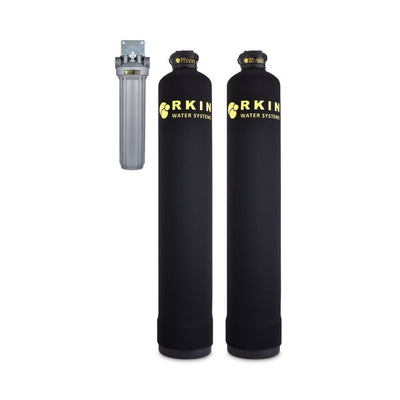
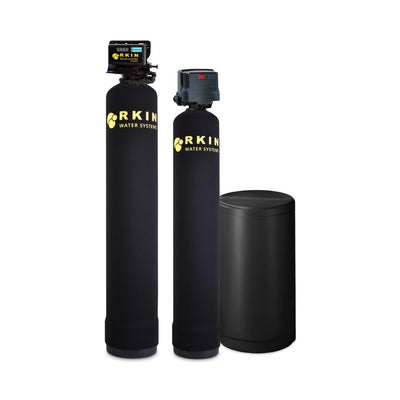
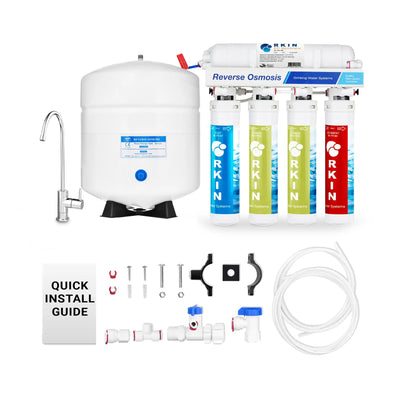
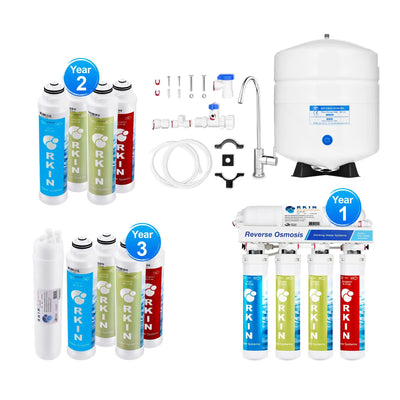
The RKIN whole house water treatment collection is built around matching the equipment to the water problem instead of selling one tank for every home. Some homes need carbon filtration. Some need scale control. Some need a salt-based softener. Some private wells need iron, sulfur, or manganese treatment. Some drinking-water concerns are better handled at the kitchen tap with reverse osmosis instead of filtering every gallon in the home.
If you are not sure where to start, use the RKIN contact page and share three facts: your water source, your latest test results if you have them, and what happens when multiple fixtures run. That is enough to avoid the most common mistake: buying equipment for the symptom you can see while missing the water chemistry behind it.
The honest recommendation is simple. In my house, I would not size a whole-home system from a product photo. I would size it from the water report, the peak flow need, and the maintenance reality of the home.
Frequently Asked Questions
What size whole house water filter do I need?
You need a system sized for your home's peak flow and your water chemistry. Count the fixtures that may run together, check incoming pressure, and use a water test to identify the job: sediment, chlorine, hardness, iron, sulfur, PFAS, lead, or drinking-water treatment. Bathroom count helps, but it should not be the only input.
Will a whole house water filter reduce water pressure?
It can if the system is undersized, the cartridge is too restrictive, the plumbing is narrow, the incoming pressure is low, or the prefilter is clogged. A correctly sized system should be selected around peak demand and maintained on schedule. Pressure gauges before and after the system can help identify clogging over time.
Is GPM more important than tank size?
GPM and tank size work together. GPM tells you how much water the home may demand at once. Tank size and media volume affect contact time, pressure drop, and capacity. A small system with a high marketing flow claim may still perform poorly if it lacks enough media for the contaminant load.
Do I need a water test before buying a whole house filter?
Yes, especially for private wells. The EPA recommends annual private-well testing and added testing after flooding, repairs, land disturbance, or changes in taste, odor, or color. City-water homeowners should read the utility report and test the tap when the issue appears to be coming from household plumbing.
Is whole house reverse osmosis the same as an under-sink RO system?
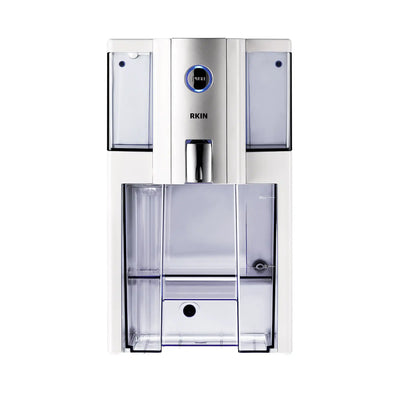
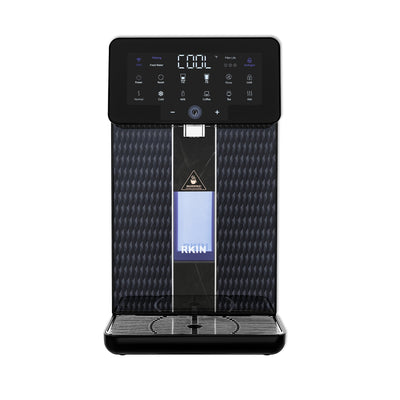
No. Under-sink or countertop RO filters drinking water at one point. Whole-home RO filters incoming water for the whole house and usually requires storage, pumps, drain planning, and a different maintenance plan. For many homes, a point-of-use RO system at the kitchen is the smarter first step for drinking water.
Ready to Size the System Correctly?
If your water problem affects the whole home, start with the right category and the right data. Review RKIN's whole house water treatment options, then send your water source, test results, and fixture-demand notes through the RKIN contact page. The goal is not the biggest system. It is the right system for your water and your home.






0 comments