
pfas filter maintenance
PFAS Filter on a Private Well: How to Verify It Works

Short answer: verify a private-well PFAS filter with maintenance records and treated-water testing from a state-certified laboratory. Taste, odor, TDS, and a generic filter light cannot confirm PFAS reduction.
Keep the Untreated Baseline
The original lab report is the comparison point. Keep the complete result, not just a screenshot with one highlighted number. Record which PFAS were measured, the sample date, the laboratory, the reporting limits, and where the sample was collected.
If the first sample came from a kitchen tap after treatment, it is not a clean untreated baseline. A raw-water sample taken before the device shows what enters the system. A treated-water sample shows what leaves it. The locations and dates must be clear.
The EPA's PFAS in Private Wells guidance, accessed September 23, 2026, covers certified labs, continuing testing, certified NSF/ANSI 53 or 58 PFAS claims, and maintenance.
Verify the Exact Claim for the Exact Model
A label that says carbon, reverse osmosis, or certified is not enough by itself. Find the complete model number and the certifier's listing or performance data sheet. The document must name the PFAS reduction claim that matches the treatment goal.
NSF/ANSI 53 applies to certain drinking-water filters, and NSF/ANSI 58 applies to point-of-use reverse osmosis systems. A standard number can include many claims, so confirm that PFAS appears for the exact model rather than assuming every product under the standard has the same result.
Save the listing with the purchase record. If a replacement cartridge or membrane changes the certified configuration, the old claim may no longer describe the assembled system.
Also record the rated capacity and normal household demand. A small device can carry the right claim and still be a poor ownership fit if it is asked to supply more water than the instructions allow.
Follow the Replacement Schedule
A treatment device is tested under defined conditions and capacity. Once a cartridge is overdue, installed incorrectly, bypassed, or used beyond its rated capacity, the original claim does not prove current performance.
Record installation date, cartridge or membrane model, replacement date, household use, and any pressure or flow change. A calendar reminder is useful, but heavy use and unusual source water can affect when service is needed.
Me personally, I would write the next replacement date on the filter and in the phone calendar. That takes less time than trying to reconstruct the date after a lab result raises a question.
Retest the Treated Water Correctly
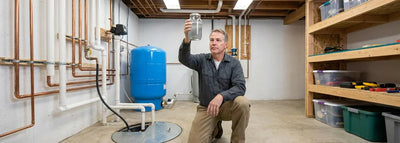
Use a laboratory certified by the state for drinking-water testing and ask for its sampling instructions. The EPA maintains state certification contacts. Confirm the lab can test the PFAS on the original report.
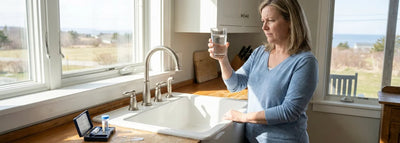
Sample at the treated tap the household actually uses, after following the lab's container, preservation, and shipping directions. Do not rinse a PFAS sample bottle unless the lab tells you to. Record whether the sample was collected before or after filter service.
For a fair comparison, use the same analyte list and understand the reporting limits. A result below one lab's reporting limit does not mean absolute zero, and two labs with different limits may not be directly comparable.
What to Do if Results Stay Elevated
First, verify sample locations and the exact system configuration. Check bypass position, cartridge orientation, service date, flow, leaks, and whether untreated water can mix with the treated line. Then review the result with the laboratory and equipment provider.
A higher treated result can reflect an installation issue, overdue media, source-water change, sampling variation, or a device that does not carry the needed claim. Do not diagnose it with taste or TDS. Those measures do not identify PFAS.
If the result remains a concern, follow state or local guidance for drinking and cooking water while the cause is resolved. Do not increase capacity or add stages without confirming what the new design is expected to reduce.
Keep Testing the Rest of the Well
A PFAS device does not replace routine private-well testing. Bacteria, nitrate, pH, TDS, and locally relevant chemicals remain separate questions. A filter selected for PFAS should not be assumed to solve every well-water issue.
The existing PFAS in well water guide covers awareness and first testing. This page is for verification after a device is installed.
Keep the baseline, listings, lab reports, service records, and plumbing diagram together. That packet makes future troubleshooting faster and protects against replacing equipment based on memory.
Photograph each model label and sample point before the first service visit. If the plumbing changes later, the photos help explain which tap and filter configuration produced each lab result.
Verification Checklist
- Save the untreated baseline and full analyte list.
- Confirm the exact model and explicit PFAS claim.
- Use only the replacement parts in the certified configuration.
- Track installation and service dates.
- Retest treated water through a state-certified lab.
- Compare sample locations and reporting limits.
- Continue routine well testing beyond PFAS.
Protect the Sample From Mix-Ups
PFAS sampling requires careful handling. Use the bottles and instructions from the laboratory, and ask about clothing, gloves, labels, packaging, and shipping. Do not transfer the sample into a household container or rinse a prepared bottle unless the lab directs it.
Map the plumbing before sampling. Label the raw-water point, the treated tap, and any bypass or storage tank between them. If the house has more than one PFAS device, identify which stages were active for each sample.
Record the cartridge age, membrane age, last service, recent high-use events, and whether the system was flushed before the sample. Those facts help interpret an unexpected result without pretending that collection details do not matter.
Read Results Without Overstating Them
Compare the same named PFAS, units, sample locations, and reporting limits. One report may use parts per trillion while another displays a different unit. Convert only with care and ask the laboratory when the formats do not line up.
A result marked non-detect means the laboratory did not detect the compound above its stated reporting limit. It does not prove absolute zero. A lower treated result is useful evidence, but one sample should be considered alongside correct installation, service records, and the lab's quality controls.
If a treated sample is higher than the raw sample, do not jump to one conclusion. Confirm the labels, collection order, plumbing, bypass, lab notes, and source-water timing before changing equipment.
Set a Verification Schedule You Can Maintain
The right retest schedule depends on state guidance, the original result, the treatment design, the manufacturer's capacity, household use, and source-water stability. Write the agreed schedule next to the cartridge schedule so laboratory checks and physical service do not drift apart.
Retest after a major repair, long bypass period, unapproved replacement part, source-water change, or result that questions performance. Keep routine well testing on its own calendar so PFAS attention does not crowd out bacteria and other local concerns.
A clear schedule should name who orders the bottles, who collects the sample, which tap is used, which lab receives it, and what result triggers a call. That makes verification repeatable instead of a one-time project.
Decide What Result Triggers Action
Before the follow-up sample, write down who will review the result and what happens if the laboratory detects the same PFAS, a different PFAS, or a level above the household's decision threshold. Use state and local guidance rather than inventing a limit from a product page.
The action may include confirming the sample, servicing the device, checking the certified configuration, using another drinking-water source temporarily, or consulting the state program. The right response depends on the result and local direction.
A written trigger keeps the household from either ignoring an important result or replacing equipment after a minor reporting difference. It also makes the next retest part of a plan instead of a reaction. Keep the laboratory and state contact information beside that trigger list.
The reason I am asking for both records and a lab sample is that neither one proves current performance alone. Together, they tell a much cleaner story.
Frequently Asked Questions
Can a TDS meter show whether PFAS was reduced?
No. A TDS meter does not identify PFAS. Use treated-water testing from a qualified laboratory.
Does every NSF/ANSI 58 RO system reduce PFAS?
Do not assume that. Verify the explicit PFAS claim for the exact model in the certifier's listing or performance data sheet.
When should I retest after installing a PFAS filter?
Follow state guidance, the laboratory's advice, and the manufacturer's maintenance schedule. Retest when verifying installation and after meaningful service or source-water changes.
Should I test before and after the filter?
An untreated baseline and a treated-water sample can show what enters and leaves the system. Label both locations and follow the lab's instructions.
Does a PFAS filter replace annual well testing?
No. Routine testing for bacteria, nitrate, pH, TDS, and locally relevant chemicals remains separate.
Build the Verification Packet
Put the untreated report, exact model listing, replacement schedule, and plumbing sample points in one folder, then use the EPA's state laboratory contacts to arrange treated-water follow-up testing.



0 comments