
reverse osmosis pfas removal
Water Report Shows Hardness, Iron, and PFAS: What to Do

You finally pulled your utility's Consumer Confidence Report — or sent a well sample to the lab — and the page in front of you has three problems at once: hardness above 10 grains per gallon, iron showing up in the secondary standards column, and PFAS quantified in parts per trillion. Most homeowners read that page, freeze, and default to the cheapest filter on a shelf. That filter handles exactly one of those three issues, and the other two keep compounding.
A 2024 EWG Tap Water Database analysis found that 62% of U.S. community systems report at least one regulated contaminant alongside hardness, and over 7,200 systems have quantifiable PFAS. If your well report shows the same combo, you're not an outlier — you're facing the most common triage problem in residential water treatment. Here's how to solve all three in the right order.
Why One Filter Can't Fix Hardness, Iron, and PFAS
Each of those three problems comes from a different category of contaminant, and each needs a different treatment mechanism:
- Hardness is dissolved calcium and magnesium. It's measured in grains per gallon (gpg) or parts per million. It doesn't get "filtered out" — it gets either exchanged (traditional softener), conditioned (salt-free), or reduced through reverse osmosis at the point of use.
- Iron can be either dissolved (ferrous, clear water iron) or oxidized (ferric, red-water iron). The treatment differs based on form, concentration, and whether hydrogen sulfide or manganese shows up alongside it.
- PFAS — per- and polyfluoroalkyl substances — are synthetic chemicals that don't break down naturally. The EPA's April 2024 final rule set enforceable limits of 4 parts per trillion for PFOA and PFOS. Carbon filtration reduces PFAS, but household pitcher-grade carbon saturates quickly. Reverse osmosis is the most reliable point-of-use path.
Because hardness, iron, and PFAS respond to three different technologies, a single-cartridge pitcher or a single-stage whole-home filter will always under-perform on two of the three problems. The solution is a layered plan — not a bigger filter.
What the Report Is Actually Telling You
Before buying anything, read the report twice and write down these five numbers. They drive every treatment decision.
- Hardness (gpg or mg/L as CaCO₃) — under 3 gpg is soft, 3–7 is moderate, 7–10 is hard, above 10 is very hard.
- Total iron (mg/L) — the EPA secondary standard is 0.3 mg/L. Above that you'll see staining.
- Manganese (mg/L) — often shows up with iron on well reports; secondary standard is 0.05 mg/L.
- PFAS (ng/L or ppt) — any detection above the EPA's 4 ppt MCL for PFOA/PFOS is actionable. HFPO-DA, PFHxS, and PFNA have their own 10 ppt individual limits plus a Hazard Index.
- Chlorine or chloramine (mg/L) — if you're on city water, this affects which softener resin you pick and whether you need carbon upstream.
If any of those numbers are missing from your utility's report, contact the water quality lead listed on the report and ask. For well water, a certified lab test (the EPA's private well guidance explains how to sample) runs a few hundred dollars and gives you all five plus nitrate, bacteria, and pH.
What Doesn't Work (And Why People Buy It Anyway)
Two shortcuts tempt homeowners at this stage. Both fail on the hardness-iron-PFAS triple.
Pitcher filters and faucet attachments. A standard pitcher holds 6–10 ounces of carbon. It addresses taste and some chlorine. It does not remove hardness and does not meaningfully reduce PFAS at the rated capacity once saturation sets in — which happens faster on water with higher contaminant loads. Independent testing by Consumer Reports has shown wide variance in pitcher PFAS performance.
Boiling. Boiling removes volatile compounds and some biological contamination. It does nothing to hardness, iron, or PFAS. PFAS actually concentrate as water evaporates — boiling can make the problem worse, not better.
If you've already tried either of these and still see scale on your dishes, orange staining in toilets, or a new PFAS detection on your report, that's the signal that you need treatment that matches the chemistry — not a filter that just feels like progress.
The Right Treatment Stack for All Three
Solve these in order: hardness and iron at the point of entry (where water comes into the home), PFAS at the point of use (where you drink and cook).
Step 1: Handle Hardness at the Main Line
If you're above 7 gpg, a whole-home softening technology belongs upstream of anything else. You have two paths:
- Salt-based water softener. Uses ion exchange to swap calcium and magnesium for sodium. Most effective if hardness is above 15 gpg or you have scale damage history. Needs salt and drain access.
- Salt-free water conditioner. Uses template-assisted crystallization (TAC) to convert hardness minerals into inert crystals that don't bond to surfaces. No salt, no brine discharge, lower maintenance. Best for moderate hardness (7–20 gpg) and homes with salt or drainage restrictions.
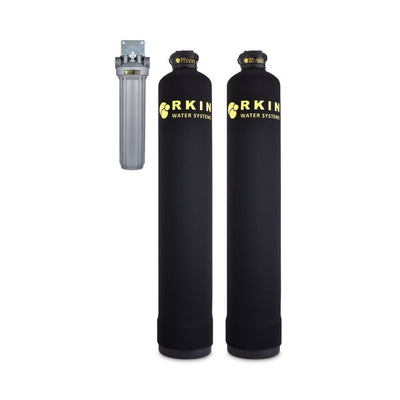
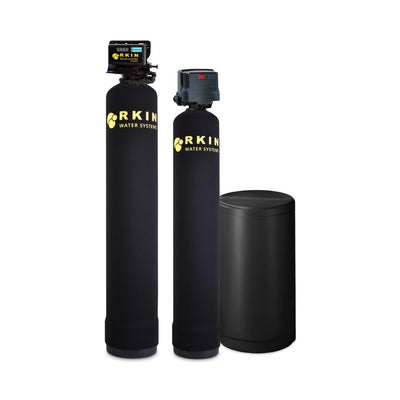
For whole-home salt-free treatment, see the RKIN OnliSoft Salt-Free Water Conditioner. For higher hardness or heavy scale issues, the RKIN Whole House Salt-Based Water Softener System is the conventional choice.
Step 2: Add Iron Removal Upstream of the Softener (If Well Water)
Iron fouls softener resin fast. If your well report shows iron above 0.3 mg/L — or you see any orange staining — add iron-specific media before the softener. The RKIN Well Water Whole House Filter targets iron, sulfur, and manganese in one tank and protects downstream equipment.
On city water, iron is usually below secondary-standard levels and a carbon filter handles the residual. For that path, the RKIN CBS Dual Carbon Whole House Filter handles chlorine, taste, and low-level iron across the entire home.
Step 3: Handle PFAS at the Kitchen Sink
This is where point-of-use reverse osmosis belongs. Whole-home RO is overbuilt for PFAS — you don't need RO water to shower — and adds cost and waste. A countertop or undersink RO at the primary drinking-water tap is the standard approach.
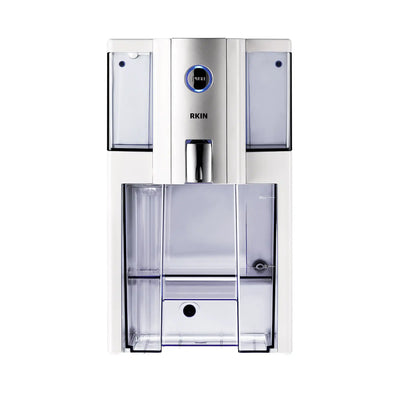
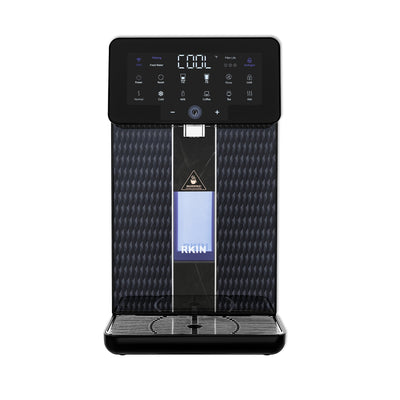
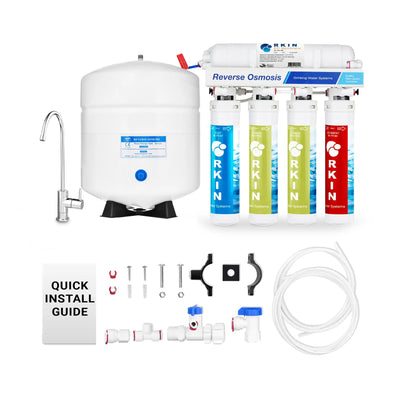
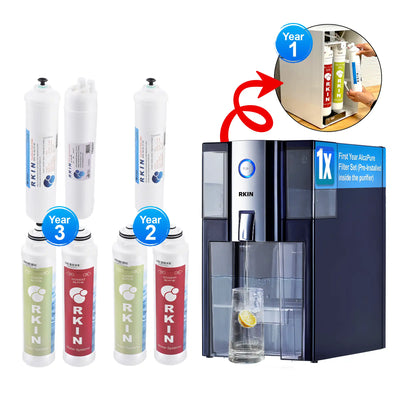
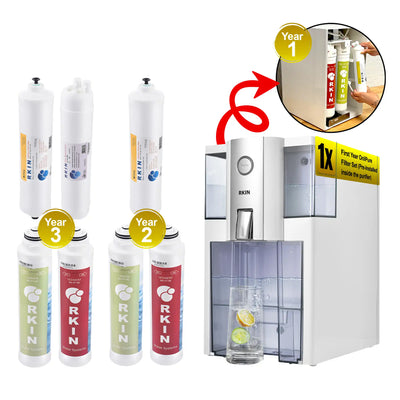
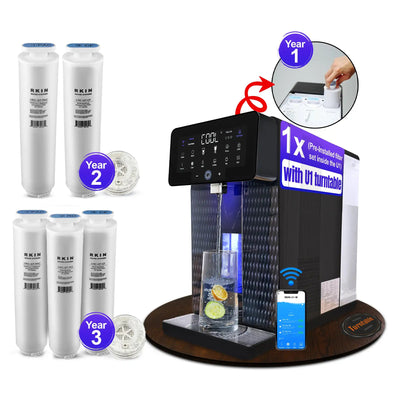
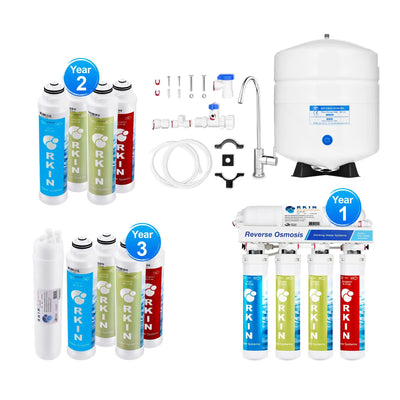
For renters or anyone who can't modify plumbing, the RKIN Zero Installation Purifier sits on the counter and connects to the faucet — no drill, no plumber. For homes with cabinet space and a cold-water line under the sink, the RKIN Flash Undersink RO System produces filtered water to a dedicated faucet with a 3.2-gallon storage tank.
Sequencing Matters: Protect Downstream Equipment
The order water passes through your treatment stack changes the lifespan of every component. The right sequence for a home with hardness, iron, and PFAS:
- Sediment filter (if you have visible particulate or well water)
- Iron removal (if iron is above 0.3 mg/L)
- Softener or salt-free conditioner (hardness)
- Whole-home carbon (chlorine, taste, residual organics)
- Point-of-use RO at the kitchen (PFAS and anything else dissolved)
Skip any layer and the next one pays the price. An RO membrane fed hard, iron-laden water fails in months instead of years. A softener fed high-iron well water loses capacity quickly. Sequencing is half the battle.
What to Monitor After Installation
Re-test your water 60 days after the treatment stack is installed, and then annually. Check the same five numbers from your original report. If PFAS remains detectable post-RO, verify the membrane is installed correctly and check the storage tank for bypass. If hardness readings stay flat post-softener, the resin may be fouled by iron you didn't catch upstream — that's your signal to add iron removal.
Frequently Asked Questions
Do I need a whole-home RO system to remove PFAS?
No. Point-of-use reverse osmosis at the kitchen handles PFAS in your drinking and cooking water, which is where ingestion exposure happens. Whole-home RO is typically reserved for specific agricultural or industrial situations, not residential PFAS treatment. A countertop or undersink RO is the standard path.
Can a water softener remove PFAS?
No. Softeners use ion exchange to swap calcium and magnesium for sodium — the resin has no meaningful affinity for PFAS molecules. You need activated carbon or reverse osmosis for PFAS. A softener is still useful for the hardness side of the problem, but it is not a PFAS solution.
Will iron in my well water damage a reverse osmosis system?
Yes, if iron concentrations are high enough. Iron above 0.3 mg/L can foul the RO pre-filters and membrane rapidly. That's why iron removal belongs upstream of softening and RO on well systems — it protects the downstream equipment and keeps replacement costs predictable.
How do I know if my iron is ferrous or ferric?
Draw a glass of water and let it sit on the counter for 15 minutes. If the water starts clear and turns rust-colored as it sits, that's ferrous (dissolved) iron oxidizing. If it comes out already orange-tinted, that's ferric (oxidized) iron. Most well-water treatment stacks handle both, but labs can confirm the split.
If my utility already treats for PFAS, do I still need an RO?
Utility compliance with the EPA's 2024 PFAS rule phases in over several years, and enforcement doesn't start until 2029 for existing systems. Even compliant utilities treat to the MCL, not to non-detect. If you want PFAS below detection limits at your tap today, point-of-use RO is the most reliable path.
How often should I replace filters on this kind of stack?
Sediment and carbon cartridges in the drinking-water RO typically run every 6–12 months depending on water quality and usage. Whole-home carbon systems and well-water iron/sulfur tanks are rated in gallons or years — check each product's spec page. Your actual cadence depends on incoming water chemistry, which is why the 60-day and annual re-tests matter.
Ready to Solve All Three at Once?
Hardness, iron, and PFAS don't respond to the same technology — but they do respond to the right sequence. Start by reading your report, then layer the treatment stack in order: iron first, softening second, carbon third, RO at the kitchen.
If you want help mapping your specific water report to a stack, the RKIN Whole House Water Treatment collection covers salt-free, salt-based, well-water, and carbon options — and the Countertop Water Filter collection covers the point-of-use RO side. No plumbing required for countertop systems. Ships free.






0 comments