


private well water test
Well Water Test at Faucet or Pump? Sample Location Matters

A clean well sample does not always mean clean water at every tap. The sample location can change the story.
That is why “test the well” is good advice, but incomplete advice. A sample taken near the pressure tank can tell you about the source water. A sample taken at the kitchen faucet can show what your plumbing, fixtures, treatment equipment, water heater, or point-of-use filter may be adding or changing along the way. If you only test one location, you may buy equipment for the wrong problem.
The EPA’s 2026 private well guidance says private well owners should test at least once a year for total coliform bacteria, nitrates, total dissolved solids, and pH, and use a certified laboratory. It also tells homeowners to test when taste, color, or smell changes. The missing practical question is where to sample first.
For homeowners, the answer is simple: match the sample location to the question you are trying to answer.
The Problem: Source Water and Tap Water Are Not Always the Same
Private wells are different from city water. There is no utility testing and treating the water before it reaches your house. The well owner is responsible for the source, the pump, the pressure tank, the treatment equipment, and the plumbing downstream.
The EPA’s private well page, updated in 2026, explains that well owners should test annually and test immediately when conditions change near the well, a well component is replaced or repaired, or water quality changes. EPA also links certain symptoms to certain tests: objectionable taste or smell can point toward hydrogen sulfide, corrosion, or metals; stained plumbing fixtures can point toward iron, copper, or manganese; scaly residue can point toward hardness. See the EPA guidance here: Protect Your Home’s Water.
That symptom list matters because a faucet complaint can have more than one source. Brown water at one bathroom sink may be local pipe corrosion. Brown water at every tap may be iron from the well. Rotten-egg odor in hot water only may be the water heater. Rotten-egg odor in hot and cold water may be hydrogen sulfide from the well. Blue-green stains may point toward copper and pH, not hardness.
If the well sample and faucet sample disagree, that is not a reason to panic. It is useful evidence. It tells you where the problem may be entering the system.
When to Test at the Well or Pressure Tank
A source-side sample is best when you want to know what the well is producing before treatment and household plumbing change it. This is usually the first sample for private-well decisions.
Use a source-side sample when you are trying to confirm:
- Hardness before choosing a softener or conditioner
- Iron, sulfur, or manganese before choosing a well-water filter
- pH, alkalinity, and corrosion potential before blaming fixtures
- Nitrate, bacteria indicators, or local contaminants recommended by your health department
- Whether existing treatment equipment is solving the problem downstream
The cleanest source-side sample is typically taken from a raw-water spigot before any softener, carbon filter, cartridge filter, UV system, or reverse osmosis unit. Many homes have a sampling tap near the pressure tank or treatment equipment. If yours does not, a well professional or lab can tell you the best location.
Do not sample through a hose unless the lab says that is acceptable. Hoses can add their own residues and bacteria. Do not sample after a carbon filter if the question is what the well contains. Do not sample after a softener if the question is raw hardness, iron, or manganese.
If you are testing for bacteria, follow the lab’s instructions exactly. That may include disinfecting the faucet, removing aerators, and using sterile bottles. A sloppy sample can create a false alarm or hide a real concern.
When to Test at the Faucet
A faucet sample is best when the complaint shows up at the tap or when you suspect plumbing is changing the water after it leaves the well system.
Test at the faucet when the issue is:
- Metallic taste at one sink
- Blue-green staining near one fixture
- Particles from an old faucet aerator
- Lead or copper concerns from older plumbing
- Odor that appears only in hot water
- Filter performance after an installed system
- Drinking-water quality at the kitchen tap
Faucet sampling is especially relevant for lead and copper because those metals usually come from plumbing materials, solder, valves, or fixtures rather than the aquifer itself. A raw well sample may look fine while water that sits overnight in older plumbing picks up metals by morning.
That does not mean every faucet problem requires a whole-house filter. Sometimes the right fix is replacing a corroded fixture, flushing a water heater, cleaning an aerator, or correcting pH. Sometimes the source water is fine, but the distribution inside the home needs attention. Testing both locations keeps you from overspending on the wrong category.
For drinking-water systems, faucet sampling can also confirm whether a filter is performing as expected. Test before treatment to identify the problem, then test after treatment to confirm the result. One number without the other is hard to interpret.
What Does Not Work: Sampling Wherever Is Easiest
The easiest sample is not always the right sample. Filling a bottle from the kitchen faucet may be convenient, but it may not answer the raw-well question. Filling a bottle from the pressure tank may be useful, but it may not explain why the upstairs bathroom has particles.
Another mistake is testing after equipment and then sizing new equipment from that result. If a softener is already installed, a downstream hardness result may be low even though the raw well is very hard. If a sediment filter is clogged, a downstream sample may make the well look worse than it is. If a carbon filter is exhausted, the faucet result may show a taste problem that started as a maintenance issue.
Season matters too. Heavy rain, drought, well work, plumbing work, and long periods of vacancy can change what appears at the tap. The CDC says to test when water taste, color, or smell changes, and EPA says to test after flooding, land disturbances, repairs, or new activity near the well. In other words, timing and location both matter.
If a salesperson or installer does not ask where the sample came from, be careful. The sample location is part of the result.
The Solution: Use a Two-Sample Water Test Plan
For many well-water homes, the practical plan is two samples: one raw-water sample and one faucet sample.
The raw-water sample answers: what is coming out of the well before treatment? This is where you look at hardness, iron, manganese, hydrogen sulfide indicators, pH, total dissolved solids, sediment, nitrate, bacteria indicators, and local concerns recommended by the health department or lab.
The faucet sample answers: what is the household actually using at the tap? This is where you check drinking-water quality, lead and copper from plumbing, hot-water-only odor, post-filter performance, and problems isolated to one room.
Then compare the two.
If the raw-water sample is high in iron and every fixture stains orange, the problem is likely source-side and whole-house treatment may fit. If the raw sample is clean but one faucet has particles, the problem may be local. If the raw sample has hardness and the faucet still has hardness after a softener, the softener may be bypassed, undersized, misprogrammed, or exhausted. If cold water is fine but hot water smells, the water heater deserves attention before a new whole-house system is chosen.
This approach is slower than guessing, but it is cheaper than buying the wrong system and then buying the right one later.
Where RKIN Fits
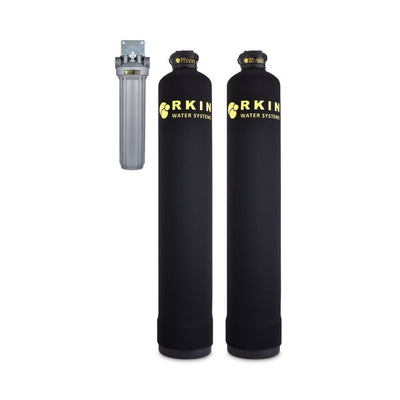
If raw-well testing shows whole-home iron, sulfur, or manganese concerns, the Sulfur, Iron, Manganese Well Water Filter System is the RKIN product family to review. It is designed for well-water problems that show up across the house, not just at one faucet.
If faucet-level testing points toward certified whole-house lead, cyst, PFOA, or PFOS reduction, review the RKIN OP1L Certified Whole House Lead, Cyst, PFOA, and PFOS Water Filter System. That is a different category than a softener or an iron-sulfur-manganese well filter, so the test report should drive the choice.
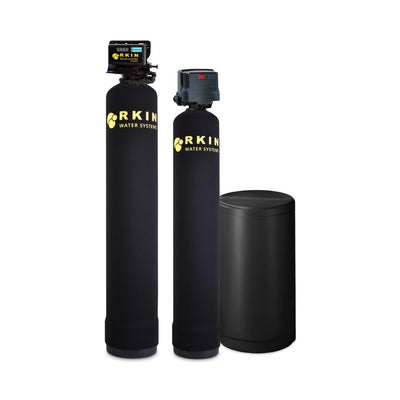
If the report shows hardness as the main problem, compare the RKIN Water Softener System. If you are still sorting out source-side treatment versus tap-level treatment, start with the RKIN Whole House Water Treatment collection and match the system to the sample location and result.
The main point: do not buy a whole-house system for a one-faucet problem, and do not buy a faucet filter for a source-water problem that affects every shower, washer, and fixture.
Me personally, I would label raw and treated samples before they leave the house.
Frequently Asked Questions
Should I test well water at the faucet or the pressure tank?
Use both if the decision is important. A pressure-tank or raw-water sample shows what the well is producing before treatment. A faucet sample shows what arrives after plumbing, fixtures, water heaters, and installed equipment. The difference helps locate the problem.
Why would my well sample be clean but tap water look dirty?
The issue may be downstream of the well: old plumbing, corrosion, a water heater, a fixture, a clogged filter, a softener problem, or sediment trapped in the household lines. Test another fixture and compare hot versus cold before choosing equipment.
Can one faucet sample size a whole-house filter?
Not reliably. A faucet sample can show what you are drinking or seeing at that tap, but whole-house equipment should usually be sized from raw-water data plus flow needs and household symptoms. The sample location should be written on the lab report.
When should I retest private well water?
CDC and EPA guidance recommend at least annual testing, plus testing when taste, color, or smell changes; after flooding or land disturbance; after well repairs; and when local conditions suggest a specific contaminant. Use a state-certified lab.
What if hot water smells but cold water does not?
That often points toward the water heater rather than the well source. A faucet test that separates hot and cold water can prevent you from buying a whole-house system for a water-heater-specific issue.
Which RKIN system fits a well-water test problem?
It depends on the report. Iron, sulfur, and manganese across the house point toward the Sulfur, Iron, Manganese Well Water Filter System. Hardness points toward the RKIN Water Softener System. Lead, cyst, PFOA, or PFOS concerns point toward the RKIN OP1L Certified Whole House Lead, Cyst, PFOA, and PFOS Water Filter System.
Ready to Test Before You Buy?
Sample location is not a detail. It is part of the diagnosis.
Before you choose a filter, write down where the sample came from, whether it was before or after existing equipment, and which fixture showed the problem. Then compare the result against the RKIN Whole House Water Treatment collection or contact RKIN with your lab report so the system matches the water you actually have.






0 comments